Donnacha Dennehy OPERAS The Hunger (2014), The Last Hotel (2015), The Second Violinist (2017), The First Child (2021)
The First Child An opera (2021) Libretto by Enda Walsh Duration: 1 hour 30 minutes Premiere: October 2021, Dublin Theatre Festival, Crash Ensemble
cast
KAREN: Soprano ALVA: Mezzo-soprano SIMON: Baritone GARY: Tenor NURSE: Countertenor GIRL: Actor/Dancer OLD WOMAN: Actor Children’s Choir or Young Person’s Choir (of around 8 voices of soloist standard, but can be expanded to 16)
orchestra
1(pic).0.2(II:bcl).1(cbn)/hn/perc/pf(cel,syn)/egtr(syn).acn(syn)/str
synopsis
The First Child is the third in the collaborative trilogy of contemporary operas by Dennehy and Walsh. Karen, a single woman, comes into contact with a young couple and their new baby via repeated “chance” meetings through which they become better acquainted. As the drama progresses we come to understand their shared past and how their lives interconnect with the old woman and her nurse, who are introduced via interspersed scenes. The First Child grapples with, among other contemporary issues, the impact of childhood bullying and the negative outcomes that can last a lifetime.
press
“The First Child is simply magnificent.” — Chris O’Rourke, The Arts Review “Equal parts baffling and brilliant, The First Child is a remarkable conclusion to the Dennehy-Walsh partnership. What a treat it would be to see the cycle performed in rep.” — Sara Keating, The Irish Times “The First Child is dark, strange and hugely enjoyable.” — Alan O’Riordan, Irish Examiner “...exquisitely tunes our emotional register to the damage of childhood trauma...a powerful and compelling excursion into the sinister side of suburban life.” — The Sunday Times
composer note
The First Child is the last opera in my trilogy with Enda Walsh. It feels to me to be the most intense of the three, powered along by a kind of tidal energy. And yet within that, I’m forever seeking the melody in these broken characters. In some way, the opera is about the impact that circular forces can have on our life and on nature. Though it has a dystopian looping structure to it ultimately, there is also a kind of catharsis unleashed by the power of the music. I should let you know that three of the players within Crash Ensemble also double up as microtonal pianists, playing notes between the equal tempered scale. Quite often these relate to the overtone series, but at other times they present strange doppelgangers of their equal-tempered equivalents. The bulk of the opera was written during the pandemic, and one can almost feel the music yearning and bursting to break the banks set up around it. Writing this opera was probably the most intense creative experience of my life so far. — Donnacha Dennehy
The Second Violinist An opera in one act (2017) Fedora’s 2017 Generali Prize for Opera
Libretto by Enda Walsh Duration: 1 hour 40 minutes Premiere: July 2017, Galway International Arts Festival
cast
HANNAH: Lyric soprano AMY: Mezzo-soprano MATTHEW: Baritone MARTIN: speaking role SCARLETT: speaking role 16-voice SATB chorus
ensemble
2(I:pic.II:afl,pic).0.2(II:bcl).0/hn/2perc/pf/2vn.va.vdga.vc.db
synopsis
Martin, the second violinist, starts to experience a mental breakdown. A married couple, Matthew and Amy, and their houseguest Hannah, sing. Martin’s playing is increasingly terrible. A voice reaches out from Martin’s screen. A forest enters his dreams. Matthew and Amy’s marriage is in a bad state, and Amy is in love with Hannah. Matthew murders them in revenge. We become aware that Matthew is the younger version of Martin: this is his past. He arranges to meet the voice that had reached out to him – in the forest. It’s a 14-year-old girl who has come to meet a 14-year-old boy. We sense he’s going to kill her. Here he will end things.
press
“Intoxicating, exciting and surprising…” —Michael Klier, BachTrack.com “Dennehy’s brilliant and volatile music, distantly referencing Gesualdo one moment, thudding out club beats the next, or whispering laments for love lost or besmirched…” — Geoff Brown, The Times “…a stimulating and provocative thrill-ride.” — Padraic Killeen, Irish Examiner “From the exhilarating score, lyrical singing, and dazzlingly intricate design, this is a work that needs to be seen more than once in order to absorb the rich detail. Like its recurring filmed image of a murmuration of starlings, it soars.” — Helen Meany, The Guardian
composer note
Subtext is as important as text to me. The music, as it were, powers the subtext; and an important ingredient in the music for The Second Violinist is a thread made of deconstructed, re-fashioned strains of Gesualdo. The main protagonist’s interest in the music of Gesualdo is sporadically made explicit in the actual text of this opera (especially in the projected messages between him and Scarlett38) but it carries even greater portent in the score. These strains even inform the flowering overtone textures that become ever more radiant as the opera proceeds, creating a friction between the almost ecstatic luminosity of the score and the brutal reality of the plot. This contradiction of course lies at the heart of the real life story of Gesualdo, the Renaissance composer – his yearning, beautifully strange music seems to be in stark contradiction to his grubby real-life act of killing his wife and her lover. — Donnacha Dennehy
The Last Hotel An opera in one act (2015) Libretto by Enda Walsh Duration: 1 hour 20 minutes Premiere: August 2015, Edinburgh International Festival, Crash Ensemble
cast
WOMAN: Soprano HUSBAND: Baritone WIFE: Soprano PORTER: Silent Role
ensemble
fl(pic,trec), cl(bcl), tbn, perc, acn, egtr(bass drum), pf, 2vn, va, vc, db(5-string); sound design
synopsis
press
An English couple and an Irish woman meet at a hotel. Pensioners arrive with their families. The husband asks himself – how many of them would choose to die. The Irish woman wants to know when they’re going to rehearse – because a rehearsal was an important part of the service the husband and wife were offering. The husband talks about what he’ll build when they return home to England. They rehearse the woman’s suicide. They will use pills and gas. This is the moment. Suddenly the husband and wife are on a car ferry – the hotel still visible in the distance. The wife is left alone and she calls out to the Universe for some resolution – some peace. She’ll have to live with the voices of many dead people in a house built from their souls. There is no rest for the Irish woman. Though now dead – she still hurts.
“Entirely, breathtakingly glorious…” — Sophie Gorman, The Irish Independent “It’s propulsive, gritty and rich.” — Kate Molleson, The Guardian “...this wonderful piece of operatic theatre...” — Sarita Rao, Luxembourg Times
The Hunger A docu-opera (2014)
Libretto in English and Gaelic by Asenath Nicholson and anon. Interviews with Noam Chomsky, Paul Krugman, Maureen Murphy, Branko Milan Duration: 1 hour 10 minutes Stage premiere: September 2016, Alarm Will Sound, St. Louis, MO
cast
Soprano, sean nós singer
ensemble
1(pic,afl).1(ca).2(bcl).1/1.1.1.0/2perc/pf/str(1.1.1.1.1 [or multiples]); vintage recordings, electronics, video interviews
synopsis
The Hunger concerns itself with the Great Irish Famine of 1845-52, which transformed Irish society irrevocably. The main narrative in the piece is provided by the accounts of the famine by the American non-conformist Asenath Nicholson who spent two years travelling around Ireland helping those dying from starvation and writing about her experiences. Her account stands outside the norm because of her transgressive sympathy; she directly quotes from those suffering, and stayed in their cabins. Extremely little is available from those who directly suffered. Only the one song, “Na Prátaí Dubha” (“Black Potatoes”), of the sean nós tradition deals with the topic. Shards of that song form the basis of an extended section sung by the sean nós singer.
press
“...affecting and compelling...” — Chris Gibson, Broadway World
“...bright, hot, metallic, and pointed.” — Daniel Stephen Johnson, Musical America
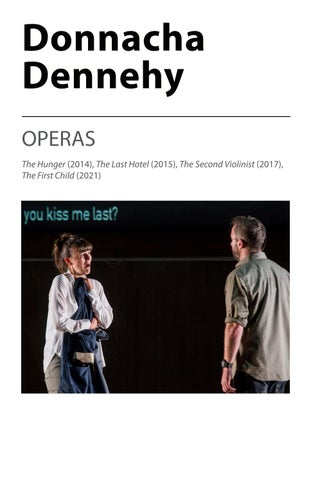
photos Cover: The Last Hotel at Wide Open Opera, photo by Patrick Redmond The First Child at Dublin Theatre Festival
The Second Violinist at Landmark Productions & Irish National Opera photo, by Patrick Redmond The Last Hotel at Wide Open Opera, photo by Patrick Redmond The Hunger at Alarm Will Sound
For more information contact Peggy Monastra peggy.monastra@schirmer.com, 212-254-2100
ORDERING INFORMATION
Rental orders and fee quotations: Zinfonia.com or WiseMusicClassical.com/licensing
Sales materials:
MusicDispatch.com or MusicRoom.com or your music dealer
Publisher and Agency Representation for Wise Music Group: WiseMusicClassical.com/rental
Wise Music Group
USA: G. Schirmer, Inc. Associated Music Publishers, Inc.
UK: Chester Music Novello & Co
France: Première Music Group
Spain: Unión Musical Ediciones
schirmer@schirmer.com
promotion@wisemusic.com
classical.madrid@wisemusic.com
classical.paris@wisemusic.com
Australia: G. Schirmer Pty Ltd
ewh@ewh.dk
Germany: Bosworth Music GmbH
Denmark: Edition Wilhelm Hansen AS Iceland: Wise Music Iceland
inga.weisshappel@wisemusic.com
classical@wisemusic.com
classical.berlin@wisemusic.com
C.F. Peters GmbH & Co. KG
info.de@editionpeters.com
Photo by Britt Olsen-Ecker
Born in Dublin, Donnacha Dennehy has had work featured in festivals and venues around the world, including the Edinburgh International Festival, Royal Opera House (London), Carnegie Hall, The Barbican, BAM, Huddersfield Contemporary Music Festival, ISCM World Music Days, WNYC’s New Sounds Live, Bang On A Can, Ultima Festival (Oslo), Musica Viva (Lisbon), the Saarbrucken Festival, the Schleswig-Holstein Festival, and the Gaudeamus Festival (Amsterdam). He founded Ireland’s Crash Ensemble in 1997, whose Nonesuch release Grá agus Bás was named one of NPR’s ‘50 favorite albums’ (in any genre) in 2011. He is Professor of Music at Princeton University.