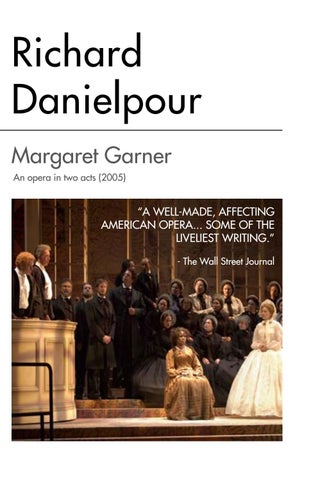
Learn more about Margaret Garner at www.musicsalesclassical.com. Photos from Margaret Garner by John Grigaitis, courtesy of Michigan Opera Theatre.
For more information contact Peggy Monastra,
ORDERING INFORMATION Rental orders and fee quotations: Zinfonia.com or MusicSalesClassical.com/licensing
Perusal scores: MusicaSalesClassical.com/OnDemand
Sales materials: MusicDispatch.com or MusicRoom.com or your music dealer
Publisher and Agency Representation for the Music Sales Group: MusicSalesClassical.com/rental
The Music Sales Group of Companies USA: G. Schirmer, Inc. Associated Music Publishers, Inc.
UK: Chester Music Ltd Novello & Co Ltd
France: Alphonse Leduc Chant du Monde Chester Music France Les Editions Choudens
Spain: Unión Musical Ediciones
Denmark: Edition Wilhelm Hansen AS
Germany: Music Sales Classical Berlin
chesterfrance@musicsales.co.uk
ewh@ewh.dk
the composer
Richard Danielpour Margaret Garner An opera in two acts (2005)
“A WELL-MADE, AFFECTING AMERICAN OPERA... SOME OF THE LIVELIEST WRITING.” - The Wall Street Journal
peggy.monastra@schirmer.com, 212-254-2100.
schirmer@schirmer.com
PHoto by Mike Minehan
Richard Danielpour has become one of the most sought-after composers of his generation — a composer whose distinctive American voice is part of a rich neo-Romantic heritage with influences from pivotal composers like Britten, Copland, Bernstein, and Barber. Danielpour has commented that “music [must] have an immediate visceral impact and elicit a visceral response.” This visceral element can indeed be heard throughout Danielpour’s oeuvre: expansive, sweeping, romantic gestures; energetic rhythmic accentuations; contrasting stylistic characters; arresting, introspective, melodic beauty; rich, enticing orchestrations; and brilliantly juxtaposed, yet cohesive harmonic angles.
promotion@musicsales.co.uk
unionmusicalediciones@musicsales.co.uk
Australia: G. Schirmer Pty Ltd publishing@musicsales.com.au
classical.berlin@musicsales.co.uk
Margaret Garner An opera in two acts (2005)
Score by Richard Danielpour Libretto by Toni Morrison
cast list
World Premiere: May 2005, Michigan Opera Theater Orchestra: 3(pic).2(ca).3(bcl).3(cbn)/4.3Ctpt.2+bt bn.1/timp.3perc/hp.pf(cel).stage pf/str
PRINCIPAL ROLES MARGARET GARNER*: MezzoSoprano ROBERT GARNER*: Lyric Baritone CILLA*: Dramatic Soprano EDWARD GAINES: Lyric Baritone
* Although much latitude is possible in casting, Margaret Garner does require that these roles be sung by Black performers. ** These roles can be sung by members of the White Chorus. *** It is essential that the TOWNSPEOPLE be exclusively White performers. Also, this “White Chorus” must outnumber the “Slave Chorus.”
SECONDARY ROLES CASEY: Dramatic Tenor CAROLINE GAINES: Light Lyric Soprano GEORGE HANCOCK: Tenor AUCTIONEER, a professional salesman: Lyric Tenor (doubles as Judge I) 8 SLAVE CATCHERS**: from chorus (4T, 4Bar) A FOREMAN/THE HANGMAN: non-singing role
3 JUDGES**: From chorus (T, Bar, B-Bar) (Judge I doubles as Auctinoeer) 2 MILITIA OFFICERS: non-singing roles MARGARET’S 2 CHILDREN: non-singing roles TOWNSPEOPLE/GUESTS***: SATB White Chorus (40 voices suggested) THE SLAVES*: SATB Black Chorus (32 voices suggested)
historical background In its own time, the case of Margaret Garner was among the most significant and controversial of all antebellum fugitive slave stories, arguably more compelling than similar cases involving such famous figures as Dred Scott and Anthony Burns. Fleeing Kentucky’s Maplewood Plantation in 1856 for freedom in Ohio, Margaret Garner sacrificed her own children when capture was at hand rather than see them returned to the bonds of slavery. The Garner case addressed crucial issues in constitutional law and posed key questions at the core of the rift in the Union. To abolitionists, the case decisively illustrated the pathology of slavery. The events leading up to and including the ultimate act of infanticide were endemic, they proclaimed, to slavery’s tragic heroism. On the other side however, Margaret’s actions served only to underline the subhuman nature of all slaves and their absolute need for indenture. Debate concerning the constitutionality of the 1850 Fugitive Slave Act, demanding that citizens assent to and assist in the capture of fugitive Blacks, was integral to the case. Also relevant were all-important states’ rights issues, which in the Garner case pitted a charge of murder in Ohio, a “free” state, against a mere destruction of property suit in Kentucky. The latter issue was hotly contested at the time in the courts of public opinion, and both sides saw in their differences nothing short of the simmering roots of civil war. But beyond historical significance and issues of law, Margaret Garner, as conceived by Richard Danielpour and Toni Morrison, speaks to us on a purely human level. It is an opera that confronts and shocks us with the remembered horrors of slavery and Civil War-era America, but most importantly it is one that conveys the enduring resonance and irrepressible power of the human spirit.
“Margaret Garner, moroever is history, literature, and now theatre... Danielpour has composed a melting pot in tones... [His] musical language hews to gracious harmonies...” - New York Times “Danielpour is an expert orchestrator...These are deeply expressive passages full of authentic emotionalism and even mystery.” - Detroit Free Press
Margaret Garner An opera in two acts (2005)
Score by Richard Danielpour Libretto by Toni Morrison
cast list
World Premiere: May 2005, Michigan Opera Theater Orchestra: 3(pic).2(ca).3(bcl).3(cbn)/4.3Ctpt.2+bt bn.1/timp.3perc/hp.pf(cel).stage pf/str
PRINCIPAL ROLES MARGARET GARNER*: MezzoSoprano ROBERT GARNER*: Lyric Baritone CILLA*: Dramatic Soprano EDWARD GAINES: Lyric Baritone
* Although much latitude is possible in casting, Margaret Garner does require that these roles be sung by Black performers. ** These roles can be sung by members of the White Chorus. *** It is essential that the TOWNSPEOPLE be exclusively White performers. Also, this “White Chorus” must outnumber the “Slave Chorus.”
SECONDARY ROLES CASEY: Dramatic Tenor CAROLINE GAINES: Light Lyric Soprano GEORGE HANCOCK: Tenor AUCTIONEER, a professional salesman: Lyric Tenor (doubles as Judge I) 8 SLAVE CATCHERS**: from chorus (4T, 4Bar) A FOREMAN/THE HANGMAN: non-singing role
3 JUDGES**: From chorus (T, Bar, B-Bar) (Judge I doubles as Auctinoeer) 2 MILITIA OFFICERS: non-singing roles MARGARET’S 2 CHILDREN: non-singing roles TOWNSPEOPLE/GUESTS***: SATB White Chorus (40 voices suggested) THE SLAVES*: SATB Black Chorus (32 voices suggested)
historical background In its own time, the case of Margaret Garner was among the most significant and controversial of all antebellum fugitive slave stories, arguably more compelling than similar cases involving such famous figures as Dred Scott and Anthony Burns. Fleeing Kentucky’s Maplewood Plantation in 1856 for freedom in Ohio, Margaret Garner sacrificed her own children when capture was at hand rather than see them returned to the bonds of slavery. The Garner case addressed crucial issues in constitutional law and posed key questions at the core of the rift in the Union. To abolitionists, the case decisively illustrated the pathology of slavery. The events leading up to and including the ultimate act of infanticide were endemic, they proclaimed, to slavery’s tragic heroism. On the other side however, Margaret’s actions served only to underline the subhuman nature of all slaves and their absolute need for indenture. Debate concerning the constitutionality of the 1850 Fugitive Slave Act, demanding that citizens assent to and assist in the capture of fugitive Blacks, was integral to the case. Also relevant were all-important states’ rights issues, which in the Garner case pitted a charge of murder in Ohio, a “free” state, against a mere destruction of property suit in Kentucky. The latter issue was hotly contested at the time in the courts of public opinion, and both sides saw in their differences nothing short of the simmering roots of civil war. But beyond historical significance and issues of law, Margaret Garner, as conceived by Richard Danielpour and Toni Morrison, speaks to us on a purely human level. It is an opera that confronts and shocks us with the remembered horrors of slavery and Civil War-era America, but most importantly it is one that conveys the enduring resonance and irrepressible power of the human spirit.
“Margaret Garner, moroever is history, literature, and now theatre... Danielpour has composed a melting pot in tones... [His] musical language hews to gracious harmonies...” - New York Times “Danielpour is an expert orchestrator...These are deeply expressive passages full of authentic emotionalism and even mystery.” - Detroit Free Press
Learn more about Margaret Garner at www.musicsalesclassical.com. Photos from Margaret Garner by John Grigaitis, courtesy of Michigan Opera Theatre.
For more information contact Peggy Monastra,
ORDERING INFORMATION Rental orders and fee quotations: Zinfonia.com or MusicSalesClassical.com/licensing
Perusal scores: MusicaSalesClassical.com/OnDemand
Sales materials: MusicDispatch.com or MusicRoom.com or your music dealer
Publisher and Agency Representation for the Music Sales Group: MusicSalesClassical.com/rental
The Music Sales Group of Companies USA: G. Schirmer, Inc. Associated Music Publishers, Inc.
UK: Chester Music Ltd Novello & Co Ltd
France: Alphonse Leduc Chant du Monde Chester Music France Les Editions Choudens
Spain: Unión Musical Ediciones
Denmark: Edition Wilhelm Hansen AS
Germany: Music Sales Classical Berlin
chesterfrance@musicsales.co.uk
ewh@ewh.dk
the composer
Richard Danielpour Margaret Garner An opera in two acts (2005)
“A WELL-MADE, AFFECTING AMERICAN OPERA... SOME OF THE LIVELIEST WRITING.” - The Wall Street Journal
peggy.monastra@schirmer.com, 212-254-2100.
schirmer@schirmer.com
PHoto by Mike Minehan
Richard Danielpour has become one of the most sought-after composers of his generation — a composer whose distinctive American voice is part of a rich neo-Romantic heritage with influences from pivotal composers like Britten, Copland, Bernstein, and Barber. Danielpour has commented that “music [must] have an immediate visceral impact and elicit a visceral response.” This visceral element can indeed be heard throughout Danielpour’s oeuvre: expansive, sweeping, romantic gestures; energetic rhythmic accentuations; contrasting stylistic characters; arresting, introspective, melodic beauty; rich, enticing orchestrations; and brilliantly juxtaposed, yet cohesive harmonic angles.
promotion@musicsales.co.uk
unionmusicalediciones@musicsales.co.uk
Australia: G. Schirmer Pty Ltd publishing@musicsales.com.au
classical.berlin@musicsales.co.uk