Contemporary
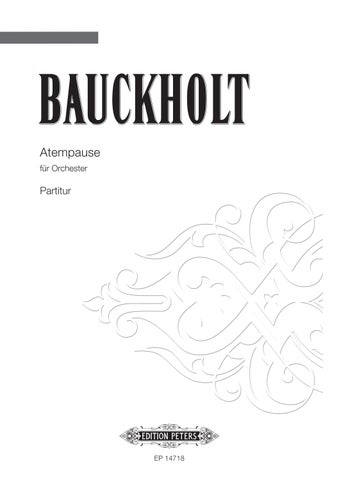
BAUCKHOLT Atempause für Orchester
Partitur
EP 14718
CAROLA BAUCKHOLT
Atempause für Orchester (2000/2001)
Partitur (Faksimile der Komponistin)
ALLE RECHTE VORBEHALTEN
· ALL RIGHTS RESERVED
EDITION PETERS L E I P Z I G · L O N D O N · NEW YORK
Kompositionsauftrag des Europäischen Musikmonats 2001 für die Basel Sinfonietta
Uraufführung: 15. September 2001, Stadtcasino, Basel Basel Sinfonietta, dirigiert von Muhai Tang
Carola Bauckholt Atempause 3 Flutes (1. doubling Piccolo, 2. and 3. doubling Bass Flute (if possible)) 2 Oboes 2 Clarinets 1 Bass Clarinet 2 Bassoons 1 Contrabassoon 2 Trumpets (1. doubling Piccolo with harmon-, straight mute, cup and wah-wah) 4 Horns 3 Trombones (with straight mute, cup and wah-wah) 1 Tuba Percussion 1 (back right) - thin water jet in water bucket (e.g., large watering can with thin spout, pour at a great distance, or pour water from a vessel e.g., a screw-top jar with a hole in the lid into a bowl from a great distance, as clearly visible as possible) - strongly muffled gong - 2 deep wooden sounds (wooden drums, one very deep) - “steps in gravel” (fill large base with shells, walk on it crunching) - rub card board box on resonance box - with soft brush fleetingly wipe over large natural skin - 2 glasses ("h" and "f"), are made to sound by rubbing them (the glass should be a little higher so that it can be tuned with little water) - tube of hard rubber o 3-4 cm; is beaten on a stone, e.g. Tricoflex Nobel about 60 cm - imitate Bartok pizzicato sound of double basses e.g. rod is beaten on wood Percussion 2 (middle) - with soft brush fleetingly wipe over large natural skin - wooden guero - strongly muffled gong - middle rattle (single impulses) - tam-tam - grooved stick (turned wooden stick) on wooden table or resonance box or empty bottle case (snore) - wipe styrofoam piece along rough wooden plate (like breathe) - wipe 2 soft brushes (light, dark) along rough wooden plate - crash cymbal (high, hard, immediately dampen) - tube of hard rubber o 3-4 cm; is beaten on a stone, e.g. Tricoflex Nobel about 60 cm - imitate Bartok pizzicato sound of double basses e.g. rod is beaten on wood Percussion 3 (back left) - big knack frog - Cabassa - wind-up sound (fine metal rattling) run over metal with coarse metal chain - with soft brush fleetingly wipe over large natural skin - low timpani (downward glissando like muffled moan) e.g. c sharp-A 2 - 2 glasses ("h" and "f"), are made to sound by rubbing them (the glass should be a little higher so that it can be tuned with little water) - tube of hard rubber o 3-4 cm; is beaten on a stone, e.g. Tricoflex Nobel about 60 cm - imitate Bartok pizzicato sound of double basses e.g. rod is beaten on wood - scratching on bongo with fingernail 1 Harp 12 - 14 Violins I 10 - 12 Violins II 8-10 Violas 6 - 8 Violoncellos 5 - 6 Double Basses (4 strings)
The score is written in C. Double basses and contrabassoon sound one octave lower than notated, piccolo one octave higher. = Quarter tone higher = Quarter tone lower = Beginning of a crescendo or ending of a decrescendo inaudible (from/to niente) = Indicates the energy put into the gesture not the resulting dynamic = Slow transition = Target tone that is not played, but just reached. = Even glissando: pitches are given only as reference points and should not be perceived as a pitch.
Strings and Harp wo
= Zipper sound: run fingernail quickly along string. Double basses sul E (sounds good on wound strings), harp on several strings (with a plastic ruler). = Pluck in pegbox with plectrum = Behind the bridge = pizzicato with fingernail = grip with fingernail left hand, pluck with fingernail right hand close to grip finger, while doing big glissando-vibrato = Fingerhit
= = col legno battuto imitate crunch = bow lies on the strings, sound only by pressure shift, tilting movement of the bow = ohne Auf- und Abstrich Wischbewegung mit dem Bogenhaar entlang der Saite = Towards pegbox = Towards bridge = wipe quickly over the corpus with the flat of the hand without pressure = Violin glissando as high as possible = “bouncing”: Place the bow on the point on the string where the given pitch would be fingered. The pitch determines the contact point of the bow on the string. Bow at the frog with a lot of rosin and relatively extreme bow pressure, using as little bow as possible. Mute the string with the finger ca. 1 cm behind the bow hair and lift it above the bow to make bowing easier. Slow single attacks - a very resonate, sparkling impulse should result. Doublebass: hit the fretboard alternately with both hands: right hand on the spot, left hand alternately above and below it.
Winds = Air at specified pitch = Breath in = Breath out = Hit with hand on mouthpiece = Tongue ram, quickly close the embouchure by ramming the tongue against the aperture thereby producing a pizzicato like sound. For the flute the resulting pitch is a seventh lower than the note fingered. = Key click, indeterminate pitch = Fluttertongue = Clarinet: suck mouthpiece free (smacking sound) = Flute: loose throat creak into the mouthpiece. While doing so, an American R is formed followed by a gentle transition to an “eh” to imitate the sound of a frog.
Edition Peters 14718
© 2001 by Thürmchen Verlag, Köln 2023 assigned to Henry Litolff's Verlag Ltd & Co. KG, Leipzig
Edition Peters For more than 200 years, Edition Peters has been synonymous with excellence in classical music publishing. Established in 1800 with the keyboard works of J. S. Bach, by 1802 the company had acquired Beethoven’s First Symphony. In the years following, an active publishing policy enabled the company to expand its catalogue with new works by composers such as Brahms, Grieg and Liszt, followed in the 20th century by Richard Strauss, Arnold Schoenberg and John Cage. Today, with its offices in Leipzig, London and New York publishing the work of living composers from around the world, Edition Peters maintains its role as a champion of new music. At the same time, the company’s historic and educational catalogues continue to be developed with awardwinning critical and pedagogical editions. Seit über 200 Jahren steht die Edition Peters für höchste Qualität im Bereich klassischer Notenausgaben. Gegründet im Jahr 1800, begann der Verlag seine Tätigkeit mit der Herausgabe von Bachs Musik für Tasteninstrumente. Schon 1802 kamen die Rechte an Beethovens erster Sinfonie hinzu. In der Folgezeit wuchs der Katalog um neue Werke von Komponisten wie Brahms, Grieg und Liszt sowie – im 20. Jahrhundert – Richard Strauss, Arnold Schönberg und John Cage. Als Verleger zahlreicher zeitgenössischer Komponisten aus aller Welt ist die Edition Peters mit ihren Standorten Leipzig, London und New York auch weiterhin Anwalt neuer Musik. Zugleich wird das Verlagsprogramm im klassischen wie im pädagogischen Bereich kontinuierlich durch vielfach preisgekrönte Ausgaben erweitert.
Photo © Irène Zandel The offices of Edition Peters in Talstraße, Leipzig Geschäftssitz der Edition Peters in der Leipziger Talstraße
EDITION PETERS GROUP L E I P Z I G
·
L O N D O N
·
N E W
www.editionpeters.com
Y O R K