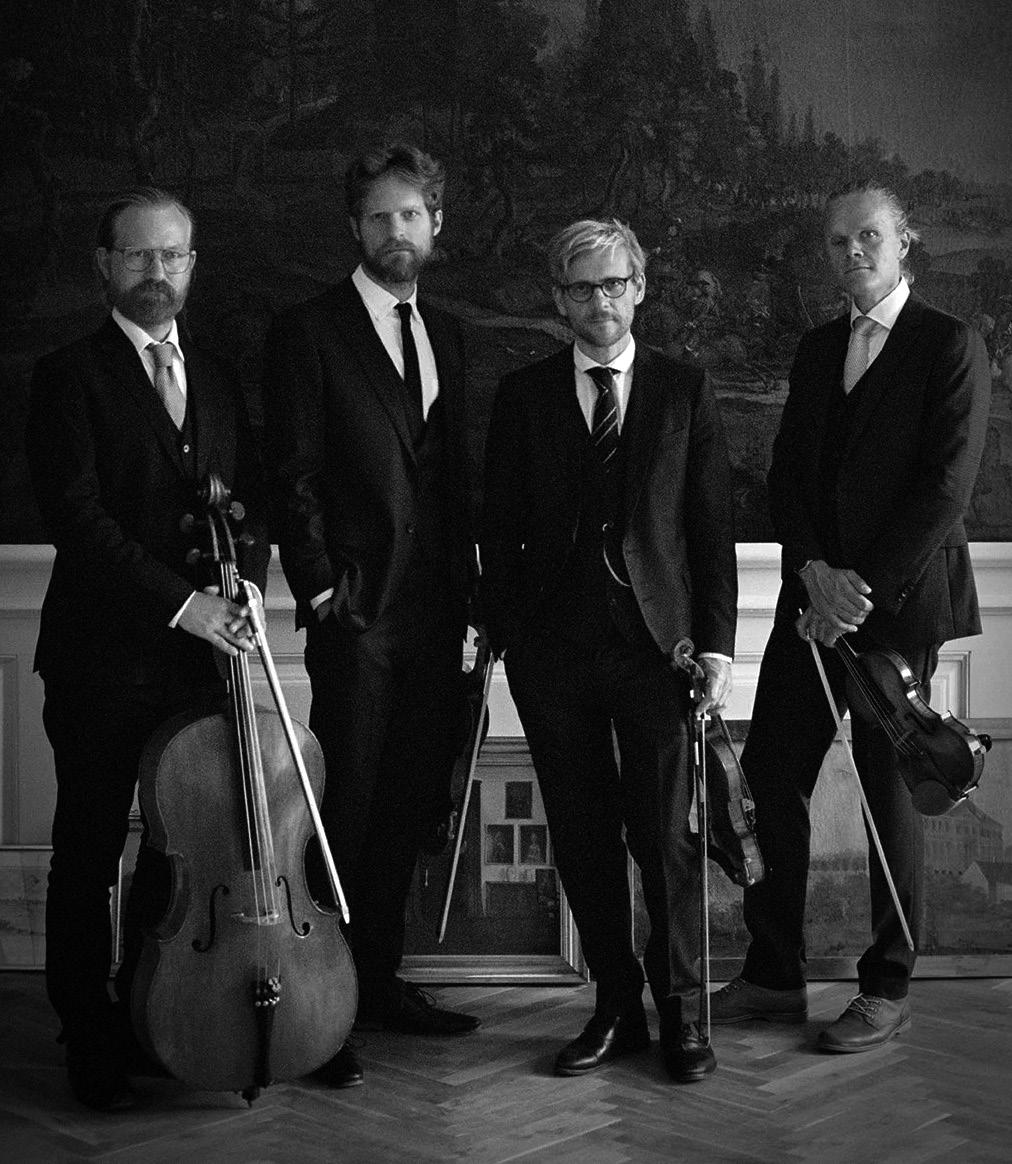
The folk tunes getting a classical makeover come courtesy of the Copenhagenbased Danish String Quartet: no, the four players aren’t here in person, but their musical creations very much are.
so strong that she forces her way into his room that night, causing scandal at court. The Queen steps in to resolve matters: why don’t Stæedelil and Virgin Regitze simply marry? Based around a catchy tune, the ballad takes a brief foray into slightly more melancholy music half-way through. The tune even has an existing classical connection: none other than Ludwig van Beethoven concocted a version for soprano, chorus and piano of the Danish version – called ‘Ridder Stig’ (‘Knight Stig’) – in the 1810s.
The tender, slower-moving ‘Æ Rømeser’ takes us closer to the Danish String Quartet’s home. It’s an example of a musical form – called sønderhoning since it comes from the village of Sønderho – that’s unique to the island of Fanø, off the west coast of Denmark. This particular tune comes from the 18th century, and its title simply means ‘the one from Romø’, another island just to the south of Fanø. It’s perhaps hard to imagine the tune as a dance
from its atmospheric opening, but it develops a sense of gentle, fluid movement as the music progresses.
From the Faroes and Denmark, we travel to northern Sweden for the final tune, and specifically the Lapland village of Dorotea – hence the title ‘Polska from Dorotea’. Like the better-known polka and polonaise, a polska is simply a dance with Polish roots. This particular one is attributed to the great Swedish fiddler and teacher Johan August Andersson, who lived in the second half of the 19th century. Andersson’s life story was particularly tragic: he lost both his wife and daughter, cursed God for these tragedies in church, only to be shunned and ostracised by his fellow villagers as a madman as a result. Not that there’s any sense of tragedy in this dashing music, which keeps you on your toes with its shifting melodic lengths and grows increasingly outspoken as the piece develops.
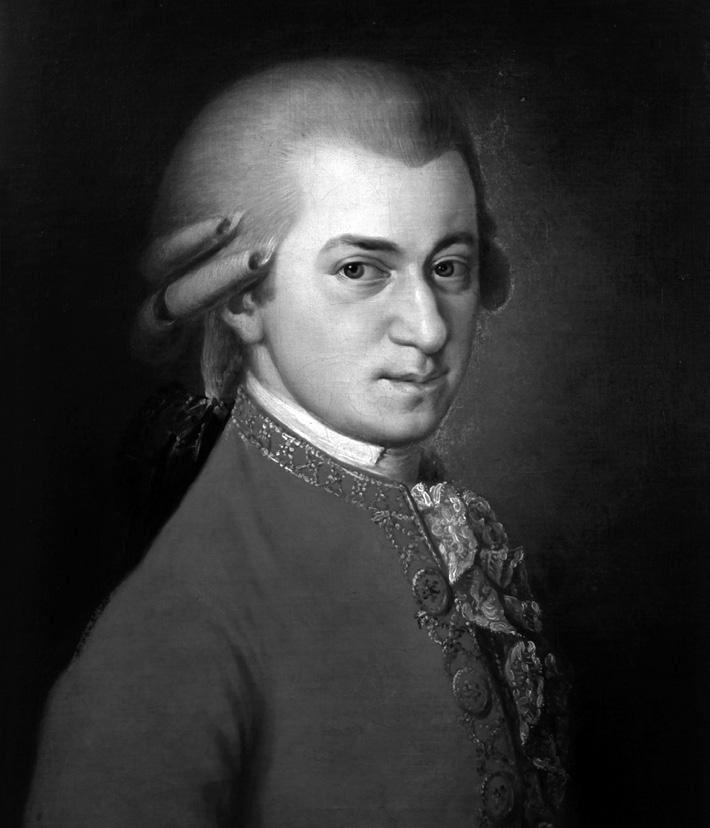
While the younger Mozart’s earlier violin concertos might have stuck quite closely to tried-and-tested models, by No. 5 the composer was stretching his wings.
From Nordic nations, we travel south and east to the splendours of the Ottoman court for tonight’s next piece – well, kind of. Mozart’s Fifth Violin Concerto might have acquired the nickname ‘Turkish’, but it’s really only Turkish in a very Viennese manner of speaking. That Austrian fascination with all things Turkish began as far back as 1699, when long-time foes in the Austrian and Ottoman empires negotiated the Treaty of Karlowitz, bringing to an end the Great Turkish War that had raged for the previous 13 years. In celebration, the Ottomans sent to Vienna a Janissary military band, bringing with them exotic percussion and wind instruments never before encountered. Later Ottoman musicians entertained delighted listeners in Poland, Russia, Prussia and elsewhere in Austria, and composers set about incorporating the bands’ unusual sounds into their own music. Haydn employed triangle, bass drum and cymbals in his ‘Military’ Symphony, No.100, to
represent the noise of battle, while Beethoven incorporated ‘Turkish’ sounds in his incidental music to The Ruins of Athens and even in the finale of his Ninth Symphony. Mozart would go on to set a whole opera – Die Entführung aus dem Serail – in a make-believe Turkey in 1782, and the following year he concluded his Keyboard Sonata in A, K331, with the percussive rhythms of his famous ‘Rondo alla turca’. Eight years earlier, however, he’d already included distinctively ‘Turkish’ sounds in the final movement of his Violin Concerto No.5.
It’s the last of the five violin concertos that Mozart wrote in his birthplace of Salzburg between April and December 1775, at the age of just 19, possibly for himself to perform. Young Wolfgang was a fine violinist, and had been encouraged in his fiddle studies by his father Leopold, one of the great violin exponents of the time, and author of a
seminal treatise on violin playing that’s still in use today.
And while the younger Mozart’s earlier violin concertos might have stuck quite closely to tried-and-tested models, by No. 5 the composer was stretching his wings. After the first movement’s orchestra-only introduction, for example, the soloist suddenly slows the tempo for their unusually thoughtful first entry, before launching into the movement’s main theme. Mozart’s slower second movement is lyrical, contemplative and richly scored. And his closing movement might begin as a refined minuet, led by the violin, but it suddenly shifts from major to minor, and from a tripping three-time dance to a more military two-time march, when Mozart introduces his ‘Turkish’ music. There are no additional percussion instruments as such, although Mozart asks his cellos and double basses to play with the wood of their bows, producing a brittle, percussive sound. The movement quickly returns to the gracefulness of its opening minuet before its elegant close, however.
If Mozart was embracing new ideas in his Fifth Violin Concerto, the 63-year-old Joseph Haydn was perhaps doing something similar in his ‘London’ Symphony, No.104. By the time he wrote the Symphony, in 1794-5, he’d spent almost 30 years in the employment of the fabulously wealthy Esterházy family, much of that time in the lavish but rather isolated Eszterháza Palace, then firmly at the heart of the Habsburg Empire but now in north-west Hungary. During those decades, he’d used the court’s resident musicians to the fullest, virtually inventing the modern symphony and string quartet as musical forms, and developing his clean, clear, elegant and mischievously witty musical style across operas, chamber music and plenty more.
But equally, he felt he needed to move on. In 1790, at the age of 58, he found his chance. The incoming Prince Anton Esterházy looked to trim back his artistic outgoings: he’d still guarantee an ongoing salary for Haydn, but he no longer required his permanent presence at court. The composer’s music was already wildly popular among London audiences, and German-born, London-based impresario Johann Peter Salomon snapped him up for two visits to England, first in 1791-2, and again in 1794-5. Both went down a storm, so much so that Haydn reportedly even considered settling permanently in the English capital (and was explicitly invited to do so by King George III, no less).
He hobnobbed with royalty and the aristocracy, was fêted at high-society occasions, and even received an honorary doctorate in Oxford (which provided his ‘Oxford’ Symphony, No.92, with its nickname). More importantly, with the six symphonies he composed for his first visit, he got to know just what his London listeners liked. When he returned two years later, he could give it to them all over again – and plenty more besides – with six more ‘London’ symphonies. In that respect, Haydn’s second batch of ‘London’ symphonies – Nos 99 to 104 – represents a rare meeting of composer’s and audience’s minds: each knows the other intimately, and each is out to enjoy that relationship to the fullest.
No.104, however, is the only one of Haydn’s 12 ‘London’ symphonies to have retained its ‘London’ nickname. It’s also the very final Symphony that Haydn would ever write. Was he aware of that fact when creating it? It’s unlikely – more probably, he simply didn’t compose any more in the 14 years he lived after completing it. Nonetheless, there’s a definite feeling of celebration and festivity to
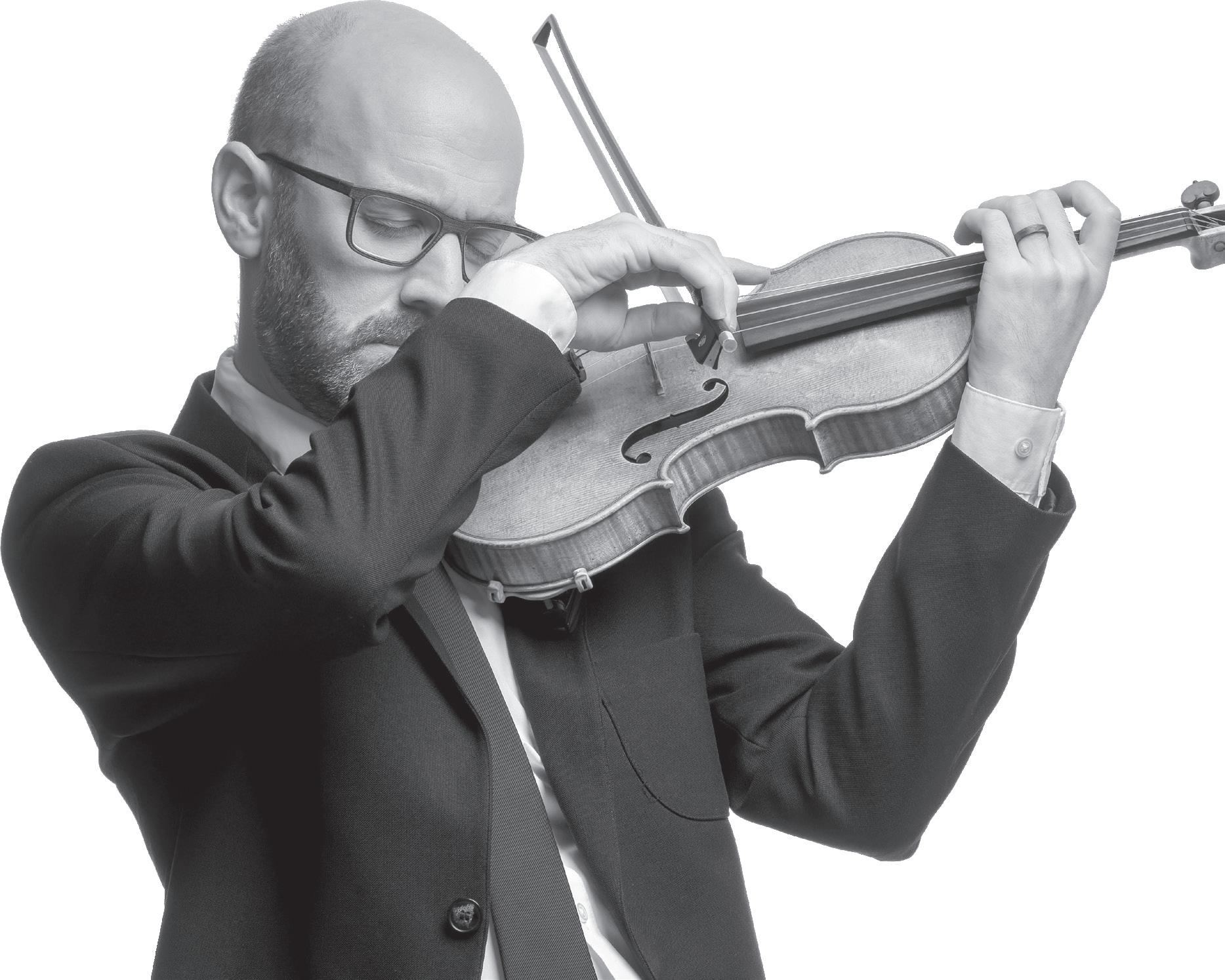
Gordon Bragg Sub-Principal Second Violin
Photo: Christopher Bowen