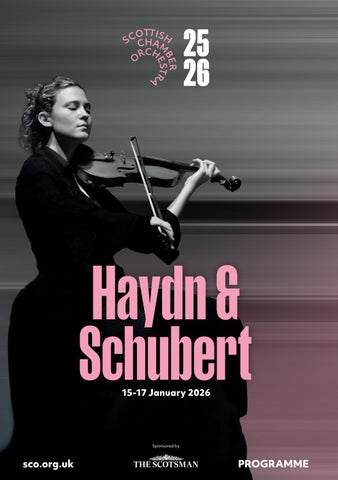
Haydn & Schubert 15-17 January 2026
Sponsored by
sco.org.uk
PROGRAMME
25/26 Concert Season
Cover image © Frank Stewart
Haydn & Schubert With Lorenza Borrani
Thursday 15 January, 2pm The Queen's Hall, Edinburgh Friday 16 January, 2pm City Halls, Glasgow Saturday 17 January, 7.30pm Easterbrook Hall, Dumfries HAYDN Symphony No.56 in C SCHNITTKE Concerto Grosso No.1 Interval of 20 minutes
SCHUBERT Symphony No.8 ‘Unfinished’ Lorenza Borrani director/violin © Piera Mungiguerra
Lorenza Borrani
4 Royal Terrace, Edinburgh EH7 5AB +44 (0)131 557 6800 | info@sco.org.uk | sco.org.uk
The Scottish Chamber Orchestra is a charity registered in Scotland No. SC015039. Company registration No. SC075079.
3
THANK YOU
Principal Conductor's Circle Our Principal Conductor’s Circle are a special part of our musical family. Their commitment and generosity benefit us all – musicians, audiences and creative learning participants alike. Annual Fund James and Patricia Cook
American Development Fund Erik Lars Hansen and Vanessa C L Chang
Visiting Artists Fund Harry and Carol Nimmo Anne and Matthew Richards
Productions Fund Anne, Tom and Natalie Usher Bill and Celia Carman
International Touring Fund Gavin and Kate Gemmell
Scottish Touring Fund Eriadne and George Mackintosh Claire and Anthony Tait
Creative Learning Fund Sabine and Brian Thomson
CHAIR SPONSORS Conductor Emeritus Joseph Swensen Donald and Louise MacDonald
Cello Eric de Wit Jasmine Macquaker Charitable Fund
Chorus Director Gregory Batsleer Anne McFarlane
Principal Flute André Cebrián Claire and Mark Urquhart
Principal Second Violin Marcus Barcham Stevens Jo and Alison Elliot
Principal Oboe The Hedley Gordon Wright Charitable Trust
Second Violin Rachel Smith J Douglas Home Principal Viola Max Mandel Ken Barker and Martha Vail Barker Viola Brian Schiele Christine Lessels Viola Steve King Sir Ewan and Lady Brown Principal Cello Philip Higham The Thomas Family Sub-Principal Cello Su-a Lee Ronald and Stella Bowie Cello Donald Gillan Professor Sue Lightman
Sub-Principal Oboe Katherine Bryer Ulrike and Mark Wilson Principal Clarinet Maximiliano Martín Stuart and Alison Paul Principal Bassoon Cerys Ambrose-Evans Claire and Anthony Tait Sub-Principal Bassoon Alison Green George Rubienski Principal Horn Kenneth Henderson Caroline Hahn and Richard Neville-Towle Principal Timpani Louise Lewis Goodwin Geoff and Mary Ball
THANK YOU
Funding Partners Core Funder
Benefactor
Local Authority
Broadcast Partner
Media Partner
Funding Partner
Business Partners
Key Funders
Delivered by
Charity Partner
5
THANK YOU
SCO Donors Diamond
Gold
The Cockaigne Fund
Peter Armit
Malcolm and Avril Gourlay
Adam Gaines and Joanna Baker
John and Jane Griffiths
John and Maggie Bolton
James and Felicity Ivory
Elizabeth Brittin
George Ritchie
Kate Calder
Tom and Natalie Usher
James Wastle and Glenn Craig Jo and Christine Danbolt
Platinum
James and Caroline Denison-Pender
E.C. Benton
Andrew and Kirsty Desson
Michael and Simone Bird
David and Sheila Ferrier
Silvia and Andrew Brown
Chris and Claire Fletcher
David Caldwell in memory of Ann
James Friend
Dr Peter Williamson and Ms Margaret Duffy
Iain Gow
Judith and David Halkerston
Margaret Green
David and Elizabeth Hudson
Christopher and Kathleen Haddow
Helen B Jackson
Catherine Johnstone
Dr and Mrs Peter Jackson
Julie and Julian Keanie
Dr Daniel Lamont
Gordon Kirk
Graham and Elma Leisk
Janey and Barrie Lambie
Professor and Mrs Ludlam
Mike and Karen Mair
Chris and Gill Masters
Roy and Svend McEwan-Brown
Duncan and Una McGhie
John and Liz Murphy
Anne-Marie McQueen
Tom Pate
James F Muirhead
Maggie Peatfield
Robin and Catherine Parbrook
Sarah and Spiro Phanos
Patrick and Susan Prenter
Charles Platt and Jennifer Bidwell
Mr and Mrs J Reid
Alison and Stephen Rawles
The Walter and Janet Reid Charitable Trust
Andrew Robinson
Martin and Mairi Ritchie
Olivia Robinson
Hilary E Ross
Anne McAlister and Philip Sawyer
Elaine Ross
Irene Smith
Sir Muir and Lady Russell
Dr Jonathan Smithers
Jill and Brian Sandford
Ian S Swanson
Michael and Elizabeth Sudlow
Ian and Janet Szymanski
Robert and Elizabeth Turcan
John-Paul and Joanna Temperley
Alan and Sue Warner
Douglas and Sandra Tweddl
Anny and Bobby White
Bill Welsh
Robert Mackay and Philip Whitley
Catherine Wilson
Finlay and Lynn Williamson
Neil and Philippa Woodcock
Ruth Woodburn
Silver
Philip Holman
Roy Alexander
Clephane Hume
Fiona and Neil Ballantyne
Tim and Anna Ingold
The Batsleer Family
David and Pamela Jenkins
Jack Bogle
Margaret Mortimer and Ken Jobling
Jane Borland
Ross D. Johnstone
Alan Borthwick
Professor Christopher and Mrs Alison Kelnar
Dinah Bourne
Dr Ian Laing
Michael and Jane Boyle
Geoff Lewis
Mary Brady
Dorothy A Lunt
John Brownlie
Vincent Macaulay
Laura Buist
James McClure in memory of Robert Duncan
Robert Burns
Ben McCorkell
Sheila Colvin
Lucy McCorkell
Lorn and Camilla Cowie
Gavin McCrone
Adam and Lesley Cumming
Michael McGarvie
Dr Wilma Dickson
Brian Miller
Seona Reid and Cordelia Ditton
Alistair Montgomerie
Sylvia Dow
Andrew Murchison
Colin Duncan in memory of Norma Moore
Pamela Andrews and Alan Norton
Raymond Ellis
Gilly Ogilvy-Wedderburn
Dr and Mrs Alan Falconer
Mairi & Ken Paterson
Sheila Ferguson
John Peutherer in memory of Audrey Peutherer
Dr William Irvine Fortescue
James S Potter
Dr David Grant
Timothy Barnes and Janet Sidaway
Anne Grindley
Catherine Steel
Andrew Hadden
John and Angela Swales
J Martin Haldane
Takashi and Mikako Taji
Ronnie and Ann Hanna
C S Weir
Roderick Hart
Susannah Johnston and Jamie Weir
Norman Hazelton
David and Lucy Wren
Ron and Evelynne Hill
––––– We are indebted to everyone acknowledged here who gives philanthropic gifts to the SCO of £300 or greater each year, as well as those who prefer to remain anonymous. We are also incredibly thankful to the many individuals not listed who are kind enough to support the Orchestra financially on a regular or ad hoc basis. Every single donation makes a difference. Become a regular donor, from as little as £5 a month, by contacting Hannah Wilkinson on 0131 478 8364 or hannah.wilkinson@sco.org.uk. 7
“ …an orchestral sound that seemed to gleam from within.” THE SCOTSMAN
HM The King Patron Donald MacDonald CBE Life President Joanna Baker CBE Chair Gavin Reid LVO Chief Executive Maxim Emelyanychev Principal Conductor Andrew Manze Principal Guest Conductor Joseph Swensen Conductor Emeritus Gregory Batsleer Chorus Director Jay Capperauld Associate Composer
© Chris Christodoulou
Our Musicians
Your Orchestra Tonight Information correct at the time of going to print
First Violin Lorenza Borrani Afonso Fesch Huw Daniel Aisling O’Dea Fiona Alexander Sarah Bevan Baker Kristin Deeken Tom Hankey Second Violin Marcus Barcham Stevens Hatty Haynes Michelle Dierx Rachel Smith Rachel Spencer Will McGahon
Flute André Cebrián Marta Gómez
Trumpet Peter Franks Shaun Harrold
Oboe Maria Victoria Munõz Zaragozá Katherine Bryer
Trombone Duncan Wilson Nigel Cox Alan Adams
Clarinet Maximiliano Martín William Stafford
Timpani Louise Lewis Goodwin
Bassoon Cerys Ambrose-Evans Alison Green Horn Lauren Reeve-Rawlings Gavin Edwards
Viola Simone van der Giessen Francesca Gilbert Brian Schiele Steve King
Jamie Kenny Principal Bass
Cello Philip Higham Su-a Lee Donald Gillan Eric de Wit
© Christopher Bowen
Bass Jamie Kenny Ben Burnley
Harpsichord/Piano Jan Waterfield
What You Are About To Hear HAYDN (1732-1809) Symphony No.56 in C major (1774) Allegro di molto Adagio Menuetto Finale: Prestissimo
SCHNITTKE (1934-1998) Concerto Grosso No. 1 (1976–1977) Preludio: Andante Toccata: Allegro Recitativo: Lento Cadenza Rondo: Agitato Postludio: Andante
Two forward-looking symphonies bookend today’s diverse programme, separated by a far more recent piece that gazes backwards to the Baroque brilliance of Vivaldi and Corelli with plenty of wit and humour (even if some of it is decidedly dark). We begin, though, with Joseph Haydn, who for the best part of three decades from 1761 worked as a court musician to the fabulously wealthy Esterházy family. During that long period, he was responsible for running the court orchestra, composing music to delight Prince Nikolaus and his family, giving chamber music performances and even staging opera productions. Not for nothing is Haydn often dubbed the ‘father of the symphony’: it was while he was an Esterházy employee – both in Eisenstadt, near Vienna, and in the far further-flung Eszterháza Palace, now in Hungary – that he developed and refined, almost single-handedly, the symphony in the form we know it today. (He did the same for the string quartet, too, and wrote a lot of works in both forms during his time with the family.)
SCHUBERT (1797-1828) Symphony No.8 ‘Unfinished’, D.759 (1822) Allegro moderato Andante con moto
Haydn’s Symphony No. 56 comes from 1774. The composer had found his contributions increasingly appreciated by the Prince (and his responsibilities growing as a result), and he took the recognition as a cue for ever more ambitious work. The Symphony No. 56 is one result, and it seems specifically intended to show off the Eszterháza Palace’s court orchestra and its individual players to his appreciative boss, as if to remind the Prince what a fine band of musicians he had at his beck and call. Fanfare-like figures abound in its exuberant opening movement, but even within its opening theme, there are striking contrasts between the bright passages involving
10
Not for nothing is Haydn often dubbed the ‘father of the symphony’. Franz Joseph Haydn
winds and horns and the far softer, gentler material for the strings. Once its more lyrical second main theme has been heard, both
and in his restless switching between contrasting instrumental groups.
are combined in clever counterpoint in the stormier central development section, before they return at the close – Haydn even heralds the return of his quieter string theme with a gentle timpani roll. He shows off Eszterháza’s fine wind players in the gentle slow movement, whose long melody unfurls on a duo of oboes and later a bassoon against a backdrop of muted strings. He plays a small musical prank in his jolly minuet, whose gushing enthusiasm drives it unexpectedly into the ‘wrong’ key: Haydn simply stops abruptly, only to recommence the music as if nothing has happened. His whirling finale draws on the rhythms of Italian tarantella and saltarello dances, and explores the full colours
The mood changes quite noticeably in today’s second piece. Despite a prolific output of music over several decades, Alfred Schnittke was a composer virtually unknown to listeners in Western Europe and America until the 1980s. There was a simple reason: Schnittke lived almost his entire life under the strictures of the Soviet regime, and though his abilities and expertise were recognised within the USSR, his music was rarely permitted to be heard west of the Soviet bloc. Nonetheless, in his home country – and, as time went on, beyond – he was widely considered the heir to Shostakovich’s legacy, continuing that earlier composer’s uncanny mix of despair, frustration and often bitter, sarcastic humour. In Schnittke’s music, it’s often hard
available to Haydn in his rich orchestration
to tell where one stops and the other begins.
Nonetheless, Schnittke gained a few glimpses of Western musical developments throughout his life, during three childhood
Schnittke had his own individual perspective on the polystylism of his Concerto Grosso No.1, which he explained in a programme
years in Vienna, and also as a student at the Moscow Conservatoire during the so-called ‘Krushchev thaw’ following the death of Stalin, when more avant-garde artistic ideas began seeping in from Western Europe. Ironically, however, it was Schnittke’s early success as a film composer that set him down the path that he would follow later in his career. Used to combining numerous different musical styles within a film score, even switching back and forth between them nimbly as the storyline demanded, Schnittke quickly adopted this freewheeling mix of styles – later termed ‘polystylism’ – as his overarching musical approach.
note for an early performance, in Vienna in 1977: ‘I dream of the Utopia of a united style, where fragments of “U” (Unterhaltung [entertaining]) and “E” (Ernst [serious]) are not used for comic effect but seriously represent multi-faceted musical reality. That’s why I’ve decided to put together some fragments from my cartoon film music; a joyful children’s chorus; a nostalgic atonal serenade; a piece of 100%-guaranteed Corelli (made in the USSR); and finally, my grandmother’s favourite tango played by my great-grandmother on a harpsichord. I am sure all these themes go together very well, and I use them absolutely seriously.’
It's a simple idea: when there are so many ways of creating music, and so many styles you might adopt, why restrict yourself to just one of them? Why not instead throw them all together and use
Indeed, there’s little doubt that Schnittke was entirely serious about the evident humour in his Concerto Grosso No.1. It had been commissioned by violinists Gidon Kremer and Tatiana Gridenko, who gave its premiere on 21 March 1977 in
any or all of them as the mood takes you? Much of Schnittke’s music – including today’s Concerto Grosso No.1 – does just that, freely leaping from dense modernism to lightweight tango, for example, or from Baroque pastiche to nursery-rhyme simplicity in a single piece, with results that are sometimes humorous, sometimes disconcerting. It’s an approach that’s been criticised for an apparent lack of authenticity – as though we’re never quite sure which one of these musical impersonations represents the ‘real’ Schnittke. The answer is probably that they all do – or at least that the apparently irreconcilably different styles add up to music that reflects the profusion and confusion of ideas and voices we
Leningrad, with the Leningrad Chamber Orchestra conducted by Eri Klas. It was around that time that Schnittke’s music was slowly becoming better known in the West, with the result that the Soviet authorities cracked down hard on allowing him to travel. For a European tour with the Lithuanian Chamber Orchestra, however, Kremer and Gridenko came up with a sly solution: they’d employ him as the piece’s harpsichord and prepared piano player, thereby making him an essential presence, but sidestepping the possibility that he’d be barred from travelling as simply the piece’s composer.
encounter in modern-day life.
a trio of soloists – its two violinists and
12
The piece is indeed a true Baroque-style concerto grosso in the way it contrasts
Schnittke lived almost his entire life under the strictures of the Soviet regime, and though his abilities and expertise were recognised within the USSR, his music was rarely permitted to be heard west of the Soviet bloc. Alfred Schnittke
a harpsichord/prepared piano player – against the larger forces of a string orchestra. The work’s two violinists are
Preludio, playing a strange, naive but slightly unsettling tune that might sound something like a nursery rhyme, and which
most often in the limelight, but its keyboard performer plays a crucial role, too, whether summoning a Baroque-style sound world on the harpsichord, or conjuring sounds that are far more warped and unsettling with the very modern prepared piano. Invented in the 1940s by maverick US composer John Cage, the prepared piano is simply an everyday acoustic piano that’s had objects inserted between its strings, altering its sounds in often strange and unpredictable ways. Cage wrote extensively for it – including the hour-long, 20-movement Sonatas and Interludes – and it’s been taken up by numerous more recent composers too.
will return again and again throughout the piece. The two violinists call to each other in increasingly desperate – and increasingly dissonant – two-note ideas, another musical element that we’ll hear later.
It's the prepared piano that launches the
The Toccata begins as an affectionate pastiche of Vivaldi, but becomes increasingly dissonant and obsessive as it develops. It gives way to the funereal Recitativo, in which the two-note ideas we heard earlier return, as though the intense energy of the previous movement has changed nothing. The Cadenza is a two-part showpiece for the two violinists that heads inexorably to a violent climax – only to suddenly swerve sideways into a
six-movement Concerto Grosso’s opening
different kind of music altogether.
Schubert’s two existing movements exhibit a strange kind of balance and unity on their own, as if they’re two sides of the same coin. Franz Peter Schubert
The penultimate Rondo opens as though it’s another tribute to Vivaldi (or perhaps Corelli), though the earlier dissonances
Schubert’s ‘Unfinished’ was always intended to end up as a conventional, four-movement Symphony. Alongside its completed first and
quickly return. Either shockingly or humorously – depending on your mood – the music suddenly transports us to sultry South America to dance a smoky, sophisticated tango, but the movement is capped off by the return of the prepared piano’s nursery-rhyme tune, now set against a dense cloud of dissonant harmony from the string orchestra.
second movements, a reduced version of a projected third movement exists, though there’s nothing at all to indicate what the composer had in mind for a finale. Scholars and performers have put forward various competing completions down the centuries, but none has stuck. That’s perhaps because Schubert’s two existing movements exhibit a strange kind of balance and unity on their own, as if they’re two sides of the same coin.
Schnittke’s closing Postludio returns the solo violin duo to their two-note opening idea, now apparently drained of life and energy as it rises ever higher – and ever more enigmatically – into the stratosphere. We close today’s concert with another enigmatic piece, this time one of the
It’s not even clear why Schubert left the Symphony unfinished – although it’s hardly the only one he failed to complete. He began 13 symphonies in total, but only finished seven of them, leading to all manner of inconsistencies as to numberings (you might find the ‘Unfinished’ referred to
repertoire’s best-loved symphonies.
as No. 7, No. 8 or even No. 9, depending on
14
how editors viewed the other symphonies – complete, sketched or partially completed – that came before and after it). Various theories have been put forward as to why Schubert seemed to stop after just two movements. Perhaps it was for reasons of health: he began to feel the first serious effects of the syphilis that would later kill him around the same time he began work on the Symphony, in the autumn of 1822. There’s little doubt that the sense of turmoil and despair that Schubert evokes in his opening movement feels rooted in genuine personal experience. Or perhaps he was overawed by the remarkable achievements of Beethoven. Schubert would have no doubt heard the premieres of the elder composer’s Seventh and Eighth Symphonies in Vienna just a few years earlier, and he clearly took those bold, pioneering creations as models for his new work. It seems he may have intended to complete the Symphony after taking a
own in a prospective future concert, Anselm Hüttenbrenner miraculously remembered the music by Schubert he’d hidden away all those years ago, and Herbeck duly gave the ‘Unfinished’ Symphony its premiere on 17 December 1865 in Vienna (with a finale tacked on from Schubert’s teenage Symphony No. 3). It went down a storm. It might well have been that delay in performance, coupled with changing musical tastes, that ensured Schubert’s ‘Unfinished’ its success. From the hushed murmurings of its sombre opening on cellos and basses, and its melancholy oboe melody, it feels like music ahead of its time, but very much in tune with the high emotions and drama of the Romantic movement that was in full flight by the mid-19th century. A single held note from the horns acts as a pivot into the brighter music of the opening movement’s second main theme, a graceful cello melody, but the new-found contentment suddenly comes to a halt, interrupted by anguished chords
break from working on it. In 1823, he received an honorary diploma from the Graz Music Society, an honour he felt obliged to recognise by dedicating a new symphony to the organisation. His friend Joseph Hüttenbrenner was a member, and Schubert sent him the two symphonic movements he’d written in 1822 to be getting on with – then did nothing more. Hüttenbrenner later passed the score on to his brother Anselm for safekeeping, and it remained in Anselm’s possession until 1865, almost four decades after Schubert’s death. The conductor Johann von Herbeck had been tipped off about the existence of a mysterious, incomplete Schubert symphony, and visited Anselm to find out more. Flattered by the suggestion
from across the orchestra. After a turbulent central development section, the two earlier themes return to propel the movement to its stormy, unremittingly dark close.
that Herbeck might include a work of his
© David Kettle
In many ways, Schubert’s second movement is the lighter, brighter twin of the heavier, darker first, in the same three-time, and even passing by at a similar speed. And though it’s tempting to see its dancing, lyrical melodies as the mirror images of the first movement’s melancholy, brooding themes, in many ways it’s just as turbulent and unpredictable. Its calm, floating tunes are often interrupted by violence, so that its conclusion, though reassuringly calm, also feels somewhat provisional.
Director/violin
© Piera Mungiguerra
Lorenza Borrani
Lorenza Borrani’s inspiring programmes and inclusive approach in music making are recognized and appreciated by leading orchestras throughout the world. Alongside her orchestral activities, she is a committed chamber music partner in special projects with her close musical friends. Previous season’s highlights include her successful debut with Orchestre de Paris with Haydn’s Symphony Concertante and Symphony No.60 'Il Distratto' and Ligeti’s Kammerkonzert which she conducted. Lorenza Borrani’s long term chamber music partner, cellist and composer Ursina Braun, has written a concerto for her which she premiered with Arctic Philharmonic in Norway and Musica Vitae in Sweden. Aged 25, Lorenza Borrani was appointed the Leader of the Chamber Orchestra of Europe. Her work with Nikolaus Harnoncourt and Lorenzo Coppola inspired her love and knowledge of period performance practice. Her encounters with Lorin Maazel and Symphonica Toscanini, Claudio Abbado and Orchestra Mozart, where she also performed as a soloist, shaped her musical ideas and interests. As a soloist, she has collaborated with Trevor Pinnock, Yannick Nézet-Séguin and Bernard Haitink. Lorenza is one of the co-founders of Spira mirabilis, a laboratory for the preparation and performance of orchestral and chamber music repertoire of all periods, which works without a conductor or a leader. Their projects have included Mozart's Le Nozze di Figaro, Beethoven’s Symphony No.9, fragments from Mozart’s Così fan tutte and the premiere of Colin Matthew’s Spiralling, in Aldeburgh. Lorenza studied with Alina Company, Piero Farulli, Zinaida Gilels and Pavel Vernikov at the Scuola di Musica di Fiesole, and took the postgraduate course at the Kunstuniversität Graz with Boris Kuschnir. She is a Professor of Violin at the Scuola di Musica di Fiesole and a visiting professor at London's Royal Academy of Music since 2019. For full biography please visit sco.org.uk
16
29-31 January 2026, 7.30pm Edinburgh | Glasgow | Aberdeen sco.org.uk
Maxim Emelyanychev conductor
Mozart’s Last Three Symphonies LEARN MORE Kindly supported by Anne, Tom and Natalie Usher
Company Registration Number: SC075079. A charity registered in Scotland No. SC015039.
Scottish Chamber Orchestra The Scottish Chamber Orchestra (SCO) is one of Scotland’s five National Performing Companies and has been a galvanizing force in Scotland’s music scene since its inception in 1974. The SCO believes that access to world-class music is not a luxury but something that everyone should have the opportunity to participate in, helping individuals and communities everywhere to thrive. Funded by the Scottish Government, City of Edinburgh Council and a community of philanthropic supporters, the SCO has an international reputation for exceptional, idiomatic performances: from mainstream classical music to newly commissioned works, each year its wide-ranging programme of work is presented across the length and breadth of Scotland, overseas and increasingly online. Equally at home on and off the concert stage, each one of the SCO’s highly talented and creative musicians and staff is passionate about transforming and enhancing lives through the power of music. The SCO’s Creative Learning programme engages people of all ages and backgrounds with a diverse range of projects, concerts, participatory workshops and resources. The SCO’s current five-year Residency in Edinburgh’s Craigmillar builds on the area’s extraordinary history of Community Arts, connecting the local community with a national cultural resource. An exciting new chapter for the SCO began in September 2019 with the arrival of dynamic young conductor Maxim Emelyanychev as the Orchestra’s Principal Conductor. His tenure has recently been extended until 2028. The SCO and Emelyanychev released their first album together (Linn Records) in 2019 to widespread critical acclaim. Their second recording together, of Mendelssohn symphonies, was released in 2023, with Schubert Symphonies Nos 5 and 8 following in 2024. The SCO also has long-standing associations with many eminent guest conductors and directors including Principal Guest Conductor Andrew Manze, Pekka Kuusisto, François Leleux, Nicola Benedetti, Isabelle van Keulen, Anthony Marwood, Richard Egarr, Mark Wigglesworth, Lorenza Borrani and Conductor Emeritus Joseph Swensen. The Orchestra’s current Associate Composer is Jay Capperauld. The SCO enjoys close relationships with numerous leading composers and has commissioned around 200 new works, including pieces by Sir James MacMillan, Anna Clyne, Sally Beamish, Martin Suckling, Einojuhani Rautavaara, Karin Rehnqvist, Mark-Anthony Turnage, Nico Muhly and the late Peter Maxwell Davies. 18
© Christopher Bowen
Biography
Support Us Each year, the SCO must fundraise around £1.2 million to bring extraordinary musical performances to the stage and support groundbreaking education and community initiatives beyond it. If you share our passion for transforming lives through the power of music and want to be part of our ongoing success, we invite you to join our community of regular donors. Your support, no matter the size, has a profound impact on our work – and as a donor, you’ll enjoy an even closer connection to the Orchestra. To learn more and support the SCO from as little as £5 per month, please contact Hannah at hannah.wilkinson@sco.org.uk or call 0131 478 8364. The SCO is a charity registered in Scotland No SC015039. Photo: Stuart Armitt