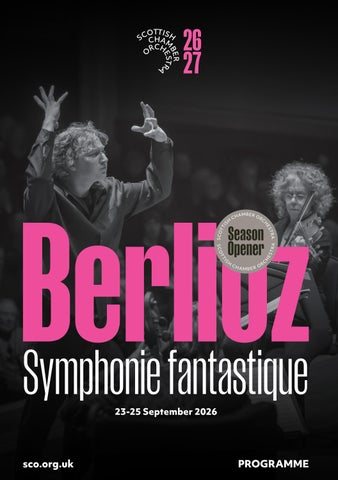
Berlioz Season Opener
Symphonie fantastique 23-25 September 2026
sco.org.uk
PROGRAMME
26/27 Concert Season
Cover image © Christopher Bowen
Berlioz Symphonie fantastique 2026/27 Season Opener With sincere thanks to Donald and Louise MacDonald for their support of this concert and their continued support of the Orchestra
Wednesday 23 September, 7pm Perth Concert Hall Thursday 24 September, 7.30pm Usher Hall, Edinburgh Friday 25 September, 7.30pm City Halls, Glasgow* BERLIOZ Harold in Italy Interval of 20 minutes
BERLIOZ Symphonie fantastique
Timothy Ridout
© Jiyang Chen
Maxim Emelyanychev
© Andrej Grilc
Maxim Emelyanychev conductor Timothy Ridout viola
*This performance will be recorded for the BBC ‘Radio 3 In Concert’ series, due for broadcast on 30 September 2026.
4 Royal Terrace, Edinburgh EH7 5AB +44 (0)131 557 6800 | info@sco.org.uk | sco.org.uk
The Scottish Chamber Orchestra is a charity registered in Scotland No. SC015039. Company registration No. SC075079.
3
THANK YOU
Principal Conductor's Circle Our Principal Conductor’s Circle are a special part of our musical family. Their commitment and generosity benefit us all – musicians, audiences and creative learning participants alike. Annual Fund James and Patricia Cook Visiting Artists Fund Harry and Carol Nimmo Anne and Matthew Richards International Touring Fund Gavin and Kate Gemmell Learning and Participation Fund Jo and Alison Elliot Sabine and Brian Thomson
Productions Fund Geoff and Mary Ball Bill and Celia Carman Anne, Tom and Natalie Usher Scottish Touring Fund Eriadne and George Mackintosh Claire and Anthony Tait New Music Fund Ken Barker and Martha Vail Barker Colin and Sue Buchan David Caldwell Nick and Kate Thomas Kimie Trust
CHAIR SPONSORS The Donald and Louise MacDonald Principal Conductor's Chair Maxim Emelyanychev Chorus Director Gregory Batsleer Anne McFarlane
Cello Eric de Wit Jasmine Macquaker Charitable Fund
Leader Stephanie Gonley Caroline Hahn and Richard Neville-Towle
Principal Double Bass Jamie Kenny Erik Lars Hansen and Vanessa C L Chang
Principal First Violin Afonso Fesch Fiona and Ian Russell
Principal Flute André Cebrián Claire and Mark Urquhart
First Violin Aisling O'Dea Finlay and Lynn Williamson
Sub-Principal Flute Marta Gómez Judith and David Halkerston
First Violin Kana Kawashima Chris and Claire Fletcher
Principal Oboe The Hedley Gordon Wright Charitable Trust
Principal Viola Max Mandel Ken Barker and Martha Vail Barker
Sub-Principal Oboe Katherine Bryer Ulrike and Mark Wilson
Sub-Principal Viola Francesca Gilbert Christine Lessels
Principal Clarinet Maximiliano Martín Stuart and Alison Paul
Viola Steve King Sir Ewan and Lady Brown
Principal Bassoon Cerys Ambrose-Evans Claire and Anthony Tait
Principal Cello Philip Higham Nick and Kate Thomas
Sub-Principal Bassoon Alison Green George Rubienski
Sub-Principal Cello Su-a Lee Ronald and Stella Bowie
Principal Trumpet Peter Franks George Ritchie
Cello Donald Gillan Professor Sue Lightman
Timpani / Percussion Louise Lewis Goodwin Silvia and Andrew Brown
THANK YOU
Funding Partners Core Funder
Benefactor
Local Authority
Broadcast Partner
Media Partner
Funding Partner
Business Partners
Key Funders
Delivered by
Charity Partner
5
THANK YOU
SCO Donors Diamond
Gold
The Cockaigne Fund
Peter Armit
Malcolm and Avril Gourlay
Sir George and Lady Bain
John and Jane Griffiths
Elizabeth Brittin
James and Felicity Ivory
Kate Calder
Anne, Tom and Natalie Usher
Vito Casadio Jo and Christine Danbolt
Platinum
James and Caroline Denison-Pender
E.C. Benton
Andrew and Kirsty Desson
Michael and Simone Bird
David and Sheila Ferrier
John and Maggie Bolton
Iain Gow
Dr Peter Williamson and Ms Margaret Duffy
Margaret Green
Adam Gaines and Joanna Baker
Christopher and Kathleen Haddow
David and Elizabeth Hudson
Catherine Johnstone
Helen B Jackson
Julie and Julian Keanie
Dr and Mrs Peter Jackson
Gordon Kirk
Dr Daniel Lamont
Janey and Barrie Lambie
Graham and Elma Leisk
Mike and Karen Mair
Professor and Mrs Ludlam
Anne McAlister and Philip Sawyer
Chris and Gill Masters
John and Liz Murphy
Paul Maxwell, in loving memory of Ruth Maxwell
Tom Pate
Duncan and Una McGhie
Maggie Peatfield
Anne-Marie McQueen
Alison and Stephen Rawles
David Moncur
Andrew Robinson
Jane Peacock, in memory of Douglas Peacock
Olivia Robinson
Charles Platt and Jennifer Bidwell
Irene Smith
Patrick and Susan Prenter
Dr Jonathan Smithers
Mr and Mrs J Reid
Ian S Swanson
The Walter and Janet Reid Charitable Trust
Ian and Janet Szymanski
Martin and Mairi Ritchie
John-Paul and Joanna Temperley
Elaine Ross
Douglas and Sandra Tweddle
Hilary E Ross
James Wastle and Glenn Craig
Sir Muir and Lady Russell
Catherine Wilson
Jill and Brian Sandford
Neil and Philippa Woodcock
Michael and Elizabeth Sudlow
Georgina Wright
Robert and Elizabeth Turcan Alan and Sue Warner Bill Welsh Anny and Bobby White Robert Mackay and Philip Whitley Ruth Woodburn
Silver
Norman Hazelton
Roy Alexander
Alistair Hector
John Anderson
Ron and Evelynne Hill
Fiona and Neil Ballantyne
Clephane Hume
Timothy Barnes and Janet Sidaway
Tim and Anna Ingold
The Batsleer Family
David and Pamela Jenkins
Jack Bogle
Susannah Johnston and Jamie Weir
Jane Borland
Ross D. Johnstone
Alan Borthwick
James Kelly, in memory of Mairi Kelly
Michael and Jane Boyle
Professor Christopher and Mrs Alison Kelnar
Mary Brady
Dr Ian Laing
Paula and Colin Brown
Geoff Lewis
John Brownlie
Dorothy A Lunt
Laura Buist
Vincent Macaulay
Robert Burns
James McClure, in memory of Robert Duncan
Mr A Campbell
Lucy McCorkell
Sheila Colvin
Gavin McCrone
Lorn and Camilla Cowie
Roy and Svend McEwan-Brown
Adam and Lesley Cumming
Michael McGarvie
Dr Wilma Dickson
Brian Miller
Sylvia Dow
Alistair Montgomerie
Colin Duncan, in memory of Norma Duncan
Norma Moore
Raymond Ellis
Margaret Mortimer and Ken Jobling
Dr and Mrs Alan Falconer
Andrew Murchison
Sheila Ferguson
Douglas Murray
Dr William Irvine Fortescue
John Peutherer, in memory of Audrey Peutherer
Patricia Glennie
James S Potter
Dr David Grant
Alastair Reid
Anne Grindley
Seona Reid and Cordelia Ditton
Andrew Hadden
Catherine Steel
J Martin Haldane
Takashi and Mikako Taji
Ronnie and Ann Hanna
C S Weir
Pamela Andrews and Alan Norton
Roderick Wylie
Roderick Hart
––––– We are indebted to everyone acknowledged here who gives philanthropic gifts to the SCO of £300 or greater each year, as well as those who prefer to remain anonymous. We are also incredibly thankful to the many individuals not listed who are kind enough to support the Orchestra financially on a regular or ad hoc basis. Every single donation makes a difference. Become a regular donor, from as little as £5 a month, by contacting Sadie Purves on 0131 478 8341 or sadie.purves@sco.org.uk.
“ …an orchestral sound that seemed to gleam from within.” THE SCOTSMAN
HM The King Patron Donald MacDonald CBE Life President Joanna Baker CBE Chair Gavin Reid LVO FRSE Chief Executive Maxim Emelyanychev Principal Conductor Andrew Manze Principal Guest Conductor Joseph Swensen Conductor Emeritus Gregory Batsleer Chorus Director Jay Capperauld Associate Composer
© Christopher Bowen
Our Musicians
Your Orchestra Tonight
Information correct at the time of going to print
This concert will be played on natural brass/timpani throughout.
Second Violin Kio Seiler Hatty Haynes Rachel Smith Joana Rodrigues Stewart Webster Kirsty Main Abigail Young Catherine James Sian Holding Viola Francesca Gilbert Elitsa Bogdanova Christine Anderson Rebecca Wexler Kathryn Jourdan Marsailidh Groat Cello Philip Higham Su-a Lee Donald Gillan Eric de Wit Niamh Molloy Robert Anderson
Bass Jamie Kenny Maitiú Gaffney Carlos Navarro Hannah Turnbull Flute André Cebrián Marta Gómez Oboe Clara Schweinberger Katherine Bryer Clarinet Maximiliano Martín William Stafford Bassoon Cerys Ambrose-Evans Alison Green Greg Topping Sarah Nixon Horn Boštjan Lipovšek David Tollington Andy Saunders Anna Drysdale
Trombone Duncan Wilson Nigel Cox Alan Adams Ophicleide Andrew Kershaw Tony George Serpent/Tuba Andrew Kershaw Timpani Louise Lewis Goodwin Laura Bradford Percussion Iain Sandilands Kate Openshaw Colin Hyson Robbie Bremner Harp Eleanor Hudson Sharron Griffiths
Trumpet Simon Bird Shaun Harrold Cornet Peter Franks Brian McGinley
Jamie Kenny Principal Double Bass
© Christopher Bowen
First Violin Bogdan Božović Matthew Ward Elizabeth Wexler Kana Kawashima Aisling O’Dea Huw Daniel Sarah Bevan-Baker Wen Wang Kristin Deeken
What You Are About To Hear BERLIOZ (1803-1869)
Harold in Italy, Op.16, H.68 (1834) Harold in the mountains March of the pilgrims Serenade of an Abruzzo mountaineer Orgy of bandits
BERLIOZ (1803-1869)
Symphonie fantastique, Op.14, H.40 (1830) Daydreams – Passions: Largo – Allegro agitato e appassionato assai A Ball. Waltz: Allegro non troppo Scene in the fields: Adagio March to the Scaffold: Allegretto non troppo Dream of a Witches’ Sabbath: Larghetto – Allegro
Hector Berlioz was a quintessentially Romantic figure. The son of a provincial French doctor who’d expected the lad to follow in his profession, Berlioz instead opted to transform himself into an uncompromising artistic individualist, a musical trailblazer who drew inspiration from literature, landscape and his own turbulent emotional life (as we’ll hear clearly in tonight’s programme). Berlioz’s pioneering use of orchestral colour and musical storytelling opened up unexplored expressive possibilities, and he often conceived music on a colossal scale, mounting spectacular concerts involving hundreds of performers – while dreaming of still more extravagant forces. He seemed to demand that music should not simply satisfy the intellect, but also overwhelm the senses and the emotions. He was fascinated by the interior psychological journeys of the soul, but also by the more literal journeys of the solitary Romantic wanderer. Tonight’s concert represents both of those sides to Berlioz’s musical personality – as well, of course, as celebrating his pioneering and deeply individual approaches to creating music itself. Let’s begin, however, in 1831, and somewhere to the southeast of France. With its resplendent history and iconic cultural achievements – not least the glories of Roman antiquity and the inspirational art and sculpture of the Renaissance – it’s perhaps no surprise that Italy formed the epicentre of many a well-to-do young man’s Grand Tour of Europe during the 18th and early 19th centuries. These were no mere tourist trips, however. The Grand Tour
10
Tonight’s concert represents both of those sides to Berlioz’s musical personality – as well, of course, as celebrating his pioneering and deeply individual approaches to creating music itself. Hector Berlioz
represented what was considered the culmination of a young gentleman’s education, offering him a direct
contest, established during the reign of Louis XIV and only suspended only as recently as 1968. A win would serve to
encounter with Italian art, culture and society, with the aim of cultivating his tastes, broadening his knowledge and – naturally – polishing his all-important manners. Goethe, Byron, Shelley and even Thomas Jefferson all undertook edifying tours of Italy. So did composer Felix Mendelssohn, though not until after he’d explored his more idiosyncratic choice of Scotland as a country of inspirational landscapes and passionate stories. Unusally, Berlioz was far more reluctant to immerse himself in the azure skies and endless sunlight of Italy.
cement a young composer’s reputation in the eyes of French society, bringing enduring fame and respect that in many cases defined their later careers. Berlioz was so keen that he tried no fewer than five times, finally winning in 1830 with his cantata La mort de Sardanapale, after his earlier attempts had been considered far too audaciously forward-looking.
What did drive the young composer, however, was a chance of winning the prestigious Prix de Rome, France’s (and
However, when it came to his prize – a lengthy stay at the Villa Medici in Rome, where he’d be allowed time to compose, free of other commitments – Berlioz did just about all he could to avoid the trip. He argued that remaining in Paris would be far more conducive to his creativity (and even got his friends and fellow
probably Europe’s) loftiest artistic
composers Meyerbeer and Spontini to 11
petition on his behalf). There was also the small matter of his love life: after his obsessive pursuit of Irish-born actress
Italian who was directly responsible for the piece’s commissioning.
Harriet Smithson (which inspired his Symphonie fantastique – we’ll return to her shortly), Berlioz’s affections were currently focused on the pianist and teacher Camille Moke.
Violinist and composer Nicolò Paganini was at that time an international superstar with something of a cult status, a musician so devilishly brilliant in his playing that he was rumoured to be in league with Satan himself (a piece of gossip taken so seriously that it was more than three decades after his death before Paganini was allowed burial in consecrated ground). Paganini had acquired a viola made by legendary luthier Antonio Stradivari, and asked Berlioz for something to showcase the instrument’s distinctive sound. But when Paganini saw Berlioz’s initial ideas for Harold en Italie, he considered he’d be spending far too long out of the limelight, and turned it down (though he still paid the fee they’d agreed). After hearing a performance of the piece in Paris in 1838, however, Paganini was so overwhelmed that he dragged Berlioz
Nonetheless, Berlioz was compelled to fulfill his Roman obligations, though with evident disdain for Italian culture, his sojourn at the Villa Medici was hardly a happy one. In his colourful Mémoires, he’d later describe life in Italy as ‘a continual martyrdom – one’s beautiful musical dreams are dispelled by grim and hopeless reality; every day brings fresh disappointment – while other arts flourish, displaying their manifold beauties, music alone is degraded to the level of a poor hunted slave’. Though it can’t have helped that he bumped into Mendelssohn (who clearly adored the place) in 1831, Berlioz nonetheless took the opportunity to sample the cultures of nearby regions, travelling to Florence, Naples, Genoa, Siena, Pisa and several other cities. (He also made an aborted return to Paris, vowing to murder his former lover Camille Moke, who’d taken up with another man, Camille Pleyel, heir to the piano manufacturing business. Berlioz got as far as Nice before thinking better of the idea.)
on stage, then knelt and kissed his hand before the adoring audience (and later sent him a follow-up gift of 20,000 francs, more than twice Berlioz’s annual earnings).
Nonetheless, following his proper return to Paris in 1834, Berlioz’s years in Italy would go on to colour and shape several of his later compositions – chief among them his ‘symphony with solo viola’
The concept that Berlioz came up with for his unusual piece was based around the poem Childe Harold’s Pilgrimage by Lord Byron, hugely popular at the time. Harold en Italie imagined Byron’s melancholy, introspective wanderer observing scenes from Italian life and landscape – though, as many commentators have pointed out, there are so few specific connections with Byron’s original that the piece might more accurately have been called Berlioz
Harold en Italie. And it was another
en Italie. And despite his misgivings, it
12
Paganini had acquired a viola made by legendary luthier Antonio Stradivari, and asked Berlioz for something to showcase the instrument’s distinctive sound. Nicolò Paganini
demonstrates just how profoundly his months in Italy affected the composer. Though each of Berlioz’s movements has a specific title, Harold en Italie doesn’t follow the same kind of specific storyline that we’ll encounter later tonight in the Symphonie fantastique. Instead, each movement represents a more general scene, in which the solo viola is the hero Harold (or perhaps Berlioz), often more of an observer than a conventional concerto soloist. In the first, ‘Harold in the Mountains’, we meet our protagonist amid the Abruzzo mountains to the east of Rome, a region that Berlioz himself adored. In the second, ‘March of the Pilgrims’, Harold encounters a troupe of devout travellers, themselves famous in literary accounts of Italy at the time. The third movement, ‘Serenade of an Abruzzo Mountaineer’, sees Harold
charming his lover with his music, while the piece concludes with wild, drunken revelry in an ‘Orgy of Bandits’. Harold en Italie received its first performance at the Paris Conservatoire on 23 November 1834, with Chrétien Urhan as soloist, and Narcisse Girard conducting. It went down relatively well (its ‘March of the Pilgrims’ was even encored), but the composer was frustrated by Girard’s many mistakes, and vowed to conduct his own music in future. For tonight’s second piece, we jump back four years to 5 December 1830, when Symphonie fantastique received its premiere, again at the Paris Conservatoire. If Harold en Italie represents Berlioz the lonely wanderer, the solitary hero lost amid a dramatic
landscape, then the Symphonie fantastique turns us inwards to a psychological journey into Berlioz’s mind
received and read, but never replied to), yet never quite summoned the courage to meet her in person. He
and soul.
began sketching out ideas that would transform his unfulfilled passions into music, but it took a rumour – which Berlioz heard in 1830 – that Smithson was having an affair with her manager to spur him into serious composing. The gossip was later proven to be untrue, but the fury and jealousy it inspired in Berlioz gave him the impetus he needed to compose the work – and, no doubt, played a significant role in the story his Symphonie would tell, too.
The question of any relationship between a composer’s life and what they write is always a vexed one. The assumption that the latter naturally mirrors the former – that a composer who’s feeling depressed will compose depressing music, for example – could often not be further from the truth. In the case of Berlioz and his Symphonie fantastique, however, that relationship is intimately close, and comprised of many tentacles that wrap life and music together in a inseparable and sometimes disturbing union. The Symphonie’s origins go back to the evening of 11 September 1827, when the 23-year-old Berlioz watched an Englishlanguage production of Shakespeare’s Hamlet in Paris. The part of Ophelia was played by the 27-year-old Irish actress Harriet Smithson, and Berlioz fell immediately and profoundly in love with her. Or, perhaps more strictly speaking, his passion was probably for some mixture of Smithson the actress and the character of Ophelia, with a strong dose of admiration for Shakespeare too. As he wrote in his Mémoires: ‘the impression made on my heart and mind by her extraordinary talent, nay her dramatic genius, was equalled only by the havoc wrought in me by the poet she so nobly interpreted.’
Indeed, the pioneering innovation that Berlioz undertook in his Symphonie fantastique was quite simply that: it would tell a story. That in itself was nothing particularly new: Beethoven’s Fifth traced a general movement from darkness to light, and his Sixth (the ‘Pastoral’) offered a series of countryside portraits that described the composer’s almost spiritual relationship with nature. Berlioz revered Beethoven, whose symphonies had taken a while to gain serious popularity in France. But in his own Symphonie, Berlioz would go further: he would tell a literal story, with characters, settings and a plot.
And so began several years of obsession and perpetual frustration for the composer, who bombarded Smithson
And if you’re looking for sex and drugs and rock ’n’ roll in classical music, you’d easily find most of those here. (Perhaps not rock ’n’ roll in its literal sense, admittedly, although Berlioz was certainly out to startle, shock and even overwhelm listeners with his radical orchestral techniques.) Symphonie fantastique’s plot can be quite simply summarised. A young artist falls madly
with letter after letter (which she
in love with an unattainable woman.
14
The parallels with Berlioz’s own life and emotions are clear – so clear, in fact, that the composer is effectively telling a heightened, fantasised version of his own story, and his own relationship towards Smithson. Harriet Smithson
She spurns him at a lavish ball, and he retreats to the countryside to lick his wounds. There, however, he poisons himself with opium, and slips into a nightmare in which he believes he’s murdered his beloved. The nightmare continues: he is tried and executed for the killing, and finds himself mocked after his death in a grotesque witches’ sabbath.
context as the piece progresses, but which remains always recognisable, indeed inescapable.
The parallels with Berlioz’s own life and emotions are clear – so clear, in fact, that the composer is effectively telling a heightened, fantasised version of his own story, and his own relationship towards Smithson. His obsession with her is symbolised in another way, too: the unattainable beloved becomes a long, furling, ever-present melody – which Berlioz dubbed the idée fixe (literally
Berlioz realised he was treading new ground with these innovations, even insisting that listeners should be supplied with a written description of the Symphonie’s story (put together by himself, of course) so that they would know what was happening. That in itself proved somewhat controversial. Some were grateful for prior knowledge of the storyline, feeling it offered unusually revealing insights into the music and its workings, but others were less convinced. His fellow composer Robert Schumann felt that the Symphonie could only be understood ‘with a slip of paper in your hand’, and that relying on such a closely followed narrative detracted from a
‘fixed idea’) – that shifts in shape and
direct engagement with the music itself.
Whichever side you agree with, Berlioz’s innovations proved hugely influential, and many later composers went on
where we find ourselves deep inside the artist’s drug-fuelled nightmare. ‘Convinced that his love is spurned, the
to follow and develop his ideas – just think of Wagner’s operas, Liszt’s symphonic poems, even Richard Strauss’ more recent Ein Heldenleben or Eine Alpensymphonie. And whether listeners appreciated Berlioz’s pioneering musical storytelling or not, Symphonie fantastique’s first performance proved a huge success, with the great and the good of the French capital there to celebrate the composer’s achievements.
artist poisons himself with opium. The dose of narcotic, while too weak to cause his death, plunges him into a heavy sleep accompanied by the strangest of visions. He dreams that he has killed his beloved, that he is condemned, led to the scaffold and is witnessing his own execution. The procession advances to the sound of a march that is sometimes sombre and wild, and sometimes brilliant and solemn, in which a dull sound of heavy footsteps follows without transition the loudest outbursts. At the end of the march, the first four bars of the idée fixe reappear like a final thought of love interrupted by the fatal blow.’
To look in more detail at the piece’s five movements, however, let’s turn to Berlioz’s own descriptions. The first movement – the brooding, yearning ‘Reveries – Passions’ – describes ‘those depressions, those groundless joys, that the artist experienced before he first saw his loved one; then the volcanic love that she suddenly inspired in him, his frenzied suffering, his jealous rages, his returns to tenderness, his religious consolations’. In the second, ‘A Ball’, ‘he encounters his loved one at a dance in the midst of the tumult of a brilliant party’, all conveyed in a lavish, unforgettable musical spectacle. In the third movement, the artist retreats to the countryside in the hope of finding peace and respite, hearing a far-off duet between two pipe-playing shepherds. ‘But she appears again, he feels a tightening in his heart, painful presentiments disturb him. One shepherd takes up his simple tune again, the other no longer answers. The sun sets – distant sound of thunder – loneliness – silence.’
The artist is dead, but the Symphonie doesn’t end there. Instead, we travel beyond the grave to ‘Dreams of a Sabbath Night’, complete with a sinister quotation of the Dies irae, the Latin plainchant describing the Day of Judgement. ‘The artist sees himself at a witches’ sabbath, in the midst of a hideous gathering of shades, sorcerers and monsters of every kind who have come together for his funeral. Strange sounds, groans, outbursts of laughter; distant shouts that seem to be answered by more shouts. The idée fixe appears once more, but has now lost its noble and shy character; it is now no more than a vulgar dance tune, trivial and grotesque: it is she who is coming to the sabbath… Roar of delight at her arrival… She joins the diabolical orgy… The funeral knell tolls, a burlesque parody of the Dies irae, the dance of the witches.’
Things take a darker turn in the fourth movement, ‘March to the Scaffold’,
But if it was Harriet Smithson who
The mythologised Smithson might have remained immortal, trapped in time and in the sounds of the Symphonie you hear this evening. The real-life Smithson, however, paid a considerable personal price for her relationship with the wild, radical, unashamedly individualist composer.
inspired Berlioz’s wild, hallucinatory Symphonie, what became of her and Berlioz? It’s quite a tragic story. In the
premiere, Berlioz’s star seemed to shine ever brighter, while Smithson’s acting career inexorably declined. They finally
end, it was the Symphonie fantastique itself that brought them together: Smithson accepted the composer’s invitation to hear him conduct it in December 1832, unaware that she was the piece’s subject matter. Upon realising, and understanding the depth of Berlioz’s feelings, she grew somewhat closer to him, and they eventually married on 3 October 1833.
separated in 1844, and Berlioz began an affair with opera singer Marie Recio.
Perhaps predictably, the union was a disaster. Despite an early period of what seems like genuine love and affection – around the time that their son, Louis, was born – the marriage quickly became intolerable for both Smithson and Berlioz. It didn’t help that, in the years following Symphonie fantastique’s
He never abandoned Smithson entirely, however, continuing to support her financially and emotionally, even as she suffered a series of strokes and a progressive paralysis, going on to die in March 1854 at the age of 53. The mythologised Smithson might have remained immortal, trapped in time and in the sounds of the Symphonie you hear this evening. The real-life Smithson, however, paid a considerable personal price for her relationship with the wild, radical, unashamedly individualist composer. © David Kettle
Maxim Emelyanychev
© Christopher Bowen
Conductor
Maxim Emelyanychev has been Principal Conductor of the Scottish Chamber Orchestra since 2019. He is also Chief Conductor of period-instrument orchestra Il Pomo d’Oro, and became Principal Guest Conductor of the Swedish Radio Symphony Orchestra from the 2025/26 Season. Born in Nizhny Novgorod, Emelyanychev made his conducting debut at the age of 12, and later joined the class of eminent conductor Gennady Rozhdestvensky at the Moscow Conservatoire. Emelyanychev was initially appointed as the SCO’s Principal Conductor until 2022; the relationship has been extended three times, to 2025, 2028 and most recently to 2031. He has conducted the SCO at the Edinburgh International Festival and the BBC Proms, as well as on several European tours and in concerts right across Scotland. He has also made three recordings with the SCO, of symphonies by Schubert and Mendelssohn (Linn Records). Emelyanychev has also conducted many international ensembles including the Berlin Philharmonic, Royal Concertgebouw Orchestra, Orchestra dell'Accademia Nazionale di Santa Cecilia, Deutsches Symphonie-Orchester Berlin, Rotterdam Philharmonic Orchestra, Finnish Radio Symphony Orchestra, Seattle Symphony and Orchestra of the Age of Enlightenment. In the opera house, Emelyanychev has conducted Handel’s Rinaldo at Glyndebourne, the same composer’s Agrippina as well as Mozart’s The Magic Flute at the Royal Opera House, Covent Garden, and Mozart’s Die Entführing aus dem Serail at the Opernhaus Zürich. He has also conducted Mozart’s Die Zauberflöte, Così fan tutte, La clemenza di Tito and Don Giovanni with the SCO at the Edinburgh International Festival. He has collaborated closely with US soprano Joyce DiDonato, including international touring and several recordings. Among his other recordings are keyboard sonatas by Mozart, and violin sonatas by Brahms with violinist Aylen Pritchin. He has also launched a project to record Mozart’s complete symphonies with Il Pomo d’Oro. In 2019, he won the Critics’ Circle Young Talent Award and an International Opera Award in the newcomer category. He received the 2025 Herbert von Karajan Award at the Salzburg Easter Festival. Maxim's Chair is kindly supported by Donald and Louise MacDonald
Viola
© Jiyang Chen Bowen
Timothy Ridout
Timothy Ridout’s recent schedule has featured appearances with many top international orchestras including BBC Symphony Orchestra/Hannu Lintu, Orchestre de Paris/ Lorenza Borrani, Die Deutsche Kammerphilharmonie Bremen/Ed Gardner, Nederlands Philharmonisch Orkest/Sir Mark Elder and Dresden Philharmonic Orchestra/Donald Runnicles. A popular soloist for many conductors, Richard Egarr takes him to Residentie Orkest, Roberto Abbado to the Orchestra Filarmonica di Bologna, Mark Wigglesworth to the Bournemouth Symphony Orchestra, and Anthony Hermus to the Ulster Orchestra. In addition, he continues his close relationship with Sir Simon Rattle for Berlioz’ Harold in Italy on gut strings with Orchestra of the Age of Enlightenment for concerts in London and Dublin. Following the successful world premiere of Mark Simpson’s Viola Concerto Hold Your Heart in Your Teeth with the Deutsches Symphonie-Orchester Berlin and Robin Ticciati, Ridout brings the work to Royal Liverpool Philharmonic with Andrew Manze, Musikkollegium Winterthur with Alexandre Bloch and Philharmonie Zuidnederlands with Duncard Ward. Timothy Ridout performs on a 1565 – 75 viola by Peregrino di Zanetto, generously on loan from a patron of the Beare’s International Violin Society. For full biography please visit sco.org.uk
Scottish Chamber Orchestra The Scottish Chamber Orchestra (SCO) is one of Scotland’s five National Performing Companies and has been a galvanizing force in Scotland’s music scene since its inception in 1974. The SCO believes that access to world-class music is not a luxury but something that everyone should have the opportunity to participate in, helping individuals and communities everywhere to thrive. Funded by the Scottish Government, City of Edinburgh Council and a community of philanthropic supporters, the SCO has an international reputation for exceptional, idiomatic performances: from mainstream classical music to newly commissioned works, each year its wide-ranging programme of work is presented across the length and breadth of Scotland, overseas and increasingly online. Equally at home on and off the concert stage, each one of the SCO’s highly talented and creative musicians and staff is passionate about transforming and enhancing lives through the power of music. The SCO’s Creative Learning programme engages people of all ages and backgrounds with a diverse range of projects, concerts, participatory workshops and resources. The SCO’s current fiveyear Residency in Edinburgh’s Craigmillar builds on the area’s extraordinary history of Community Arts, connecting the local community with a national cultural resource. An exciting new chapter for the SCO began in September 2019 with the arrival of dynamic young conductor Maxim Emelyanychev as the Orchestra’s Principal Conductor. His tenure has recently been extended until at least 2031. The SCO and Emelyanychev released their first album together (Linn Records) in 2019 to widespread critical acclaim. Their second recording together, of Mendelssohn symphonies, was released in 2023, with Schubert Symphonies Nos 5 and 8 following in 2024. The SCO also has long-standing associations with many eminent guest conductors and directors including Principal Guest Conductor Andrew Manze, Pekka Kuusisto, François Leleux, Nicola Benedetti, Isabelle van Keulen, Anthony Marwood, Richard Egarr, Mark Wigglesworth, Lorenza Borrani and Conductor Emeritus Joseph Swensen. The Orchestra’s current Associate Composer is Jay Capperauld. The SCO enjoys close relationships with numerous leading composers and has commissioned around 200 new works, including pieces by Sir James MacMillan, Anna Clyne, Sally Beamish, Martin Suckling, Einojuhani Rautavaara, Karin Rehnqvist, Mark-Anthony Turnage, Nico Muhly and the late Peter Maxwell Davies.
© Christopher Bowen
Biography
SEASON 26/27 Explore our new season today at sco.org.uk Gordon Bragg Sub-Principal Second Violin Photo: Christopher Bowen
FOR THE LOVE OF MUSIC Company Registration Number: SC075079. A charity registered in Scotland No. SC015039.
1-2 October, 7pm Edinburgh | Glasgow
St Matthew Passion Maxim Emelyanychev conductor/chamber organ
Roderick Williams baritone
Nick Pritchard Evangelist
SCO Chorus
Matthew Brook Jesus
Gregory Batsleer chorus director
Hilary Cronin soprano
Choristers of St Mary’s Episcopal Cathedral
Tim Mead counter tenor
Duncan Ferguson Master of the Music,
Robert Murray tenor
St Mary’s Episcopal Cathedral
Tickets at sco.org.uk
Choral Company Registration Number: SC075079. A charity registered in Scotland No. SC015039.
For the love of music Each year, the SCO must fundraise around £1.3 million to bring extraordinary musical performances to the stage and support groundbreaking education and community initiatives beyond it. If you share our passion for transforming lives through the power of music and want to be part of our ongoing success, we invite you to join our community of regular donors. Your support, no matter the size, has a profound impact on our work – and as a donor, you’ll enjoy an even closer connection to the Orchestra. To learn more and support the SCO from as little as £5 per month, please contact Sadie Purves on 0131 478 8341 or sadie.purves@sco.org.uk.
The SCO is a charity registered in Scotland No SC015039. Photo: Fraser Band