
A Hermeneutical Dilemma from Herodotus to Luke
Band 65
Im Auftrag der Schweizerischen Vereinigung für Altertumswissenschaft herausgegeben von Cédric Brélaz, Ulrich Eigler, Gerlinde Huber-Rebenich und Paul Schubert
M. Morgan
A Hermeneutical Dilemma from Herodotus to Luke
Schwabe Verlag
Published with the support of the Swiss National Science Foundation.
Open Access : Unless otherwise stated, this publication is licensed under the Creative Commons Attribution-NonCommercial-NoDerivatives 4.0 International ( CC BY-NC-ND 4.0 ) licence.
Any commercial exploitation by others requires the prior consent of the publisher. The use of content for the purpose of developing or training AI systems without the consent of the publisher is prohibited.
Bibliographic information published by the Deutsche Nationalbibliothek
The Deutsche Nationalbibliothek lists this publication in the Deutsche Nationalbibliografie ; detailed bibliographic data are available on the Internet at http ://dnb.dnb.de
© 2026 by James M. Morgan, published by Schwabe Verlag Basel, Schwabe Verlagsgruppe AG, Basel, Schweiz
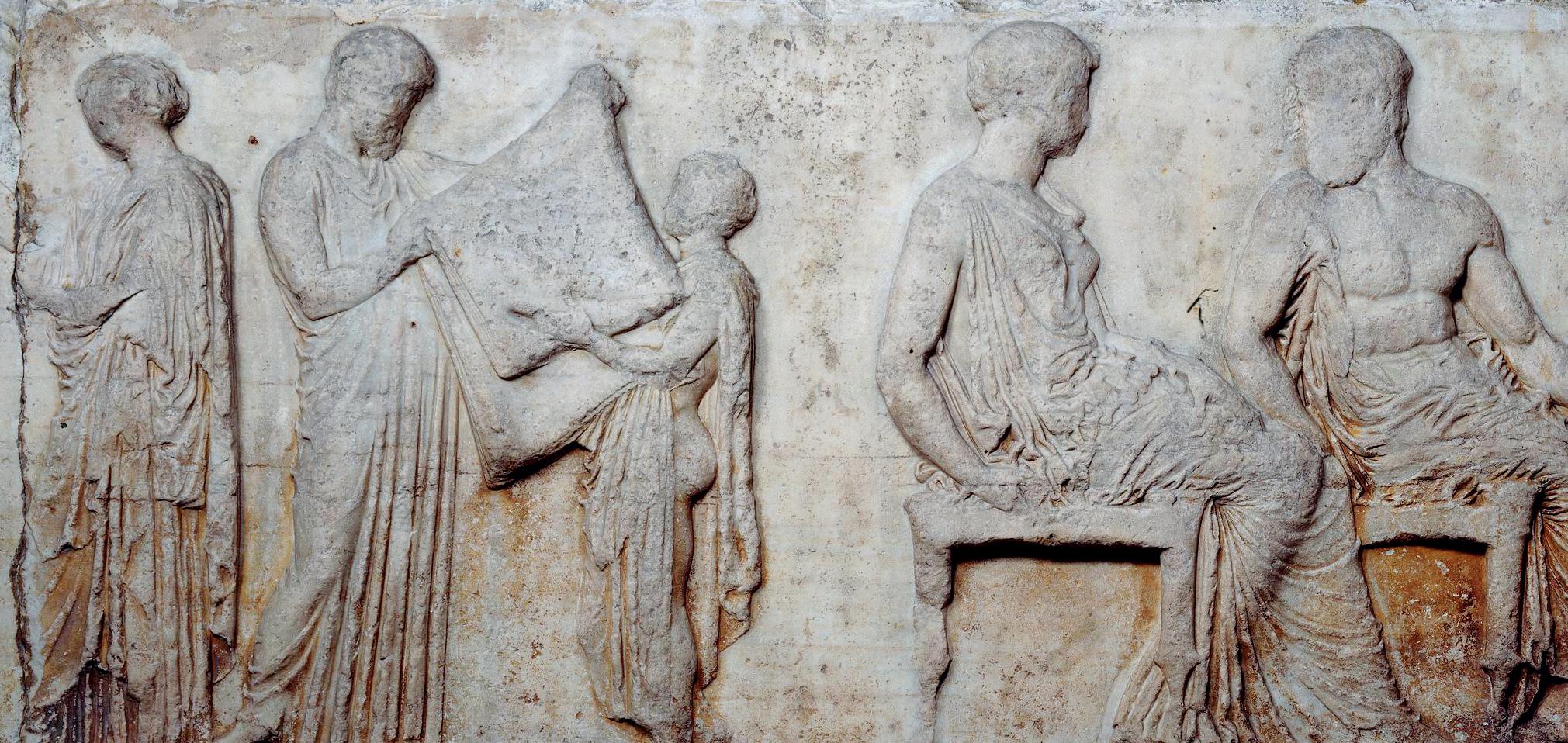
Cover illustration : Marble relief, Slab V from the East Frieze of the Parthenon –central scene : Zeus and Hera seated next to a standing man receiving the folded peplos from a young boy. © The Trustees of the British Museum
Copyediting : Kate Bird, Berlin Graphic design : icona basel gmbh, Basel Cover design : icona basel gmbH, Basel
Cover : Kathrin Strohschnieder, Stroh Designagentur, Oldenburg
Typesetting : 3w+p, Rimpar
Print : Prime Rate Kft., Budapest
Printed in the EU
Manufacturer information : Schwabe Verlagsgruppe AG, St. Alban-Vorstadt 76, CH-4052 Basel, info@schwabeverlag.ch
Responsible person under Art. 16 GPSR : Schwabe Verlag GmbH, Marienstraße 28, D-10117 Berlin, info@schwabeverlag.de
ISBN Print 978-3-7965-5495-7
ISBN eBook ( PDF ) 978-3-7965-5496-4
DOI 10.24894/978-3-7965-5496-4
The ebook has identical page numbers to the print edition ( first printing ) and supports full-text search. Furthermore, the table of contents is linked to the headings.
rights@schwabe.ch www.schwabe.ch
In memory of James Harry Morgan (1930 – 2025 ) my kind and patient father
Preface
Part I Herodotus’ Hermeneutical Dilemma and His Table of Historians with Prophetic-like Voices
1 Herodotus’ Hermeneutical Dilemma, Prophet-like Voice, and an Estranged Heir Named Luke
1.1 Framing the Question around Herodotus’ Imaginary Meeting with his Historiographical Heirs
1.2 The Hermeneutical Dilemma : Divine Agency and Historiography ( An Ancient Problem ) 31
1.3 Modern
1.4 Addressing the Hermeneutical Dilemma via Ancient Reception History, the Prophetic Voice of Historiography, and Its Demonstration in Herodotus and
2.2.3 Roman Imperial Period : Some Key Contemporaries of Luke
2.3 Conclusion : Various Theistic Views Shaping the Hermeneutical Dilemma of Greek Historiography
3 The Prophet-like Voice of Historiography : Writing the Divine as One’ s Audience Expects
3.1 Introduction
3.2 The Rhetorical Aspect of Historiography : An Author-Audience Complicity
3.3 ‘Prophetic history’, ‘Prophetic historiography’ or ‘Prophetic voice’?
3.4 Reading the Historians Theologically through Their Prophetic Voices : A Methodology .
3.5 Conclusion
Part II Herodotus and Luke : Preparing to Hear Their Prophetic Voices
4 Connecting Herodotus and Luke : Their Worlds, Incipits, and Multicultural Audiences
4.1 Their Lives and Worlds : Powers in Conflict and Flux
4.1.1 Herodotus and His World
4.1.2 Luke and His World
4.2 Herodotus and Luke’ s
The Histories
4.3.2 Luke-Acts
4.4 Conclusion
5 Extending Theistic Metanarratives : The Divine Plupast in Herodotus’ Histories and in Luke-Acts
5.1 The Plupast in Historiography
5.1.1 The Historian’ s Plupast
5.1.2 The Plupast’ s Value for Historiographical Research .
5.1.3 Theistic Metanarratives via the Historian’ s Plupast
5.2 Extending Theistic Metanarratives through a Divine Plupast in the Histories and in Luke-Acts .
5.2.1 Divine Plupast on the Macronarrative Level in the Histories
5.2.2 Divine Plupast on the Macronarrative Level in Luke-Acts
5.3 Key Divine Plupast Passages and ‘Forms of reference’ on the Micronarrative Level
5.3.1 The Divine Plupast in Solon’ s Visit to Croesus ( Hist. 1.29 –33 )
5.3.2 Luke’ s Use of the Divine Plupast in the Devil’ s Counterproposal ( Luke 4 :1– 13 ) .
5.4 Conclusion
6 Divine Constellations of Herodotus’ Histories and Luke-Acts
6.1 The Divine and Proofs of Activity (τεκμήρια): A Common Assumption of Herodotus and Luke
6.2 Perceptions of Divine Beings
6.2.1 The Histories
6.2.2 Luke-Acts .
6.3 Conclusion
Part III Hearing Herodotus’ Prophetic Voice
7.1 Introduction : A Narratological and Theological Reading of the Geopolitical Intrigue
7.2 Croesus and Divine Retribution ( Hist. 1.26 – 92 )
7.3 Cyrus and the Continuing Subjugation of the Greeks in Ionia ( Hist. 1.95 – 216 )
7.4 Cambyses’ Campaigns against Egypt and Ethiopia ( Hist. 2.1–3.66 )
7.5 Conclusion
8
Darius under Divine Rule : Persia’ s First Invasion of Greece ( Hist. End of Book 3, Books 4 – 6 )
8.1 Introduction
8.2 The Accession of Darius and the Beginnings of his Reign ( Hist. 3.61– 160 )
8.3 Darius against the Scythians and the Libyans ( Hist. 4.1– 205 ) .
8.4 Darius’ Subjugation of Thrace and Re-subjugation of Ionia ( Hist. 5.1– 126 ) .
8.5 End of the Ionian Revolt, Sparta’ s Intrigues, and Athenian Victory at Marathon ( Hist. 6.1– 140 )
8.6 Conclusion
9 Xerxes under Divine Rule : Persia’ s Second Invasion of Greece ( Hist. 7.1– 9.122 )
9.1 Xerxes and Hellas : The Land that Only Xerxes Ought to Own ( Hist. 7.1– 239 )
9.1.1 Preparations for the Invasion ( Hist. 7.1– 25 )
9.1.2 The March to and over the Hellespont Bridge ( Hist. 7.26 –56 )
9.1.3 The Persians’ March from the Hellespont to Therma ( Hist. 7.57– 131)
9.1.4 Greek Leaders and City-States Respond to Athens’ Plea for Help ( Hist. 7.132 – 77 )
9.1.5 Military Conflict on Land and Sea around Thermopylae ( Hist. 7.178 – 239 )
9.2 The Battles of Artemisium and Salamis ( Hist. 8.1– 144 )
9.2.1 Artemisium and Greek Retreat ( Hist. 8.1– 39 )
9.2.2 Prelude to Salamis via the Fall of Athens ( Hist. 8.40 –83 )
9.2.3 The Battle of Salamis ( Hist. 8.84 – 96 )
9.2.4 Xerxes’ Retreat and Mardonius’ Actions ( Hist. 8.97–144 ) .
9.3 Xerxes and Mardonius as Co-antagonist and Xerxes’ Downfall ( Hist. 9.1– 122 )
9.3.1 On the Way to Plataea ( Hist. 9.1– 24 )
9.3.2 The Battle of Plataea ( Hist. 9.25 –89 ) . .
9.3.3 The Battle of Mycale ( Hist. 9.90 – 107 )
9.3.4 Coda : The Final Victory over the Persians (9.108 – 122 ) .
9.4 Conclusion
10 Divine Rule in Luke-Acts ( Volume 1 : Luke 1 :1– 24 :53 )
10.1 Introduction
10.2 Synopsis of the Periods of Narrated Time and Redaction with regard to the Roman Empire
10.3 Review of the Divine Plupast from a Geopolitical and Theological Perspective ( Luke 1 :5 – 4 :13 ) .
10.4 The Development of the Agōn between Divine and Human Rule in Galilee ( Luke 4 :14 – 9 :50 ) .
10.5 The Development of the Agōn on the Way to Jerusalem ( Luke 9 :51– 19 :44 )
10.6 The Escalation of the Agōn between Divine and Human Rule in Jerusalem ( Luke 19 :45 – 24 :53 )
10.7 Conclusion
11 Divine Rule in Luke-Acts : From Jerusalem to Asia Minor ( Volume 2 : Acts 1 :1– 15 :35 )
Introduction to the Ensuing Agōn from Jerusalem to Rome
Outline and Narrative Focus of Luke-Acts : Volume 2
11.3 Section 1 : Divine Rule Continues and Clashes with Human and Spiritual Rule in Jerusalem ( Acts 1 :1– 7 :60 )
Focus Passages of Luke’ s Prophetic Voice and the Agōn. Pentecost and Peter’ s Speech (2 :1– 42 )
11.4 Section 2 : Divine Rule Extends the Agōn throughout Judea, Samaria, and Syria ( Acts 8 :1– 12 :25 )
Focus Passages of Luke’ s Prophetic Voice and the Agōn
11.5 Section 3 : Divine Rule Moves the Agōn westward to Cyprus and Asia Minor ( Acts 13 :1– 15 :35 )
Focus Passage of Luke’ s Prophetic Voice and the Agōn
11.6 Conclusion for Sections 1– 3 ( Acts 1 :1– 15 :35 )
12
Divine Rule in Luke-Acts : From Antioch to Europe and Rome ( Volume 2 : Acts 15 :36 – 28 :31)
12.1 Introduction
12.2
12.3
12.4
Section 4 : Divine Rule Crosses into Europe ( Acts 15 :36 – 18 :22 )
Focus Passages of Luke’ s Prophetic Voice and the Agōn
Section 5 : Divine Rule Clashes with Human Rule in Asia Minor with a Focus on Ephesus ( Acts 18 :23 – 20 :38 )
Focus Passage of Luke’ s Prophetic Voice and the Agōn
Section 6 : Divine Rule at the Centre of the Agōn in Judea and Jerusalem ( Acts 21 :1– 23 :30 )
Focus Passage of Luke’ s Prophetic Voice and the Agōn
12.5 Section 7 : Divine Rule Brings the Agōn to Imperial-ruled Caesarea ( Acts 23 :31– 26 :32 )
12.6 Section 8 : Divine Rule Comes to Rome and the Agōn Continues ( Acts 27 :1– 28 :31)
Passage of Luke’ s Prophetic Voice and the Agōn
12.7 Conclusion for Sections 4 –8 ( Acts 15 :36 – 28 :31)
13 Conclusion : Prophetic-like Voices : From Herodotus to Luke ?
13.1 Herodotus’ Table of Historians and the Building Blocks of their Craft
13.2 The Rhetorical Force of the Historians’ Prophetic-like Voices : Perceptions of the Divine to Address their Audiences’ Questions and Interests
13.3 Further Research Building on the Herodotus –Luke Axis and Herodotus’ Table of Historians
I : The Meaning of ‘Miracles’ in Herodotus’ Miraculous Story
III : Divine Activity in the Acts of the Apostles
Section 1 : Divine Rule Continues and Clashes with Human and Spiritual Rule in Jerusalem ( Acts 1 :1– 7 :60 )
Section 2 : Divine Rule Extends the Agōn throughout Judea, Samaria, and Syria ( Acts 8 :1– 12 :25 )
Section 3 : Divine Rule Moves the Agōn westward to Cyprus and Asia Minor ( Acts 13 :1– 15 :35 )
Section 4 : Divine Rule Crosses into Europe ( Acts 15 :36 – 18 :22 )
Section 5 : Divine Rule Clashes with Human Rule in Asia Minor : Focus on Ephesus ( Acts 18 :23 – 20 :38 )
Section 6 : Divine Rule at the Centre of the Agōn in Judea and Jerusalem ( Acts 21 :1– 23 :30 )
Section 7 : Divine Rule Brings the Agōn to Imperial-ruled Caesarea ( Acts 23 :31– 26 :32 )
Section 8 : Divine Rule Comes to Rome ; the Agōn Continues ( Acts 27 :1–28 :31)
I would like to express my heartfelt thanks to the groups and individuals below who encouraged me to persevere at various stages of my journey. Firstly, I would like to thank my parents, James Harry and Margaret Morgan, for instilling in me a sense of curiosity. I have dedicated this book to my late father because of his influence on me in the fields of languages and classical studies. He was a gifted and patient Latin teacher, and I benefited from his help with my homework ! He was always eager to learn how my research was combining classical and biblical studies. Although my mother was unable to fulfil her dream of further study, she taught me a very practical reflex to tough questions : “Go get the encyclopaedia !”
To my colleagues and friends in the field of Classics : I would like to acknowledge the influence and kindness of the late John Moles (1949 – 2015 ), a perceptive and generous scholar. His thought-provoking discussions and emails on Luke-Acts in relation to classical literature were invaluable. Without his inspiring insights, this book would have turned out very differently. This book is tangible proof that his legacy continues to be appreciated and explored in the Classics and Biblical Studies.
I would like to express my sincere gratitude to Cédric Brélaz, Daniel Crosby, and Anthony Ellis for their generous feedback on my project and suggestions on how to bridge the disciplines of Classics and Theology during the early stages of this study. I would also like to thank John Marincola for his valuable advice on publication matters. My sincerest thanks go especially to Edward Armstrong, who read every chapter and provided countless substantial suggestions for improving my project. I look forward to his publications and collaborating with him in the future. The ‘Herodotus Helpline’, a community of exceptional and kind scholars, has had an immense influence on me. In particular, I would like to thank Tom Harrison and Jan Haywood, the pioneers of this research group during the COVID-19 pandemic, who gave me the opportunity to present my project and receive valuable feedback.
To my colleagues and friends in Biblical Studies : I would like to thank Luc Devillers, Philippe Lefebvre, and Thomas Schumacher for sponsoring my Habilitation proposal, as well as the fantastic group of classicists and biblical scholars at the 2017 conference at the University of Fribourg. This resulted in a stimulating publication : Le corpus lucanien ( Luc-Actes ) et l’ historiographie ancienne : quels rapports ? I would also like to thank my colleagues and students at the HET-PRO and the Faculty of Theology at the University of Fribourg who supported me et m’ ont supporté avec beaucoup de patience ! Thanks also to Gudrun Nassauer,
francophone chair of New Testament, for her friendship and support of this project. I would also like to thank my colleagues from the Acts seminar of the British New Testament Society for their encouragement and support, especially Paul Wilson, who persevered through the chapters on Herodotus and provided insightful feedback on Luke and Acts.
I would like to express my gratitude to the committee of the Schweizerische Beiträge zur Altertumswissenschaft for their engaging and practical response to my book proposal. In particular, I thank Paul Schubert for his invaluable suggestions and corrections for improving the work and Arlette Neumann for her professional advice on publishing with Schwabe, her precise corrections, and her support in obtaining the generous financial support from the Swiss National Scientific Foundation to make this book available open access. Likewise, many thanks go to Arlette Neumann and Ruth Vachek at Schwabe Verlag for their painstaking work of reformatting all the footnotes and bibliography ( from SBL to Schwabe formats ), as well as for identifying numerous syntactic and typographical errors. Any remaining oddities and mistakes are my responsibility.
Finally, I would like to express my deepest gratitude and love to our beloved and ever-growing Morgan clan in Switzerland, with Lilian as our hero ! Preface
This study follows the SBL Handbook of Style : For Biblical Studies and Related Disciplines (2nd ed., Atlanta : SBL Press, 2014 ) and in some cases the Oxford Classical Dictionary (4th ed., Oxford : Oxford University Press, 2012 ).
Translations of biblical and other ancient texts are my own, except where otherwise indicated.
Critical editions to Herodotus’ Histories
– C. Hude, Herodoti Historiae, 2 vols, 3rd ed. ( Oxford 1927 ).
– N. G. Wilson, Herodoti Historiae, 2 vols. ( Oxford 2015 ).
Translations of Herodotus’ Histories often cited
– Histories ( de Sélincourt ): Herodotus. The Histories, Translated by Aubrey de Sélincourt. Penguin Classics. Revised with Introduction and Notes by John Marincola ( London 2003 ).
– Histories ( Waterfield ): Herodotus. The Histories. Translated by Robin Waterfield. Oxford World’ s Classics. With an Introduction and Notes by Carolyn Dewald ( Oxford 2008 ).
–
Persian Wars ( LCL 117– 120 ): Herodotus. The Persian Wars, Volumes I –IV, Translated by A. D. Godley. LCL 117– 120 ( Cambridge 1920 – 1925 ).
Abbreviations to lexicons
– BDAG : Danker, Frederick W., Walter Bauer, William F. Arndt, and F. Wilbur Gingrich, eds., Greek-English Lexicon of the New Testament and Other Early Christian Literature, 3rd ed. ( Chicago 2000 ).
– MGS : Montanari, Franco, The Brill Dictionary of Ancient Greek, Edited by Madeleine Goh and Chad Schroeder ( Leiden 2015 ).
–
LN : Louw, Johannes P., and Eugene A. Nida. Greek-English Lexicon of the New Testament Based on Semantic Domains. 2 vols. ( New York 1988 –89 ).
– LSJ : Liddell, Henry George, Robert Scott, Henry Stuart Jones, A Greek-English Lexicon, 9th ed. with revised supplement ( Oxford 1996 ).
– Powell : Powell, J. Enoch, A Lexicon to Herodotus ( Cambridge 1938 ; repr. Hildesheim 1977 ).
Conventions and Abbreviations
Bible texts – LXX : Septuaginta, edited by Alfred Rahlfs, Editio altera by Robert Hanhart ( Stuttgart 2006 ).
– NA28 : Novum Testamentum Graece, Nestle-Aland, 28th ed. ( Stuttgart 2012 ).
Herodotus’ Hermeneutical Dilemma and His Table of Historians with Prophetic-like Voices