C. BAY, A. ELLIS, J. MANIA, S. MOSCONE, L. TRÖGER ( eds.)
C. BAY, A. ELLIS, J. MANIA, S. MOSCONE, L. TRÖGER ( eds.)

Carson
Bay, Anthony Ellis, Judith Mania, Sara Moscone and Lena Tröger (eds.)
Reception &Reinvention in Western Europe
Schwabe Verlag
PublishedwiththesupportoftheSwissNationalScienceFoundation.
OpenAccess:Unlessotherwisestated,thispublicationislicensedundertheCreative CommonsAttribution-NonCommercial-NoDerivatives4.0International(CCBY-NC-ND4.0) licence.
Anycommercialexploitationbyothersrequiresthepriorconsentofthepublisher.
BibliographicinformationpublishedbytheDeutscheNationalbibliothek
TheDeutscheNationalbibliothekliststhispublicationintheDeutscheNationalbibliografie; detailedbibliographicdataareavailableontheInternetathttp://dnb.dnb.de.
© 2025bytheauthors;editorialmattersandcompilation © 2025CarsonBay,AnthonyEllis, JudithMania,SaraMosconeandLenaTröger,publishedbySchwabeVerlagBasel, SchwabeVerlagsgruppeAG,Basel,Schweiz
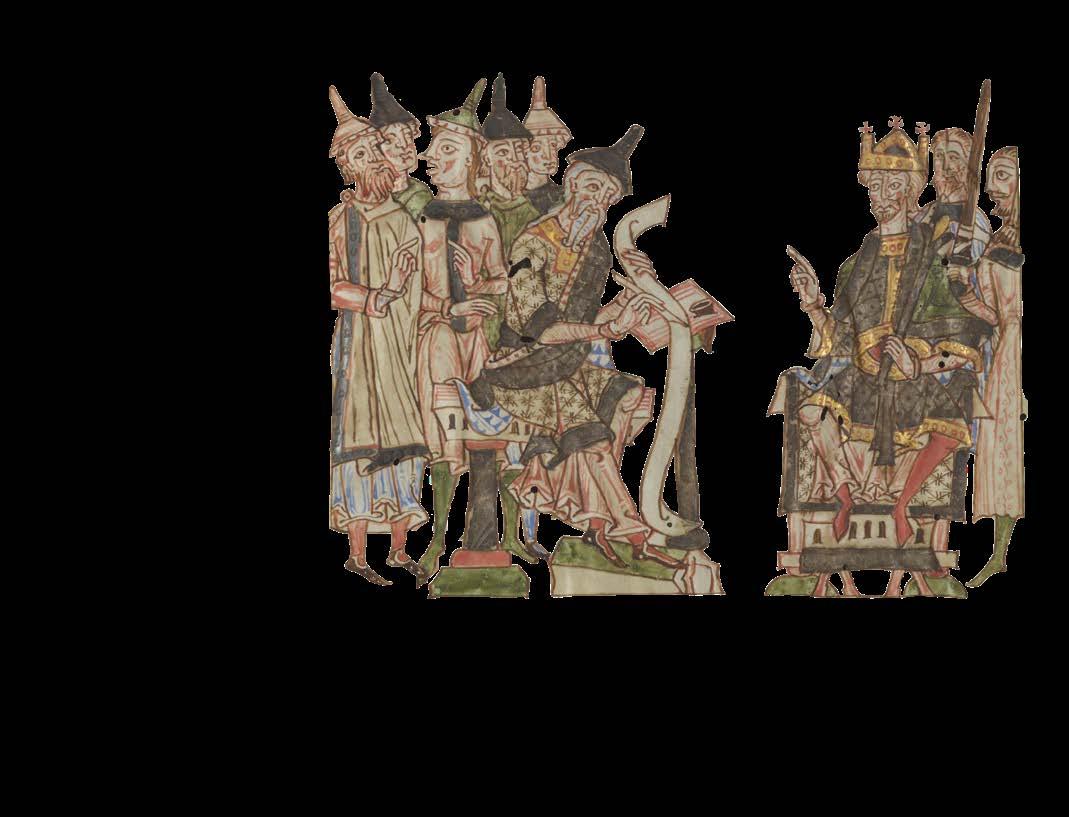
Coverillustration:FuldaHessischeLandesbibliothek,100C1,flyleaf(Josephuspresents hisworkstotheEmperorVespasian)
Copyeditingandindexing:JannaBüchi
Cover:iconabaselgmbh,Basel
Typesetting:3w+p,Rimpar
Print:PrimeRateKft.,Budapest
PrintedintheEU
Manufacturerinformation:SchwabeVerlagsgruppeAG, St.Alban-Vorstadt76,CH-4052Basel,info@schwabeverlag.ch
ResponsiblepersonunderArt.16GPSR:SchwabeVerlagGmbH, Marienstraße28,D-10117Berlin,info@schwabeverlag.de ISBNPrint978-3-7965-5259-5
ISBNe-Book(PDF)978-3-7965-5260-1
DOI10.24894/978-3-7965-5260-1
Thee-Bookhasidenticalpagenumberstotheprintedition(firstprinting)andsupports full-textsearch.Furthermore,thetableofcontentsislinkedtotheheadings.
rights@schwabe.ch www.schwabe.ch
Introduction.CarsonBay&AnthonyEllis:TheMedievalAfterlife ofHellenisticJudaisminLatinEurope ...................................
Chapter1.JohannesHeil:Der«Philo-Filter»–JüdischeAutoren inchristlicherÜberlieferung ........................................... 31
Chapter2.SimonBellmann:DiezweiKontextedesBriefdesMordechaian AlexanderdenGrossen:derlateinischeAlexanderromanund dashellenistischeJudentum?...........................................
Chapter3.AnthonyEllis:TheChristianNotionof“JewishHeresies” inLateAntiquityandtheMiddleAges ................................... 83
Chapter4.JudithMania:FramingJosephus:Annotationsand OtherParatextsintheLatinManuscripts ................................ 121
Chapter5.SaraMoscone:Josephus,Comestor,andWomeninBiblicalLaw: ExcerptsfromNumbersandDeuteronomy .............................. 161
Chapter6.GretiDinkova-Bruun:TheDeVaspasiano: AnAnonymousVersificationofJosephus’sBellumjudaicum fromtheLaterMiddleAges 181
Chapter7.LutzDoering:TheBustsofPhilofromtheHighAltarpiece intheMünsterCathedralTreasure ...................................... 201
Chapter8.BrianHamm:FromJerusalemtoTenochtitlán: TheInfluenceofFlaviusJosephusonEarlyModernSpanish ComprehensionsoftheNewWorld ..................................... 225
Chapter9.DanielSteinKokin:OntheRhetoricofRevelation: TheHellenisticMosesintheItalianRenaissance ......................... 245
Chapter10.MeirBenShahar:“And,moreover,everyonereliesuponJoseph benGorionha-Kohen”:AbrahamZacuto,FlaviusJosephus,and theBeginningsofModernJewishHistoriography ........................
Chapter11.JoannaWeinberg:Heide,KirchenvateroderRabbi?
DieKontroverseumPhilonvonAlexandriaimEuropa derfrühenNeuzeit
Chapter12.RenéBloch:ShiftingGrounds:Azariahde’Rossi’s HebrewTranslationoftheLetterofAristeas
Chapter13.KatharinaHeyden:«EinjüdischerMann,(aber) wahrheitsliebend»:JosephusinByzanz
Chapter14.JacobA.Lollar:JosephusasaScripturalAuthor intheChristianEast
Chapter15.CarsonBay:TheSemiticJosephusTraditions: Maria’steknophagiainSyriac,Hebrew,Judeo-Arabic,Copto-Arabic, andEthiopic
Afterword.RenéBloch,KatharinaHeyden,GerlindeHuber-Rebenich: LookingBackattheLegeIosephum!Project (UniversityofBern,2019–2024).
It is our pleasure to express our gratitude to Gerlinde Huber-Rebenich, René Bloch and Katharina Heyden for their inspiration and support during the many enjoyable years of the Lege Josephum! project, from whose final conference this bookemerged.WearegratefultoArletteNeumannforaccompanyingthevolume from its conception and working so closely with us during its development. Our particularthanksgo toJannaBüchiforher carefulproof-readingandindexingof the entire volume, and to Makbule Rüschendorf for her work on the images and layout.
C.B.,A.E.,J.M.,S.M.,L.T.
References to the works of Josephus, in Greek original and in Latin translation, follow the chapter numbers used in Benedikt Niese’s editio maior of the Greek text, FlaviiIosephiopera:Editiomaior(7vols.;Berlin,1885–1895).ThetitlesofJosephus’s worksareabbreviatedasfollows:
Ant. Antiquitatesjudaicae
Lat.Ant. TheancientLatintranslationoftheAntiquitatesjudaicae
Bell. Bellumjudaicum
Lat.Bell. TheancientLatintranslationoftheBellumjudaicum
C.Ap. ContraApionem
Vit. Vita
Discussions of manuscripts are oriented on the Digital Resource and Database of Paleography,ManuscriptStudiesandDiplomatic(https://www.digipal.eu/help/glossary/).
Luther’sworks are cited according to the Weimarer Ausgabe (WA), D. Martin LuthersWerke(120vols.;Weimar,1883–2009).
Volumes of the Monumenta Germaniae Historica (MGH)are indicated using the abbreviationsontheprojectwebsite(https://www.dmgh.de).
All other abbreviations follow The SBL Handbook of Style (2nd edition, 2014). SBL Press:Atlanta,GA.
CarsonBay&AnthonyEllis
The subject of this volume lurks in the shadows between religions and academic disciplines. Judaism and Christianity are often imagined as siblings, weaned in the final years of the Second Temple and the aftermath of its destruction.1 Over the following five centuries, with the spread of the rabbinic Jewish tradition on the one hand and the emergent Christian multiculture on the other, each sibling mightseemtohaveitsownlinguisticandliteraryorientation:Greekwasthefirst languageofChristianerudition,liturgy,andScripture,latersupplementedand,in most regions, replaced by Latin, Syriac, Coptic, Ethiopic, Armenian, and so on. By contrast, the language of Jewish Scripture, liturgy, and erudition was Hebrew, withaheavyadmixtureofAramaic.2
This way of thinking about the vast diversity of Judeo-Christian culture has many problems, but the one that interests us is this:Itleaves little space for a third sibling which sits between Christianity and rabbinic Judaism, but was often disavowedbyboth.Thatsiblingisconventionallyknownas“HellenisticJudaism” or “Jewish Hellenism”:3 Communities of Greek-speaking Jews scattered through-
1 See Perelmuter (1989), and more recently and influentially Boyarin (1999:1–6), along withthecriticalandexcellentdiscussionofthe“sibling”metaphorvis-à-vistheconventional “parent-child”metaphorbySchremer(2010:2–5).Otherstudiesthathavebeenapartofthis conversationincludeYuval(2006)andSegal(1986).
2 On the “(re)hebraicization” of medieval Jewish culture –a reorientation towards Hebrew which was understood as the proper medium for Jewish literature –see de Lange (1996)and Cordoni (2020)with further references. For illustrative examples of the Latin, Syriac,Coptic, andEthiopicChristian traditionsbranching off from Jewish or Christiansources written in Greek (beitthe Septuagint, Josephus, or Eusebius), see Bay in this volume. On the growth and spread of the rabbinic tradition, see the essays collected in McDowell, Naiweld, and Stökl Ben Ezra (2021), with the editors’ introduction. On the Hebrew (and Aramaic)language of rabbinic literature at different stages, see Strack and Stemberger 1996:101–107.
3 We use “Hellenistic Judaism” and “Jewish Hellenism” –along with “Judeo-Greek” or “Greco-Jewish” –torefer to the same cultural matrix. Although “Hellenistic Judaism” has been the most popular in modern scholarship, note Bloch’spreference for “Jewish Hellenism”, to emphasize how the ancient Jewish diaspora contributes to what we call “Hellenism”,with“JewishHellenism”asthebroaderculturalphenomenon(Bloch2023).
out the Hellenistic world of antiquity;diaspora communities whose philosophy, theology, history, and literature were produced in close and explicit dialogue with that of the Greek world and who, over the course of time, adopted aGreek versionoftheirHolyScripture.4 ThewritingsproducedbytheseGrecophoneJews were preserved almost exclusively by Greek-, Latin-, and Syriac-speaking Christians. Indeed, these writings are constitutive of Christianity, in that Christianity developed out of Hellenistic Judaism. Amaximalist count of the corpus of GrecoJewish texts includes 1) the so-called “Septuagint” (the ancient Greek translation of the Hebrew Bible), along with its additions –the so-called deuterocanonical books:Tobit, Judith, Baruch, Sirach, Wisdom, 1and 2Maccabees;2)along pseudepigraphic narrative of its genesis, the Letter of Aristeas;3)the vast philosophical and exegetical writings of Philo of Alexandria;4)the historiographical oeuvre of Flavius Josephus;5)the epistles of Paul of Tarsus;6)the Gospels, Acts, andApocalypseofthecanonicalNewTestament;7)otherwritingsofvariousgenres, often pseudepigraphical, which have not loomed as large in modern scholarship, but which were very much apart of what René Bloch calls “Jewish Hellenism”.5 Several of these writings were adopted as the foundational texts of Christianity, which is why these texts were preserved. And many that were not officially canonized operated as authoritative texts across early and medieval Christianity. Conversely, these texts were not adopted by or foundational for rabbinicJudaism –thoughinthelaterMiddleAgesthisbeginstochange.
This volume is therefore centered on the afterlife of Hellenistic Judaism in the Christian and Jewish textual cultures of medieval Western Europe. Its chaptersaddtoagrowingpoolofscholarshipthathastracedtheinfluenceofHellenistic Judaism on medieval Europe across arange of times and places. In the following pages, by way of introduction, we offer some broader reflections on these lines of cultural influence. To do this, we approach the influence of Hellenistic
4 Perhaps the classic study in the later 20th and 21st centuries has been Martin Hengel’s Judentum und Hellenismus (1969), though Hellenistic Judaism –or“Hellenismus und das Judentum”– quaexplicitsubjectofacademicinquiryismucholder,usuallyplaced“indasweite Gebiet der Religionsgeschichte” (Krüger 1908:7)and studied alongside the New Testament and early Christianity. The Anglophone world has produced many of the influential studies that have shaped how Hellenistic Judaism is understood today, including Gruen (1998),Barclay(1996),andCollins(1984).SeealsotheessaysinFeldman(1996)andFeldman (2006).ForthehistoryofJewsintheHellenisticperiod,seeGrabbe(2011)andGrabbe(2020).
5 See Bloch 2023. Here we are thinking of works such as the Apocalypse of Moses, the Life of Adam and Eve, the Exagoge of Ezekiel the Tragedian, the romantic novel Joseph and Aseneth,somepartsoftheSibyllineOracles,andmore.Regardingsomeworks,suchasthe1st to 2nd century CE Testaments of the Twelve Patriarchs, scholarship is divided as to whether they were originally Jewish writings later retouched by Christians or initially Christian works. On all such works, see especially Feldman, Kugel, and Schiffman 2013. For the Greek textsfoundamongtheDeadSeaScrollsatQumran,seeTov2001.
Judaismuponitsmedievaldescendantsthroughtwodistinctlenses:thehistorical (orfactual)and the discursive (orreflexive). The historical lens is the etic perspective:Itfocuses on the many aspects of the medieval Christian and Jewish Weltanschauungen that demonstrably have their origins in Hellenistic Jewish writings and culture, regardless of medieval Christian and Jewish beliefs and claims about their own intellectual genealogy. The discursive lens takes the emic perspective:Itrefers to the many ways in which Christians and Jews thought about these Greek-speaking Jews and their writings and how they engaged with the supposed “Jewishness”, “Greekness”, or “Christianity” of their texts and epistemologies.
There are many ways of conceiving of the intellectual, social, and cultural foundations of the Christian Middle Ages in Latin Europe. Yet a communis opinio runs like ascarlet thread through most scholarly treatments of the medieval West. It goes something like this:The ancient norms and mores of Christianity, especially Latinate Christianity, accompanied by policies and ideas grown on aRoman ferment,graduallymergedwithlocaltraditions,Germanic,Celtic,andsoon.6 Ofthis amalgamation was forged the medieval Europe we know, complete with ancientyet-modern social hierarchies, hybrid religious rites, and enough of apeasant presence –atleast in the modern imagination –toearn the era the label of “the darkages”.
Butthereareotherwaysoftellingthisstory.Acompellingbutunderappreciated vision is that of ametaculture whose conceptual foundations lie in Hellenistic Judaism –specifically in the way thatHellenistic Jews blended the intellectual traditionsoftheGreco-RomanworldwithSecondTempleJudaismanditsbiblical Hebrew inheritance.7 All portrayals of the medieval Christian world recognize that critical elements hail from the ancient Mediterranean. But many fail to recognizetheJewishcomponentofthosegerms.TheHellenisticJewishfoundationsof medieval culture –which is to say the ideas, terminologies, and practices conveyed in Greek texts written by Jews –represent acrucial stage in the genesis of the Latin Middle Ages. This is true on several levels. On one level, the earliest Je-
6 Thisoverallframeworkistoocommontorequireextensivedocumentationhere;itcan be found in many primary educational materials on the medieval period. See more broadly, e.g.,Wood2013;Wickham2009.
7 Urban (2001), where “metaculture” refers to the phenomenon whereby aset of habits and communication (i.e.social behavior)are understood as expressions existing within a cultural structure, manifesting by their existence its primary aims, values, lexica, and exempla.
sus followers who came to be called “Christians” were all Jews, and Jews whose legacyispreservedinGreek.Onanother,thebiblicaltraditionthatloomssolarge within medieval culture is based directly and indirectly upon the Greek Jewish Scriptures, translated from Hebrew in the third and second centuries BCE (and perhaps as late as the first).8 These Greek Scriptures –along with various literal LatintranslationsknownastheVetusLatina –alsoconstitutedtheBibleforLatinspeaking Christians until late antiquity and, in many places, long beyond. Although the Septuagint and its Latin versions were eclipsed over the medieval period by Jerome’sVulgate –oriented on the Hebrew Bible –Jerome knew that his readers were deeply attached to the language of the older Latin Scripture orientedontheSeptuagint,andaccordinglyoftendeferredinhisphraseologytotheexistingLatin(i.e.Septuagintal)traditions.
Onamoreconceptuallevel,medievalLatinauthorsandthinkersweredeeplyinfluencedbytwofigures,PhiloofAlexandriaandFlaviusJosephus,respectivelythemostfamousJewishphilosopherandhistorianofantiquity.Itwouldbedifficult to overestimate the impact of Philo’sintroduction of both allegory and Platonic philosophy into the interpretation of the Hebrew Bible, which made its way into Christianity inter alia via Clement of Alexandria, Origen of Alexandria, and Eusebius of Caesarea, giants of the early Christian tradition whose works were translated into many other Christian languages, notably Latin and Syriac.9 Likewise, Josephus’simportance as abasis for the medieval historiographical imagination is massive. As amodel for writing history, as the essential source for acritical historical era (the late Second Temple period), and as an apologetic model, Josephus had asmuch influence upon medieval thought and literature, so far as we can tell, as virtually any other ancient writer.10 The giants of the late antique Christian West –Ambrose, Jerome, Augustine –were profoundly influencedbythisGreek-writingJewishhistorian,priest,prophet,andgeneral.
There are numerous ways of illustrating the Hellenistic-Jewish foundations of medieval Christian culture. When Simon Bellmann, in the second chapter of
8 Thus,again,HellenisticJudaismisnotcoterminouswithSecondTempleJudaism,noris it adequate to view Hellenistic Judaism as aculture which vanishes in the 1st or 2nd century CE.
9 For the outlines of Philo’sinfluence on the Christian scholars of Christian Alexandria, see Otto 2018;Runia 2009;Runia 2002;Runia 1993;Inowlocki 2004;van den Hoek 1988. For (different)perspectives on Philo as aphilosophical and hermeneutical bedrock for much of theChristiantradition,seeNiehoff2018:22;Wolfson1962.
10 For introductions to the patristic reception of Josephus, see Schreckenberg 1984; Schreckenberg 1987;Hardwick 1989;Hardwick 1996;Inowlocki 2016. For the reception of Christian works ascribed to him, see –inaddition to Lollar (inthis volume)– Castelli 2011.
this volume,11 shows that numerous features of the Letter of Mordecai “durch seine Entstehung in einem jüdisch-hellenistischen Umfeld erklärt werden könnten –allerdings:nicht weniger auch in einem antik- oder mittelalterlich-christlichen, in dem die genannten Vorstellungen ebenfalls verbreitet waren”, he underlines the fundamental resemblance of Hellenistic Judaism and medieval (Latin)Christianity.Thisisnoaccident.Whilethenotionof(rabbinic)Judaismas the parent of Christianity has rightly been questioned in recentdecades, the relationship between Hellenistic Judaism and late antique or medieval Christianity can,withgoodreason,bedescribedasthatofancestoranddescendant.
Amore direct exploration of the relationship between Hellenistic Judaism and medieval Western Europe comes in Sara Moscone’schapter.12 By showing howoftenPeterComestor’sHistoriascholasticadrawsuponthehistoricalwriting ofJosephus –inLatintranslationsmadebyChristiansinlateantiquity –Moscone underlines the Hellenistic-Jewish foundations of one of the most important pedagogical texts of the High Middle Ages. Similar conclusions emerge elsewhere in this volume. Greti Dinkova-Bruun’schapter notes that Josephus’s Bellum judaicum came to inspire acorpus of medieval Christian poetry on the destruction ofJerusalem –byFlodoardofReims,PeterRiga,andothers –towhichherarticle addsanewlydiscoveredexample:theanonymousDeVaspasiano.13
Medieval Christian thought and literature was infused with Hellenistic Judaism. Grecophone Jews provided medieval Latin Christendom with its Bible, its key theological concepts and vocabulary, its interpretive strategies, theological norms, historical knowledge, and literary conventions. And, as we will see in the nextsection,theprominenceoftheseHellenisticJewishtextsandtheirauthorsin the medieval Christian imagination meant thatlatergenerations ofrabbinic Jews werealsostimulatedtofindthemaplaceintheirowncollectiveimagination.
Most of the Christian debt to Hellenistic Judaism was not understood in these terms by medieval Christians. In the medieval Christian imagination, Paul and theother evangelists werenot Jewsbut Christians.14 Animportant set of Hellenis-
11 Ch.2: “Die zwei Kontexte des Brief des Mordechai an Alexander den Grossen: der lateinischeAlexanderromanunddashellenistischeJudentum?”.
12 Ch.5: “Josephus, Comestor, and Women in Biblical Law:Excerpts from Numbers and Deuteronomy”.
13 Ch.6: “The De Vaspasiano: An Anonymous Versification of Josephus’s Bellum judaicum fromtheLaterMiddleAges”.
14 For the ways late antique and medieval Christians conceived of their own relationship to Judaism –and the split between the “two groups”, see to begin with Becker and Reed (2003)and Boyarin (2004a). For the Christian tradition of classifying Judaism as a“heresy”,
tic Jewish literature was thus appropriated as “Christian” and conceptually stripped of its Jewish associations –the Septuagint and its deuterocanonical contents, the writings of Paul, the Gospels. But this did not happen in all cases. Christians also transmitted an important subset of Hellenistic Jewish texts while explicitly identifyingthemasforeignbodies,associatedwithagroupperceivedtobeinherentlyinimicaltoChristianity:“Jews”.
These texts were arguably just as important to Christians as those which they adopted as Scripture. The works of Philo and Josephus, for instance, provided later generations of Christians with their basic orientation towards the Bible, towards the Roman Empire, towards the destruction of the Jerusalem temple, towards Greek philosophy and theology, and towards Greek history –toname just some of the most important. Christians were the tradents of these texts, and they folded them back into the leaven of Christianity again and again. In some cases, these writings were so cherished that their authors were almost adopted as honorary Christians. Astriking example from the late fourteenth century is given by Lutz Doering’sessay, which suggests that the Christian artists working on Münster Cathedral figured Philo as an Old Testament prophet who predicted Christ’s passion.15
But such cases of full “adoption” are rare. Rhetorically, at least, medieval Christians tended to hold both Philo and Josephus at arm’slength. Despite their immenseauthority,theseJudeo-Greekauthors –JosephushistoriographusIudaeorum and Philo Iudaeus –were in most cases explicitly identified as belonging to that most insidious of foreign bodies, which was to be treated with utmost suspicion:Judaism.ConsiderthedifferentcareersofJosephusandPaul,roughcontemporaries who were educated and lived as Pharisees in the Second Temple period, who both left writings which –intheir extant forms –hail Jesus as the Messiah. PaulwasadoptedbyChristianposterityasaChristian.Josephuswasremembered as aJew whose testimony on the divinity of Jesus was all the more valuable because it came from someone who was assumed, by definition, to be an enemy of Christ. As Judith Mania shows in her contribution,16 some medieval Christians compared Josephus to the Old Testament prophet Balaam:Compelled by God to speakthetruthinspiteofhimself.
see Ellis, ch.3inthis volume:“The Christian Notion of ‘Jewish Heresies’ in Late Antiquity andtheMiddleAges”.
15 Ch.7:“TheBustsofPhilofromtheHighAltarpieceintheMünsterCathedralTreasure”. For the suggestion that Josephus almost attains the status of aChristian church father, see Schreckenberg (1987:319), aclaim re-evaluated and nuanced in Pollard 2024. For Philo’s adoption as aChristian honoris causa,see Runia 1993:3–7;cf. Schimanowski 2002. While both authors are, in certain times and places, adopted without qualification, this is ahistoricalrarity.Thecrucialemphasisison“almost”.
16 Ch.4: “Framing Josephus:Annotations and Other Paratexts in the Latin Manuscripts”.
Despite the Christian belief that the writings of Josephus and Philo were “Jewish”,theirauthorswereequallyforeigntotheJewsofmedievalLatinEurope. As Johannes Heil stresses in his contribution to this volume,17 we know precious little about the afterlife of Josephus, Philo, and others in the communities of Greek- and Latin-speaking Jews that must have continued to inhabit the western Mediterranean in later antiquity, communities which, like Philo, viewed the Septuagint as their Bible and whose elites oriented their education on Greek paideia. Thesecommunitiesleftfewliteraryremainsandappeartohavebeenassimilated either into Christian or rabbinic Jewish communities, as each moved into the westernMediterraneanoverlateantiquityandtheearly MiddleAges, respectively.18 But it is clear that the rabbinic diaspora of the western Mediterranean19 –whose education was oriented on the Tanakh and the Tannaim, i.e. on traditions and texts spoken-then-written in Hebrew and Aramaic, and redacted in the schoolsofPalestineandBabylon –didnot initiallythinkof PhiloandJosephusas their own intellectual forebears, any more than they claimed descent from Paul or the Christian evangelists. Their names were not part of the collective memory. When Jews did encounter their writings, it was in Christian manuscripts written inChristianlanguages,keptinChristianmonasteries,andinvariablyputtoChristian ends –often as part of polemical anti-Judaism. Josephus was used to bear testimony against the Jews to the divinity of Christ and to put flesh on the bones of Christian supersessionism. Troupes of Christian exegetes performed Philonic acrobatics on Greek or Latin translations of the Tanakh to demonstrate that its “fleshly” message –Judaism –was to be rejected and that its true “spirit” was Christianity.
Little wonder, then, if many whom medieval Christians identified as “Jews” felt little connection to texts which Christians transmitted and identified as “Jewish”.20 But in this case, as so often, external perspectives would ultimately refash-
17 Ch.1:“Der‘Philo-Filter’–JüdischeAutoreninchristlicherÜberlieferung”.
18 To cite Costa’srecent study of the phenomenon of “rabbinization” (whereby other formsofJudaismgraduallycametobeenfoldedwithinorreplacedbyrabbinicforms):“rabbinization within the Medieval Christian world –the Latin West and the Byzantine East –remainstobeexplored”(Costa2021:88)
19 OnwhichseeKraemer2020.
20 Decidingwhich of themovements thatgrew out ofancient Judaism countasbeing “really” Jewish and which do not is ultimately amoot point for the modern historian. For the view that Judaism as asystem of religious orthodoxy was the “invention” of late antique Christians, see esp. Boyarin 2001;Boyarin 2004b. For another perspective, see Cohen (2001), whoarguesthattheformsofnational,ethnic,andreligiousJewishnesscharacteristicoflater periods emerged in the 2nd century BCE. On the shifting and ambiguous nature of Hebrew, Greek, and Latin terms often translated as “Jew” –but which might also be rendered as “Judean” –see Mason 2007. On ways of signalingJewish identity and talkingabout “Jews” in rabbinicliterature,seeStern1994:10–13.
ionself-perception.21 AlthoughtheearlyRabbisdidnotlayclaimtoliterarycorpora like those of Philo and Josephus, rabbinic scholars did, with time, incorporate these writers into their literature and their self-image.22 Over the course of the Middle Ages, Jews writing in Hebrew worked Hellenistic Jewish texts into their own writings, often reversing the anti-Jewish –orsimply less-Jewish –slant they had been given by Christians. This happened both to Greco-Jewish texts which had become Christian Scripture –for instance the appropriation of the Gospel narrativesintheToledotYeshu –andtothosewhichChristiansidentifiedas“Jewish”, such as the refashioning of Christian-Latin adaptions of Josephus to create Sefer Yosippon,giving medieval Judaism the figure of the ancient Jewish hero JosephbenGorion.23
The medieval construction and deployment of the figure of “Josephus the Jew” was acultural and literary practice in which both Christians and Jews participated. Carson Bay’scontribution to this volume points to the many distinctive linguistic iterations of astory, initially penned by the Hellenistic Jewish author Titus Flavius Josephus and centered on historical Jewish actors, that generally functioned as atool for doing Christian –then Jewish –history/theodicy.24 Christian authors used the Maria Story to associate the suffering Jewish people during the Roman-Jewish War (66–70CE) with divine abandonment, making it akey part of the supersessionist agenda;Jewish authors who engaged the Maria Story, beginning with the Hebrew Sefer Yosippon ca.900 CE, equally recognized the significance of Maria’splight for framing Jewish identity, but predictably leveraged this capacity in the opposite direction. Sefer Yosippon thus represents amedieval
21 For astriking parallel, consider the collective identity of the Sephardim, which emerged in the wake of the Iberian expulsions of Jews. This originated as an outsider perspective onadiversegroupofJewsfromallovertheIberianPeninsulawho,initially,didnotperceive themselves as members of asingle group. See Ray (2013)and, for the parallel case of Ashkenazi identity (which also emerged in the 16th century), Fishman (2018)with further references.
22 Forexample,seethecontributioninthisvolumebyWeinbergonAzariahde’ Rossiand David Provenzali,bothof whomconsidered Philo of Alexandriaan authoritative teacher (cf. alsoBloch’scontributiononde’ Rossi).
23 For the vast reception of Sefer Yosippon in the Hebrew literature of the medieval Jewish world, see Dönitz 2013. For Sefer Yosippon’s sources and its relationship with them, see the recent bibliography of Carson Bay and the essays contained in Bay, Avioz, and van Henten 2024. On the Toledot Yeshu,see the essays in Barbu and Deutsch 2020 (and the reviewbyBay2023).
24 Ch.15:“The Semitic Josephus Traditions:Maria’s teknophagia in Syriac, Hebrew, Judeo-Arabic,Copto-Arabic,andEthiopic”.
Jewish tradition that sometimes reappropriated Jewish texts and figures from theirlongstandingChristianclaimants.25
Scholarly reflexes of the same process turn up in the late fifteenth and sixteenth centuries. On the Italian and Iberian peninsulas, Jewish humanists started to incorporate Philo and Josephus into their reconstructions of Jewish history. As emerges from several essays, these Jewish scholars read and admired Hellenistic Jewish writings, but they did so in editions of the Latin translations created and published by Christians. Meir Ben Shahar’s essay shows the remarkable prominenceof“JosephusbenGorion”inthewritingsoffifteenth-centurySpanishscholar Abraham Zacuto and the Christian sources in which he read and encountered thesetexts.26
RenéBloch’sessayshowshowtheMantuanhumanistAzariahde’ RossirenderstheLetterofAristeas“nolongeraforeigntextabouttheJews(whichitnever was), but aJewish text about aJewish accomplishment with an important culturalimpact”.27 Insodoing,de’ Rossishowsthathe,liketheauthorofSeferYosippon and its later expanded versions, looked back to and interacted with Hellenistic Jewish texts as away of recycling Jewish cultural productions for new times. But the (re)adoption of Josephus and Philo was not without its complications and qualifications, as emerges from Joanna Weinberg’sessay.28 As Weinberg shows, some of Philo’senthusiasts, like David Provenzali, embraced “Rabbi Yedidyah” while explicitly rejecting the notion that he was “Greek”. De’ Rossi, by contrast, professed to be unsure whether to call him rabbi or sage, heretic or sceptic, and restricted himself to the name “Yedidyah the Alexandrian”. As Weinberg notes, theseJewishdiscussionsaboutPhiloandJosephustookplaceoverthesamedecades that Protestant humanists were starting to establish Hellenistic Judaism as a topic of academic enquiry in its own right. Daniel Stein Kokin shows how, in the generationsbeforeDe’ Rossi,HellenisticJewishwritingsaboutMosesencouraged the Christians intellectuals of northern Italy –Filelfo, Poggio, Ficino, and Macchiavelli –toreinterpret the figure of Moses, configuring him no longer (only)as
25 It is worth emphasizing that there is no de facto reason that what we are calling “HellenisticJudaism”shouldbeseenasthenativepropertyoflaterJewishtraditionasopposedto later Christian tradition except for the assumed continuity thought to obtain between those inhabiting identities referred to as “Jewish” in the Hellenistic and medieval periods respectively.
26 Ch.10:“‘And Moreover, Everyone Relies Upon Joseph ben Gorion ha-Kohen’: Abraham Zacuto,FlaviusJosephus,andtheBeginningsofModernJewishHistoriography”.
27 Ch.12:“ShiftingGrounds:Azariahde’ Rossi’sHebrewTranslationoftheLetterofAristeas”.
28 Ch.11:“Heide, Kirchenvater oder Rabbi?Die Kontroverse um Philon von Alexandria imEuropaderfrühenNeuzeit”.
prophet but also as political legislator.29 The accounts of Moses in Philo and Josephus helped the Italian Renaissance to discover in Moses aGreek-style lawgiver whodeployedclaimsofdivineinspirationforpoliticalends.
Another distinctively Christian way to interact with the Jewishness of Hellenistic Judaism was to generate leverage from the supposed paradox that aJewishperson –oftenFlavius Josephus –wasalover of truth.Since the“Jews”of the Christian imagination by definition rejected the Christian Messiah, they would seem unlikely candidatesfor this title. Yet, as wefind in Katharina Heyden’s contribution,30 this formulation was used by aseries of major Byzantine figures like Constantine VII, Niketas Choniates, and Michael Critobulus (whose approach Heyden contrasts to those of Sozomen and Isidore of Pelusium). By modeling their own experiences and their own times on those codified within Josephus’s oeuvre, such authors more or less looked past Josephus’sdefining Jewishness to find aconceptual comrade and atemplatefor undergoing andrecording military disasterandcivictragedy.
Although Hellenistic Judaism has asignificant footprint within the history of scholarship, the study of its reception is relatively new. The roots of the modern discipline can be traced back many centuries. Within the Christian and Jewish communitiesofLatinEurope,adefiningmomentwasthespreadofGreekstudies andtheWesternEuropean“rediscovery”oftheoriginalGreektextsofHellenistic Judaism –Philo, Josephus, the Bible, and so on –which stimulated intense academic study on the part of Protestant, Catholic, and Jewish scholars. René Bloch and Sarah Pearce helped frame the origins of Hellenistic Judaism as an academic discipline by examining the work of Johann Gustav Droysen. Droysen’s Geschichte des Hellenismus,published in Hamburg in 1836, coined the term “Hellenistic” as adescriptor of the period between the conquests of Alexander the GreatandtheemergenceoftheRomanEmpire,withimplicationsforthestudyof Judaism in that period.31 The phrase can be found earlier still. Decades before Droysen’sproject,JohannGottfriedvonHerderdevotedagooddealofdiscussion to “griechische Juden” (adopting, like Droysen, athoroughly Christianocentric
29 Ch.9:“OntheRhetoricofRevelation:TheHellenisticMosesintheItalianRenaissance”.
30 Ch.13:“‘EinjüdischerMann,(aber)wahrheitsliebend’:JosephusinByzanz”.
31 Bloch and Pearce rightly problematize the Christianocentric and teleological approach taken to Hellenistic Judaism by Droysen and others, and thus note that this trend is present “attheverybeginning”(2022:461).