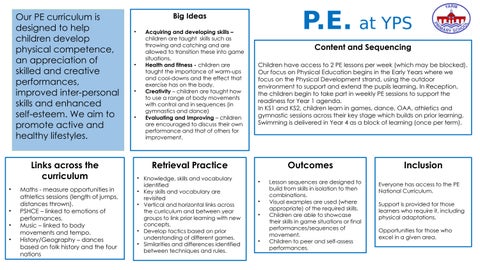
Our PE curriculum is designed to help children develop physical competence, an appreciation of skilled and creative performances, improved inter-personal skills and enhanced self-esteem. We aim to promote active and healthy lifestyles. Links across the curriculum • • • •
Maths - measure opportunities in athletics sessions (length of jumps, distances thrown). PSHCE – linked to emotions of performances. Music – linked to body movements and tempo. History/Geography – dances based on folk history and the four nations
P.E. at YPS
Big Ideas •
•
•
•
Acquiring and developing skills – children are taught skills such as throwing and catching and are allowed to transition these into game situations. Health and fitness - children are taught the importance of warm-ups and cool-downs and the effect that exercise has on the body. Creativity – children are taught how to use a range of body movements with control and in sequences (in gymnastics and dance) Evaluating and Improving – children are encouraged to discuss their own performance and that of others for improvement.
Content and Sequencing Children have access to 2 PE lessons per week (which may be blocked). Our focus on Physical Education begins in the Early Years where we focus on the Physical Development strand, using the outdoor environment to support and extend the pupils learning. In Reception, the children begin to take part in weekly PE sessions to support the readiness for Year 1 agenda. In KS1 and KS2, children learn in games, dance, OAA, athletics and gymnastic sessions across their key stage which builds on prior learning. Swimming is delivered in Year 4 as a block of learning (once per term).
Retrieval Practice • Knowledge, skills and vocabulary identified • Key skills and vocabulary are revisited • Vertical and horizontal links across the curriculum and between year groups to link prior learning with new concepts. • Develop tactics based on prior understanding of different games. • Similarities and differences identified between techniques and rules.
Outcomes • • •
•
Lesson sequences are designed to build from skills in isolation to then combinations. Visual examples are used (where appropriate) of the required skills. Children are able to showcase their skills in game situations or final performances/sequences of movement. Children to peer and self-assess performances.
Inclusion Everyone has access to the PE National Curriculum. Support is provided for those learners who require it, including physical adaptations. Opportunities for those who excel in a given area.