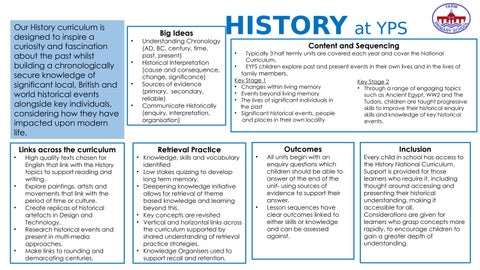
Our History curriculum is designed to inspire a curiosity and fascination about the past whilst building a chronologically secure knowledge of significant local, British and world historical events alongside key individuals, considering how they have impacted upon modern life. Links across the curriculum •
• • • •
High quality texts chosen for English that link with the History topics to support reading and writing. Explore paintings, artists and movements that link with the period of time or culture. Create replicas of historical artefacts in Design and Technology. Research historical events and present in multi-media approaches. Make links to rounding and demarcating centuries.
Big Ideas
• • • •
Understanding Chronology (AD, BC, century, time, past, present) Historical Interpretation (cause and consequence, change, significance) Sources of evidence (primary, secondary, reliable) Communicate Historically (enquiry, interpretation, organisation)
Retrieval Practice
HISTORY at YPS Content and Sequencing
Typically 3 half termly units are covered each year and cover the National Curriculum. • EYFS children explore past and present events in their own lives and in the lives of family members. Key Stage 1 Key Stage 2 • Changes within living memory • Through a range of engaging topics • Events beyond living memory such as Ancient Egypt, WW2 and The • The lives of significant individuals in Tudors, children are taught progressive the past skills to improve their historical enquiry • Significant historical events, people skills and knowledge of key historical and places in their own locality events. •
• Knowledge, skills and vocabulary identified • Low stakes quizzing to develop long term memory. • Deepening knowledge initiative allows for retrieval of theme based knowledge and learning beyond this. • Key concepts are revisited • Vertical and horizontal links across the curriculum supported by shared understanding of retrieval practice strategies. • Knowledge Organisers used to support recall and retention.
Outcomes
•
•
All units begin with an enquiry questions which children should be able to answer at the end of the unit- using sources of evidence to support their answer. Lesson sequences have clear outcomes linked to either skills or knowledge and can be assessed against.
Inclusion
Every child in school has access to the History National Curriculum. Support is provided for those learners who require it, including thought around accessing and presenting their historical understanding, making it accessible for all. Considerations are given for learners who grasp concepts more rapidly, to encourage children to gain a greater depth of understanding.