Year 9 Curriculum Plan Subject
Autumn Term
English
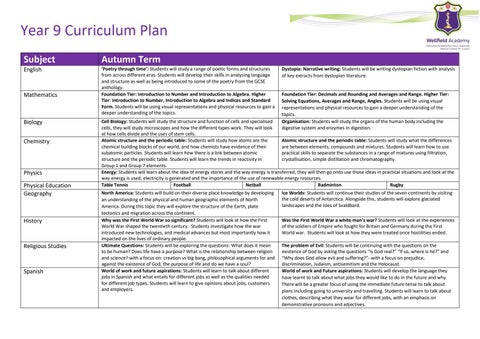
‘Poetry through time’: Students will study a range of poetic forms and structures from across different eras. Students will develop their skills in analysing language and structure as well as being introduced to some of the poetry from the GCSE anthology. Foundation Tier: Introduction to Number and Introduction to Algebra. Higher Tier: Introduction to Number, Introduction to Algebra and Indices and Standard Form. Students will be using visual representations and physical resources to gain a deeper understanding of the topics.
Mathematics
Biology Chemistry
Physics Physical Education Geography
History
Religious Studies
Spanish
Dystopia: Narrative writing: Students will be writing dystopian fiction with analysis of key extracts from dystopian literature.
Foundation Tier: Decimals and Rounding and Averages and Range. Higher Tier: Solving Equations, Averages and Range, Angles. Students will be using visual representations and physical resources to gain a deeper understanding of the topics. Organisation: Students will study the organs of the human body including the digestive system and enzymes in digestion.
Cell Biology: Students will study the structure and function of cells and specialised cells, they will study microscopes and how the different types work. They will look at how cells divide and the uses of stem cells. Atomic structure and the periodic table: Students will study how atoms are the Atomic structure and the periodic table: Students will study what the differences chemical building blocks of our world, and how chemists have evidence of their are between elements, compounds and mixtures. Students will learn how to use subatomic particles. Students will learn how there is a link between atomic practical skills to separate the substances in a range of mixtures using filtration, structure and the periodic table. Students will learn the trends in reactivity in crystallisation, simple distillation and chromatography. Group 1 and Group 7 elements. Energy: Students will learn about the idea of energy stores and the way energy is transferred, they will then go onto use those ideas in practical situations and look at the way energy is used, electricity is generated and the importance of the use of renewable energy resources. Table Tennis Football Netball Badminton Rugby North America: Students will build on their diverse place knowledge by developing an understanding of the physical and human geographic elements of North America. During this topic they will explore the structure of the Earth, plate tectonics and migration across the continent. Why was the First World War so significant? Students will look at how the First World War shaped the twentieth century. Students investigate how the war introduced new technologies, and medical advances but most importantly how it impacted on the lives of ordinary people. Ultimate Questions: Students will be exploring the questions: What does it mean to be human? Does life have a purpose? What is the relationship between religion and science? with a focus on: creation vs big bang, philosophical arguments for and against the existence of God, the purpose of life and do we have a soul? World of work and future aspirations: Students will learn to talk about different jobs in Spanish and what entails for different jobs as well as the qualities needed for different job types. Students will learn to give opinions about jobs, customers and employers.
Ice Worlds: Students will continue their studies of the seven continents by visiting the cold deserts of Antarctica. Alongside this, students will explore glaciated landscapes and the Isles of Svaldbard. Was the First World War a white man’s war? Students will look at the experiences of the soldiers of Empire who fought for Britain and Germany during the First World war. Students will look at how they were treated once hostilities ended. The problem of Evil: Students will be continuing with the questions on the existence of God by asking the questions “Is God real?” “If so, where is he?” and “Why does God allow evil and suffering?”- with a focus on prejudice, discrimination, Judaism, antisemitism and the Holocaust. World of work and Future aspirations: Students will develop the language they have learnt to talk about what jobs they would like to do in the future and why. There will be a greater focus of using the immediate future tense to talk about plans including going to university and travelling. Students will learn to talk about clothes, describing what they wear for different jobs, with an emphasis on demonstrative pronouns and adjectives.