Year 9 Curriculum Plan Subject
Autumn Term
English
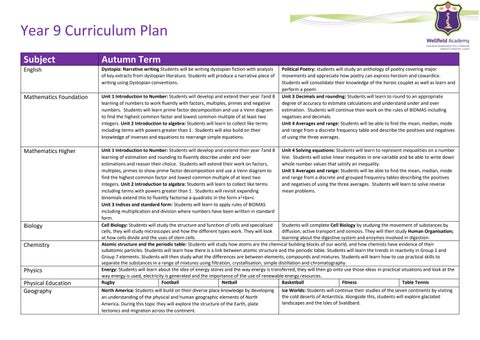
Dystopia: Narrative writing Students will be writing dystopian fiction with analysis of key extracts from dystopian literature. Students will produce a narrative piece of writing using Dystopian conventions.
Mathematics Foundation
Unit 1 Introduction to Number: Students will develop and extend their year 7and 8 learning of numbers to work fluently with factors, multiples, primes and negative numbers. Students will learn prime factor decomposition and use a Venn diagram to find the highest common factor and lowest common multiple of at least two integers. Unit 2 Introduction to algebra: Students will learn to collect like terms including terms with powers greater than 1. Students will also build on their knowledge of inverses and equations to rearrange simple equations.
Mathematics Higher
Unit 1 Introduction to Number: Students will develop and extend their year 7and 8 Unit 4 Solving equations: Students will learn to represent inequalities on a number learning of estimation and rounding to fluently describe under and over line. Students will solve linear inequities in one variable and be able to write down estimations and reason their choice. Students will extend their work on factors, whole number values that satisfy an inequality. multiples, primes to show prime factor decomposition and use a Venn diagram to Unit 5 Averages and range: Students will be able to find the mean, median, mode find the highest common factor and lowest common multiple of at least two and range from a discrete and grouped frequency tables describing the positives integers. Unit 2 Introduction to algebra: Students will learn to collect like terms and negatives of using the three averages. Students will learn to solve reverse including terms with powers greater than 1. Students will revisit expanding mean problems. binomials extend this to fluently factorise a quadratic in the form x2+bx+c Unit 3 Indices and standard form: Students will learn to apply rules of BIDMAS including multiplication and division where numbers have been written in standard form. Cell Biology: Students will study the structure and function of cells and specialised Students will complete Cell Biology by studying the movement of substances by cells, they will study microscopes and how the different types work. They will look diffusion, active transport and osmosis. They will then study Human Organisation; at how cells divide and the uses of stem cells. learning about the digestive system and enzymes involved in digestion. Atomic structure and the periodic table: Students will study how atoms are the chemical building blocks of our world, and how chemists have evidence of their subatomic particles. Students will learn how there is a link between atomic structure and the periodic table. Students will learn the trends in reactivity in Group 1 and Group 7 elements. Students will then study what the differences are between elements, compounds and mixtures. Students will learn how to use practical skills to separate the substances in a range of mixtures using filtration, crystallisation, simple distillation and chromatography. Energy: Students will learn about the idea of energy stores and the way energy is transferred, they will then go onto use those ideas in practical situations and look at the way energy is used, electricity is generated and the importance of the use of renewable energy resources. Rugby Football Netball Basketball Fitness Table Tennis
Biology Chemistry
Physics Physical Education Geography
North America: Students will build on their diverse place knowledge by developing an understanding of the physical and human geographic elements of North America. During this topic they will explore the structure of the Earth, plate tectonics and migration across the continent.
Political Poetry: students will study an anthology of poetry covering major movements and appreciate how poetry can express heroism and cowardice. Students will consolidate their knowledge of the heroic couplet as well as learn and perform a poem. Unit 3 Decimals and rounding: Students will learn to round to an appropriate degree of accuracy to estimate calculations and understand under and over estimation. Students will continue their work on the rules of BIDMAS including negatives and decimals. Unit 4 Averages and range: Students will be able to find the mean, median, mode and range from a discrete frequency table and describe the positives and negatives of using the three averages.
Ice Worlds: Students will continue their studies of the seven continents by visiting the cold deserts of Antarctica. Alongside this, students will explore glaciated landscapes and the Isles of Svaldbard.