Year 7 Curriculum Plan 2022

Page 1

Curriculum Plan

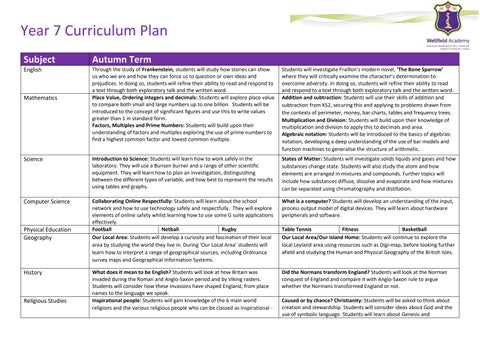
Subject Autumn Term

English Through the study of Frankenstein, students will study how stories can show us who we are and how they can force us to question or own ideas and prejudices. In doing so, students will refine their ability to read and respond to a text through both exploratory talk and the written word.

Mathematics Place Value, Ordering integers and decimals: Students will explore place value to compare both small and large numbers up to one billion. Students will be introduced to the concept of significant figures and use this to write values greater than 1 in standard form.

Factors, Multiples and Prime Numbers: Students will build upon their understanding of factors and multiples exploring the use of prime numbers to find a highest common factor and lowest common multiple.

Students will investigate Fraillon’s modern novel, ‘The Bone Sparrow’ where they will critically examine the character’s determination to overcome adversity. In doing so, students will refine their ability to read and respond to a text through both exploratory talk and the written word.

Addition and subtraction: Students will use their skills of addition and subtraction from KS2, securing this and applying to problems drawn from the contexts of perimeter, money, bar charts, tables and frequency trees.

Multiplication and Division: Students will build upon their knowledge of multiplication and division to apply this to decimals and area.

Algebraic notation: Students will be introduced to the basics of algebraic notation, developing a deep understanding of the use of bar models and function machines to generalise the structure of arithmetic.

Science Introduction to Science: Students will learn how to work safely in the laboratory. They will use a Bunsen burner and a range of other scientific equipment. They will learn how to plan an investigation, distinguishing between the different types of variable, and how best to represent the results using tables and graphs.

Computer Science

Collaborating Online Respectfully: Students will learn about the school network and how to use technology safely and respectfully. They will explore elements of online safety whilst learning how to use some G suite applications effectively.

States of Matter: Students will investigate solids liquids and gases and how substances change state. Students will also study the atom and how elements are arranged in mixtures and compounds. Further topics will include how substances diffuse, dissolve and evaporate and how mixtures can be separated using chromatography and distillation.

What is a computer? Students will develop an understanding of the input, process output model of digital devices. They will learn about hardware peripherals and software.

Table Tennis Fitness Basketball Geography

Physical Education Football Netball Rugby

Our Local Area: Students will develop a curiosity and fascination of their local area by studying the world they live in. During ‘Our Local Area’ students will learn how to interpret a range of geographical sources, including Ordinance survey maps and Geographical Information Systems.

Our Local Area/Our Island Home: Students will continue to explore the local Leyland area using resources such as Digi map, before looking further afield and studying the Human and Physical Geography of the British Isles.

History

What does it mean to be English? Students will look at how Britain was invaded during the Roman and Anglo Saxon period and by Viking raiders. Students will consider how these invasions have shaped England, from place names to the language we speak.

Did the Normans transform England? Students will look at the Norman conquest of England and compare it with Anglo Saxon rule to argue whether the Normans transformed England or not.

Religious Studies

Inspirational people: Students will gain knowledge of the 6 main world religions and the various religious people who can be classed as inspirational

Caused or by chance? Christianity: Students will be asked to think about creation and stewardship. Students will consider ideas about God and the use of symbolic language. Students will learn about Genesis and

Year 7

Year 7 Curriculum Plan

Anne Frank, Sophie Scholl, Magnus Macfarlane Barrow, Gandhi, Malala and Oscar Romero.

Spanish Basics and Classroom Language: Students will begin their language journey with the very basics of the Spanish language, as well as learning key classroom language in order to be able to start using the language as much as possible within lessons. Students will also be introduced to Spanish Phonics.

Personal Information and family: Students will describe personality traits, giving more extended information on self and family members.

Music Exploring the Orchestra: Students will explore the workings of an orchestra, learning about the different families of instruments and their role within the ensemble. Students will begin developing their appraising skills, identifying the instruments of the orchestra from their timbre.

Interpretations of Genesis, Stewardship and Greta Thunberg, Stewardship and Chico Mendes in addition to Assisi declarations on nature.

Hobbies: Students will be introduced to present tense whilst covering the topic of hobbies and sports. Weather will also be covered in speaking and writing when discussing hobbies. Students will also have an opportunity to explore cultural traditions in the Spanish speaking world at Christmas time.

Exploring Music from Other Cultures: Students will explore traditional Chinese music, focusing on its use of the pentatonic scale. Students will learn to compose and perform music revolving around the pentatonic scale, developing their keyboard skills.

Curriculum Plan

Subject Spring Term

English In a critical exploration of literature, students will consider how successful writers use the Art of Rhetoric to bring about change. Students will learn to express a personal viewpoint through their own writing; challenge societal issues and use the power of language to inspire and challenge others’ thinking.

Mathematics Equality and Equivalence: Students will continue to develop the understanding of algebraic concepts, introducing forming and solving one step equations.

Directed Number: Students will extend and deepen their understanding of directed number using multiple representations to calculate with a mixture of positive and negative numbers.

Science Cells and organisms: Students will study the structure and function of cells. They will look at how organisms are arranged including the skeleton, joints and muscles. Students will also study how substances move by diffusion before learning about the heart and circulation and how the lungs ventilate our bodies. Finally, students study the digestive system, enzymes and food tests.

Computer Science Modelling: Students will use spreadsheets to collect data, complete calculations and analyse findings.

Students will develop their own descriptive writing style by studying the transformation of characters into their secondary selves. Taking inspiration from famous Alter Egos. Students will practice writing, editing and redrafting their work.

Brackets: Students will continue their understanding of equality, equivalence and factors to expand and factorise single brackets.

Cartesian Plane: Students will look formally at algebraic rules for straight lines, starting with lines parallel to the axes and moving on to using equations to produce lines.

Energy: Students will study energy stores and transfers, energy efficiency including calculations. Heat energy transfer through conduction, convection, radiation. Energy in the home. Students weigh up the benefits of renewable and non renewable energy resources.

Control and Programming: Students will use Flowol to gain an understanding of the key programming concepts including sequence, selection and iteration.

Physical Education Table Tennis Fitness Basketball OAA Badminton Boxercise/Dance

Geography

Our Island Home: Students will continue to develop the understanding of their home by exploring the physical characteristics of coastal areas as well as the growth and cultural development of London.

Our European Neighbours: Students will branch out their geographical knowledge by exploring the human and physical characteristics of our European Neighbours. Students will focus on Russia and Italy throughout the topic.

History Could Medieval Kings do whatever they wanted? Students will look at how William the Conqueror, King John and Henry II all abused their position and power for their own gain.

Religious Studies

How do Jewish Holy days remind adherents of faith? Students will learn about the various key dates and festivals for the Jewish religion and the reasons behind why they are celebrated. This will include: Covenants and beliefs about God, Shabbat, Moses and Exodus, Pesach, Rosh Hashanah, Hanukah and Sukkot.

What was life like in England for the peasants in Medieval England? Students will look at the impact of the Black Death and how this led to the Peasants Revolt. Students will also look at the problems with the Catholic church and how people started to demand reforms by 1500.

What does belonging mean? Students will learn about key Islamic beliefs and how these unite Muslims around the world. They will study: Beliefs about God, Ummah, Identity: denominations, Identity: 5 Pillars, Islamic Relief and Islam in the local community.

Year 7

Year 7 Curriculum Plan

Spanish School: Students will learn to talk about their school subjects and lessons. Students will use this vocabulary to give opinions about their favourite and worst school subjects, using key opinion phrases. Students will also use the 1st person plural of key verbs to talk about their school day. This will develop further through greater use of time phrases and sequencing vocabulary, as well as a greater use of opinions and reasons, using a variety of adjectives.

Music Exploring World Rhythms: Students will explore the use of rhythm and texture in music. Looking at genres from around the world, such as Reggae and Samba, students will learn how to read, write and play a variety of rhythms on percussion instruments. Students will use these rhythms to compose and perform their own ‘call and response’ piece.

Family and Friends: Students will learn to give physical descriptions of themselves and others, including eyes and hair, and to describe where they live. Students will develop cultural understanding through learning about Easter traditions and customs in Spain and Spanish-speaking countries.

Exploring Pop Music: Students will explore the characteristics of today's pop music and answer the questions; what makes pop music catchy? why are certain artists successful. As well as appraising, performing and composing contemporary pop music, students will learn about the music industry and how pop is created, marketed and sold to its audience.

Curriculum Plan

Subject Summer Term

English Creative writing: Students will compose and edit their own descriptive piece of writing based on the topic of ‘Alter Egos’.

Mathematics Fractions, Decimals and Percentages: Students will be able to convert fluently between fractions, decimals and percentages.

Addition and Subtraction of Fractions: Students will learn to add and subtract any fraction with the same or different denominators.

Through the study of poets from ‘Home and Away’, students will develop their inference skills as well as making connections between contexts and literature.

Ratio and Multiplicative Change: Students will use various representations to show ratios. Students will learn how to use these representations to share an amount into a given ratio, write a fraction or percentage from a ratio and solve problems involving direct proportion.

Science

Acids and Alkali: Students will study acids and alkalis and the pH scale. They will plan an experiment to show how we can neutralise acids and alkalis.

Ecology: Students will study Classification of plants and animals.

Photosynthesis and how plant use glucose and minerals. Ecosystems, food chains and webs and how organisms are adapted to their environment.

Computer Science Data Representation: Students will study how representation has changed over time and why we need to represent information. This will lead to exploring how computers represent data by studying binary.

Physical Education

Forces and Space: Students will study contact and non contact forces, resultant forces and gravity. Students will then study space and the solar system. They will study why we have day and night and the different seasons. They will explore space including how satellites work.

Programming: Students will use block based programming programs including scratch to develop programming confidence and create event driven programs. They will develop skills in concepts such as variables, inputs and sub routines.

Geography Global Issues: Students will finish the year by consolidating their knowledge of the United Kingdom and its European neighbours. In this unit students will study big geographical talking points such as: Climate change, Plastic Pollution, Global Biomes and more.

History How significant were the Black Tudors? Students will look at the lives of ordinary people in Tudor England. They will use the work of historian Miranda Kaufman to look at the lives of Black Tudors.

Religious Studies

What is Church? Students will learn about the fundamentals of Christian belief and worship. They will study: Forms of church what does it mean? Church building, Stories/parables, the work of Jesus, The Trussell Trust, Street Pastors and Christian Aid.

What was Medieval life like outside of England? Students will look at the Islamic world and the growth of trade along the Silk Roads.

What can we learn from festivals? Students will learn about key Hindu festivals and the reasons why they are seen as important practices. Key knowledge will include: Beliefs about Gods and deities, Avataras, Puja, Ramayana, Di wali, Holi and Kumbh Mela.

Spanish

My City: Students will learn to describe the area where they live, using a wider range of adjectives. They will also learn how to tell the time and say what they do in their town or city. They will be introduced to the near future tense for the first time and begin to learn how to speak and write using two tenses together.

Free time and culture: Students will consolidate knowledge of the present and future tenses, talking about free time activities and weather, whilst also using opinions and justifications to enhance their writing. Then, students will be introduced to various cultural aspects of Spain and Latin America, appreciating different traditions in various Spanish speaking countries.

Year 7
Badminton Handball Athletics Danish Longball Cricket Rounders

Year 7 Curriculum Plan

Music Exploring how Music is Sequenced: Students will learn to sequence music using a digital audio workspace. Students will explore the use of recording, multitracking and audio editing in order to create a well balanced and professional sounding piece of music. Students will identify how to appropriately react to a brief and how to sequence music for different mediums.

Exploring Music in Film: Students will explore the use of music in film to convey emotion and drive the story. Looking at the blockbuster film composer John Williams, students will learn how the different elements of music can enhance a film sequence and how the music will change depending on genre and mood.

Curriculum Plan

Creative Subjects Rotations 1-3

Art Expressive Composition: Wassily Kandinsky Inspired visual interpretation of music. Students will produce images in response to pieces of music as part of an expressive mark making focus. Students will represent their emotional responses with colour, shape and lines, describing their feelings in a mixed media piece of work. Students will create their own abstract compositions using emotional reactions to the music they listen to everyday.

Drama Darkwood Manor: Students will explore Darkwood Manor, the haunted mansion, through practical activities. They will develop and understand basic skills such as still image, roleplay, tension in performance, use of voice and storytelling.

Funky Fish: Niki De St Phalle influenced sculptural project. Students will construct their own 3D piece of marine life inspired artwork. They will investigate the theme of abstract sculpture by designing and creating their own piece of artwork. Students will evaluate the success of their final piece, with specific reference to the project brief and artist influence.

Naïve Animals: Henri Rousseau inspired project creating images depicting tropical environments and jungle animals. Investigating the work of the artist and using a naïve artistic technique. Students will initially work in a group and then create a 2D individual piece depicting their chosen animal in a jungle setting with naïve quality in a variety of medium. Students will reflect on the investigated genre and critically analyse both their own and others work.

Pantomime: Students will explore the conventions and history of pantomime, stock characters and develop skills through practical exploration. Students will develop an understanding of the key elements of Pantomime working towards creating their own miniPantomime. This will broaden their knowledge and skills including performing to an audience and script writing.

Spy School/Masks: Students will be exploring the theme of becoming spies. Throughout this topic students will gain understanding and knowledge of becoming creative thinkers and be able to devise, create characters and role play.

Students will also explore elements of physical theatre and apply those skills in a devised performance from a given stimulus.

Students will develop an understanding of masks, the techniques used when wearing a mask and explore the use of masks in performance.

Food & Design Technology Food Safety & Hygiene: Students will explore health and safety in the kitchen including safe use of equipment. Students will explore bacteria and associated links to food poisoning including types, symptoms, causes, on-set times and risk reduction methods.

Nutrition, Food Provenance & Food Science: Students will explore nutrition including both macro and micronutrients, their functions in the diet and how they contribute towards supporting a healthy balanced diet. Students will explore seasonality and primary and secondary processing of ingredients.

Exploring Polymers: Students will explore the functional properties of polymers, use of templates, sustainability and use associated handheld and fixed tools and equipment whilst demonstrating an understanding and awareness of health and safety practices in the workshop.

Students will explore the design process when designing, making and evaluating products to achieve a solution in a given style.

Year 7

Turn static files into dynamic content formats.

Create a flipbook