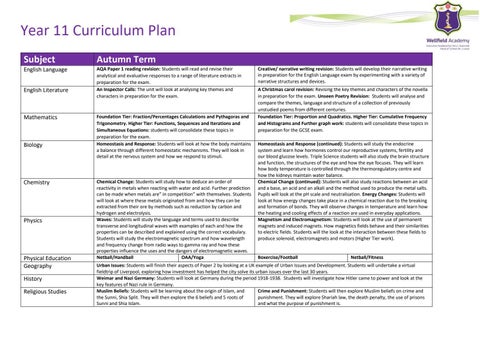
Year 11 Curriculum Plan Subject
Autumn Term
English Language
AQA Paper 1 reading revision: Students will read and revise their analytical and evaluative responses to a range of literature extracts in preparation for the exam. An Inspector Calls: The unit will look at analysing key themes and characters in preparation for the exam.
English Literature
Mathematics
Biology
Chemistry
Physics
Physical Education Geography History Religious Studies
Foundation Tier: Fraction/Percentages Calculations and Pythagoras and Trigonometry. Higher Tier: Functions, Sequences and Iterations and Simultaneous Equations: students will consolidate these topics in preparation for the exam. Homeostasis and Response: Students will look at how the body maintains a balance through different homeostatic mechanisms. They will look in detail at the nervous system and how we respond to stimuli.
Chemical Change: Students will study how to deduce an order of reactivity in metals when reacting with water and acid. Further prediction can be made when metals are” in competition” with themselves. Students will look at where these metals originated from and how they can be extracted from their ore by methods such as reduction by carbon and hydrogen and electrolysis. Waves: Students will study the language and terms used to describe transverse and longitudinal waves with examples of each and how the properties can be described and explained using the correct vocabulary. Students will study the electromagnetic spectrum and how wavelength and frequency change from radio ways to gamma ray and how these properties influence the uses and the dangers of electromagnetic waves. Netball/Handball OAA/Yoga
Creative/ narrative writing revision: Students will develop their narrative writing in preparation for the English Language exam by experimenting with a variety of narrative structures and devices. A Christmas carol revision: Revising the key themes and characters of the novella in preparation for the exam. Unseen Poetry Revision: Students will analyse and compare the themes, language and structure of a collection of previously unstudied poems from different centuries. Foundation Tier: Proportion and Quadratics. Higher Tier: Cumulative Frequency and Histograms and Further graph work: students will consolidate these topics in preparation for the GCSE exam. Homeostasis and Response (continued): Students will study the endocrine system and learn how hormones control our reproductive systems, fertility and our blood glucose levels. Triple Science students will also study the brain structure and function, the structures of the eye and how the eye focuses. They will learn how body temperature is controlled through the thermoregulatory centre and how the kidneys maintain water balance. Chemical Change (continued): Students will also study reactions between an acid and a base, an acid and an alkali and the method used to produce the metal salts. Pupils will look at the pH scale and neutralisation. Energy Changes: Students will look at how energy changes take place in a chemical reaction due to the breaking and formation of bonds. They will observe changes in temperature and learn how the heating and cooling effects of a reaction are used in everyday applications. Magnetism and Electromagnetism: Students will look at the use of permanent magnets and induced magnets. How magnetics fields behave and their similarities to electric fields. Students will the look at the interaction between these fields to produce solenoid, electromagnets and motors (Higher Tier work).
Boxercise/Football
Netball/Fitness
Urban Issues: Students will finish their aspects of Paper 2 by looking at a UK example of Urban Issues and Development. Students will undertake a virtual fieldtrip of Liverpool, exploring how investment has helped the city solve its urban issues over the last 30 years. Weimar and Nazi Germany: Students will look at Germany during the period 1918-1938. Students will investigate how Hitler came to power and look at the key features of Nazi rule in Germany. Muslim Beliefs: Students will be learning about the origin of Islam, and Crime and Punishment: Students will then explore Muslim beliefs on crime and the Sunni, Shia Split. They will then explore the 6 beliefs and 5 roots of punishment. They will explore Shariah law, the death penalty, the use of prisons Sunni and Shia Islam. and what the purpose of punishment is.