Curriculum Plan
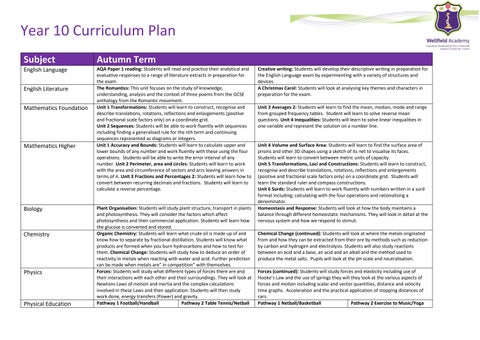
Subject Autumn Term
English Language
AQA Paper 1 reading: Students will read and practice their analytical and evaluative responses to a range of literature extracts in preparation for the exam.
English Literature
Mathematics Foundation
The Romantics: This unit focuses on the study of knowledge, understanding, analysis and the context of three poems from the GCSE anthology from the Romantic movement.
Unit 1 Transformations: Students will learn to construct, recognise and describe translations, rotations, reflections and enlargements (positive and fractional scale factors only) on a coordinate grid.
Unit 2 Sequences: Students will be able to work fluently with sequences including finding a generalised rule for the nth term and continuing sequences represented as diagrams or integers.
Mathematics Higher Unit 1 Accuracy and Bounds: Students will learn to calculate upper and lower bounds of any number and work fluently with these using the four operations. Students will be able to write the error interval of any number. Unit 2 Perimeter, area and circles: Students will learn to work with the area and circumference of sectors and arcs leaving answers in terms of π. Unit 3 Fractions and Percentages 2: Students will learn how to convert between recurring decimals and fractions. Students will learn to calculate a reverse percentage.
Creative writing: Students will develop their descriptive writing in preparation for the English Language exam by experimenting with a variety of structures and devices.
A Christmas Carol: Students will look at analysing key themes and characters in preparation for the exam.
Unit 3 Averages 2: Students will learn to find the mean, median, mode and range from grouped frequency tables. Student will learn to solve reverse mean questions. Unit 4 Inequalities: Students will learn to solve linear inequalities in one variable and represent the solution on a number line.
Unit 4 Volume and Surface Area: Students will learn to find the surface area of prisms and other 3D shapes using a sketch of its net to visualise its faces. Students will learn to convert between metric units of capacity.
Unit 5 Transformations, Loci and Constructions: Students will learn to construct, recognise and describe translations, rotations, reflections and enlargements (positive and fractional scale factors only) on a coordinate grid. Students will learn the standard ruler and compass constructions.
Unit 6 Surds: Students will learn to work fluently with numbers written in a surd format including; calculating with the four operations and rationalising a denominator.
Biology
Plant Organisation: Students will study plant structure, transport in plants and photosynthesis. They will consider the factors which affect photosynthesis and their commercial application. Students will learn how the glucose is converted and stored.
Chemistry Organic Chemistry: Students will learn what crude oil is made up of and know how to separate by fractional distillation. Students will know what products are formed when you burn hydrocarbons and how to test for them. Chemical Change: Students will study how to deduce an order of reactivity in metals when reacting with water and acid. Further prediction can be made when metals are” in competition” with themselves.
Physics Forces: Students will study what different types of forces there are and their interactions with each other and their surroundings. They will look at Newtons Laws of motion and inertia and the complex calculations involved in these Laws and their application. Students will then study work done, energy transfers (Power) and gravity.
Homeostasis and Response: Students will look at how the body maintains a balance through different homeostatic mechanisms. They will look in detail at the nervous system and how we respond to stimuli.
Chemical Change (continued): Students will look at where the metals originated from and how they can be extracted from their ore by methods such as reduction by carbon and hydrogen and electrolysis. Students will also study reactions between an acid and a base, an acid and an alkali and the method used to produce the metal salts. Pupils will look at the pH scale and neutralisation.
Forces (continued): Students will study forces and elasticity including use of Hooke’s Law and the use of springs they will they look at the various aspects of forces and motion including scalar and vector quantities, distance and velocity time graphs. Acceleration and the practical application of stopping distances of cars.
Year 10 Curriculum Plan
Geography Changing Economic World: Students will start their GCSE journey with a focus on Nigeria and the UK and how each country and continent has developed over time.
The Changing Economic world/Weather Hazards: Students will look at the economic make up of the UK with a focus on the North South divide and Sheffield's movement from a manufacturing town before moving on to explore weather hazards.
History Medicine Through Time: Students will be introduced to the first topic of their GCSE course. They will look at how medicine developed through the Medieval, Renaissance, Industrial and Modern periods.
Religious Studies Component 1: Themes - Issues of Relationships: Students will begin the thematic studies exploring relationships covering different attitudes towards: sexuality, gender roles, adultery, homosexuality, and marriage vs cohabitation
Spanish Desconéctate (theme - local area, holiday and travel): Students will begin talking about holidays and how they like to spend their holidays. Students will be able to use the imperfect tense to describe what there was at the accommodation, as well as learn how to book their holiday in the target language and complain about any potential issues.
Art Skills Workshops: Students will complete skills workshops over a number of weeks, they will gain skills in the following techniques and processes: Batik, Painting, Oil Pastel, Chalk Pastel, Lino Printing, Wax Resist, Collage Students will also begin to think of ideas for their Portfolio unit, the students will work on one main project throughout the two years.
Computer Science Algorithms: Students will develop their computational thinking skills and understanding of techniques including abstraction and decomposition. They will design, create and refine algorithms. They will explore common searching and sorting algorithms.
Drama Exploration or practitioners and theatre styles: Students will be exploring theatre styles through practical exploration. Students will learn about a variety of practitioners (Frantic Assembly, Stanislavski, Brecht and Paper Birds) and their influences in the world of theatre.
Component 2: Christianity: Students will begin by exploring the Christian beliefs on: the nature of God, the incarnation, the atonement and the end times.
Mi vida en el insti (School): Students will talk about school in detail, talking about subjects and teachers using a range of opinions, as well as school uniform, school rules and extracurricular activities.
Skills Workshops: Students will continue working through a series of workshops investigating and trialling different art practices, techniques and processes. They will begin to establish their chosen area of study for their coursework portfolio and begin producing images relating to this topic as well as researching and recording from primary sources developing observation techniques.
Systems Architecture: Students will study the components of the CPU (central processing unit) and the factors that affect its performance. They will also look at embedded systems and how these differ to general purpose devices.
Exploration of Blood Brothers: Students will read the play and start to research the setting, costume, makeup, hairstyles, scenery and lighting for the play. Students will understand the social and historical context of the play through research and practical exploration. Students will also perform extracts from the play to put themselves in the position of the character to gain a deeper understanding to support responses to component 1 questions. Theatre roles and terminology: Students will begin to understand the implications of stage configuration and the use of performance space. Students will also research and understand the roles and responsibilities of theatre makers looking at each role, the activities involved in their daily work and their accountability in the rehearsal and performance process.
Food Preparation & Nutrition
Food Safety, Spoilage & Waste: Students will explore the importance of food safety and its direct link to food spoilage. Students will know how to identify the characteristics of food spoilage along with how to prevent this from occurring. They will know the environmental issues associated with food waste and know the reasons behind why food is wasted by individuals and manufacturers.
Food Provenance & Food Waste: Students will explore where food comes from including how ingredients are grown, reared and caught. They will analyse in detail the environmental issues associated with food including seasonality, organic foods, issues associated with food packaging and carbon footprint.
Students will investigate the impact of food and food security on local and global markets and communities including climate change and genetically modified (GM) foods.
Year 10 Curriculum Plan
Music Elements of Music: Students will explore the different elements of music, understanding how they work and learning key vocabulary and techniques to help describe them. These elements are: Melody, Articulation, Dynamics, Texture, Structure, Harmony, Instrumentation, Rhythm, Tempo and Style.
Sports Studies
In this unit students will have an opportunity to develop skills both as a performer in two different sporting activities, and as a leader, developing a range of transferable skills. They will perform under pressure, both as a participant and as a leader, and will use initiative to solve problems and make decisions.
Topics include:
o Applying practice methods to support improvement in a sporting activity
o Organising and planning a sports activity session
o Reviewing your own performance in planning and leading a sports activity session.
Using DAW: Students will explore the digital audio workspace Logic Pro X. Students will develop composing and sequencing techniques, as well as how to react to a set brief. Students will compose a variety of pieces using their knowledge of the elements of music.
In this unit students will have an opportunity to develop skills both as a performer in two different sporting activities, and as a leader, developing a range of transferable skills. they will perform under pressure, both as a participant and as a leader, and will use initiative to solve problems and make decisions.
Topics include:
o Applying practice methods to support improvement in a sporting activity
o Key components of performance
o Leading a sports activity session
Year 10 Curriculum Plan
Subject Spring Term
English Language
English Literature
Mathematics Foundation
Non-fiction Reading: Students will read and compare two pieces of non fiction from across different eras. In line with the GCSE English Language criteria, reading skills include selecting and retrieving, analysing language and structure; synthesising and comparing information.
The Victorians: This unit focuses on the study of knowledge, understanding, analysis and the context of three poems from the GCSE anthology from the Victorian era.
Unit 5 Volume and Surface Area: Students will learn to identify and find the surface area and volume of prisms and other 3D shapes. Unit 6 Fractions and Percentage Calculations: Students will learn to use percentages and fractions to solve problems including comparisons.
Early 20th Century poetry: Students will study a selection of poems from the GCSE Literature anthology. Students will gain a knowledge and understanding of the 20th century context and how to apply this effectively when analysing poetry.
Unit 7 Construction, Loci, Bearings, Plans and Elevations: Students will learn the standard ruler and compass constructions. Students will learn to understand, draw and measure bearings. Students will learn how to interpret and draw 2D representations of 3D shapes. Unit 8 Proportion: Students will learn to identify proportion from a table of values calculating its scale factor (k). Students will understand and use compound measure.
Mathematics Higher Unit 7 Pythagoras and Trigonometry 2: Students will extend and deepen their understanding of Pythagoras and trigonometry linking this to 3D problems. Unit 8 Proportion 2: Students will explore direct and inverse proportion within formal notation. Students will calculate fluently with speed, distance, time and density, mass volume.
Biology Homeostasis and Response (continued): Students will study the endocrine system and learn how hormones control our blood glucose levels, metabolism and growth. Students will learn about the hormones in our reproductive systems; covering both contraception and fertility/IVF.
Chemistry
Energy Changes: Students will look at how energy changes take place in a chemical reaction due to the breaking and formation of bonds. They will observe changes in temperature and learn how the heating and cooling effects of a reaction are used in everyday applications.
Physics Forces (continued): Finally, students will study the practical application of forces, to the stopping distances of vehicles including the influence of weather, maintenance and driver behaviour on the overall stopping distance.
Unit 9 Quadratics including graphs: Students will learn to solve quadratic equations by factorising, completing the square and using the quadratic formula. Students will learn to plot the graphs of quadratic, cubic and other equations.
Unit 10 Functions: Students will learn to use function notation and find composite and inverse functions. Students will learn to recognise and transform graphs of functions.
Inheritance: Students will study DNA structure and function, genome, mutations, Mendelian genetics and genetic disorders. They will link this back to IVF and embryo screening. Students will learn also about cloning, genetic engineering and selective breeding.
Chemistry of the Atmosphere: Students will know how our atmosphere developed and how it evolved over time. Students will learn how to evaluate the quality of evidence in a report about global climate change, given appropriate information. Students will discuss the problems caused by increased pollutants in the air.
Waves: Students will study the language and terms used to describe transverse and longitudinal waves with examples of each and how the properties can be described and explained using the correct vocabulary.
Physical Education Pathway 1 Boxercise/Volleyball Pathway 2 Volleyball/OAA Pathway 1 Rugby/Badminton Pathway 2 Badminton/Boxercise
Geography Weather Hazards: Students will study what weather hazards are, where they affect and how we can mitigate the effects of these hazards Climate Change: Students will begin their final subtopic of the Challenge of Natural Hazards by exploring the theory of climate change. They will look at evidence for climate change, the causes of climate change, and what can be done to stop its devastating effects.
History Historic Environment: The Western Front Students will look at medical developments during the First World War.
River Landscapes: Students will develop on their previous understanding of rivers and their processes. Students will study how rivers work, the formations they create, as well as the ways in which they impact the UK.
Elizabethan England: Students will study England under the reign of Elizabeth I. They will look at how she overcame obstacles and threats to become one of
Year 10 Curriculum Plan
Religious Studies Component 2: Christianity: Students will continue to explore how Christians practice their beliefs looking at “The Lord’s supper, baptism, and religious services”
Spanish Mi gente (theme identity and culture): Students will look at the use of social media networks and apps and their advantages and disadvantages. Students will look at talking about their free time, making plans using the present continuous tense as well as their reading preferences. Students will also talk about their friends and family using a range of relationship verbs and using the past and present tenses.
England’s most successful monarchs. Students will also look at how life for ordinary people changed under her rule.
Component 1: themes - Issues of life and death: Students will explore different beliefs over: Creation, Abortion, Euthanasia and death.
Interests and Influences (theme identity and culture): Students will talk about their free time activities and what they like to watch on Television and why. Students will talk about what they usually do during their free time, sports that they play and about role models who inspires them and why.
Art AO1 DEVELOP: Students will critically assess the work of other Artists and apply this knowledge to inform their own practice. The knowledge gained should inform students own work and development should ensue from this. They should work ‘in the style of several Artists’.
Computer Science Programming and Robust Programs: Students will develop their programming skills whilst developing an understanding of the programming fundamentals data types and advanced techniques. They will focus on how to produce robust programs by using defensive design and testing.
Drama Process of creating devised Drama: Students will be given a range of stimuli and will explore these through the Initial response to the stimulus, Developing Ideas, themes, settings, Research findings, understanding their Dramatic aims and intentions. Students will then practically explore their ideas in response to the stimuli.
Memory and storage: Students will explore the similarities and differences between Primary storage (Memory) and Secondary storage. They will study how data is represented, how it is stored and compressed.
Devising Log and Component 2 GCSE stimulus: Students will learn how to write a devising log and document their journey through the devising process. Students will write about how they developed and refined ideas and those of the group. Students will be able to write how they developed and refined the piece in rehearsal, how they developed and refined their own theatrical skills during the devising process and their response to feedback and how they as individual used their refined theatrical skills and ideas in the final piece.
Food Preparation & Nutrition Technological Developments in Food Production: Students will explore the primary and secondary stages of food processing and production and evaluate how processing affects the sensory and nutritional properties of ingredients. They will explore technological developments to support better health and food production including fortification and modified foods with health benefits and the efficacy of these.
Music Set Piece 1: Students will look at our first set piece, Toto’s Africa. Students will listen and appraise the piece before evaluating the different musical techniques within it. Students will develop their knowledge of the soft rock genre and the context behind the piece.
Sports Studies In this unit students will have an opportunity to develop skills both as a performer in two different sporting activities, and as a leader, developing a range of transferable skills. They will perform under pressure, both as a participant and as a leader, and will use initiative to solve problems and make decisions.
Topics include:
o Key components of performance
o Reviewing your own performance in planning and leading a sports activity session.
Cultures & Cuisines: Students will develop their understanding of typical food products from British tradition along with other cultures and cuisines. As part of this work, students will investigate a style characteristic of a particular country or region where the cuisine has developed historically using distinctive ingredients, specific preparation and cooking methods or equipment, and presentation or serving techniques.
Set Piece 2: Students will look at our second set piece, Bach’s Banderie. Students will listen and appraise the piece before evaluating the different musical techniques within it. Students will develop their knowledge of the baroque genre and the context behind the piece.
In this unit students will have an opportunity to develop skills both as a performer in two different sporting activities, and as a leader, developing a range of transferable skills. They will perform under pressure, both as a participant and as a leader, and will use initiative to solve problems and make decisions.
Topics include:
o Reviewing your own performance in planning and leading a sports activity session.
o Applying practice methods to support improvement in a sporting activity
o Organising and planning a sports activity session
Year 10 Curriculum Plan
Subject Summer Term
English Language
Non-fiction writing: Students will revise and practice the conventions of transactional writing; revise their spelling, punctuation and grammar; and developing an understanding of how these forms can be used to appropriately communicate to an audience.
Spoken Language assessment: Students will complete their GCSE Spoken Language. They will be assessed on their ability to deliver and respond to a speech of their own composition.
English Literature
Mathematics Foundation
Unseen Poetry: Students will analyse and compare the themes, language and structure of a collection of previously unstudied poems from different centuries.
Unit 9 Pythagoras and Trigonometry: Students will learn how to use and apply Pythagoras and trigonometry in right angled triangles. Unit 10 Quadratics: Students will revisit expanding binomials extend this to fluently factorise a quadratic in the form x2+bx+c. Students will learn how to plot quadratics and use the graph to find the roots.
Mathematics Higher Unit 11 Sequences and Iteration: Students will learn to continue and find the generalised nth term rule for quadratic sequences.
Unit 12 Simultaneous Equations: Students will learn to solve simultaneous equations involving quadratics. Students will learn to solve simultaneous equations (both linear and quadratic) graphically.
Biology Ecology: Students will study how organisms are adapted to their environment and the interactions between them. They will identify the biotic and abiotic factors which influence population growth. Students will also undertake field studies using quadrats.
Chemistry Using Resources: Students will study how in order to operate sustainably, chemists need to minimise the use of limited resources, use of energy, waste produced and environmental impact.
Shakespeare’s Macbeth: Students will be consolidating their knowledge and understanding of the play whilst focusing on strengthening their analytical skills in preparation for their GCSE examination.
Unit 11 Circle and Cylinders: Students will learn how to find the area and circumference of circles and parts of circles. Students will extend their learning of volume and surface area to find the surface area and volume of cylinders.
Unit 13 Inequalities: Students will learn to solve quadratic inequalities both algebraically and graphically. Unit 14 Cumulative Frequency and Histograms: Students will learn to draw and interpret cumulative frequency, histograms and box plots exploring the relationship between these graphs and the averages and measures of spread. Unit 15 Probability 2: Students will learn to draw and interpret probability trees.
Ecology (continued): Students will learn how water and carbon are recycled in the environment; part of this work includes studying decomposition. The ecology topic finishes with global issues such as loss of biodiversity through deforestation and global warming.
Quantitative chemistry revisited: Students will learn how to calculate the relative formula mass of a compound. Pupils will look at the practicality of conservation of mass and subsequently balancing simple equations. Students will learn how to use balanced symbol equations to calculate masses of reactants and products. Students will know how to calculate the concentration of solutions.
Physics Waves (continued): Students will study the electromagnetic spectrum and how wavelength and frequency change from radio ways to gamma ray. Students will consider how these properties influence the uses of each type of electromagnetic wave and what dangers they present.
Physical Education
Geography
Pathway 1
Tennis/Athletics
2
Magnetism and Electromagnetism: Students will look at the use of permanent magnets and induced magnets, how magnetics fields behave and their similarities to electric fields. Students will the look at the interaction between these fields to produce solenoid, electromagnets and motors (HT)
Urban Issues and Challenges: Students will prepare for their GCSE fieldwork by looking at urban change across the globe, with a focus on Liverpool and Rio de Janeiro.
History Elizabethan England: Students will study England under the reign of Elizabeth I. They will look at how she overcame obstacles and threats to become one of England’s most successful monarchs. Students will also look at how life for ordinary people changed under her rule.
Elizabethan England and Medicine Revision: Students will undertake exam practice questions and will revisit the topics to ensure they have a sound grasp of the content.
Year 10 Curriculum Plan
Religious Studies Component 1: themes Good and Evil: Students will explore various beliefs about what it is to be good and evil, crime, and the death penalty.
Spanish Interests and Influences (theme identity and culture): Students will continue to talk about their free time activities and what they like to watch on television and why. Students will develop the range of language used to discuss free time, sports that they play and role models who inspire them and why.
Component 1: themes Issues of Human rights: Students will explore what social justice is and human rights. They will then study what the issues are around wealth and poverty.
Interests and Influences (theme – local area, holiday and travel): Students will learn to use the future tense to be able to plan activities in a town or city. Students will also be able to describe the features of a region, talk about shopping as well as talking about problems in a town. Grammatically, students will be introduced to more complex structures, will be able to use demonstrative adjectives as well as use various tenses together to enhance their writing.
Art AO2 EXPERIMENT: Students will use the techniques, skills and knowledge gained so far throughout AO1 and AO3 to inform their own work. They will apply practical Art skills to produce their work. Students will use a variety of media, Pastels, Charcoal, Printing, Painting and compositional techniques and skills to demonstrate their knowledge and understanding. Several ideas should be finalised.
Computer Science Languages and IDEs: Students will explore the categories of high and low level programming languages and their characteristics. They will investigate different Integrated Development Environments and their differing features.
Drama Analysis and evaluation Log books – Section 3 & Introduction of a text: Students will be able to analyse and evaluate how far they developed their theatrical skills, the benefits they brought to the pair/group and the way in which they positively shaped the outcome, the overall impact they had as individuals and further development. Students will begin to explore a variety of texts for component 3 through practical workshops, exploring monologues and duologues from texts that could be performed for their exam.
Food Preparation & Nutrition
Factors Affecting Food Choice: Students will develop their knowledge and understanding of the differing factors which may influence food choice including those related to religion, culture, ethical and moral beliefs, and medical conditions. Students will learn about food packaging and how labelling and marketing may influence food choice. As part of this work, students will develop a greater understanding of the need for sensory testing, including different methods and how taste receptors and olfactory systems work when tasting food.
Music Performance: Students will choose and rehearse a solo and ensemble performance piece. Students will evaluate their chosen piece against the elements of music, with specific focus to their chosen instrument.
Sports Studies In this unit students will have an opportunity to develop skills both as a performer in two different sporting activities, and as a leader, developing a range of transferable skills. They will perform under pressure, both as a participant and as a leader, and will use initiative to solve problems and make decisions.
Topics include:
Ethical, legal, cultural and environmental impacts of digital technology: Students will study different computing legislation and their impact, evaluate the difference between open source and proprietary software and explore the positive and negative impact technology has on the environment, culture and our everyday lives.
Live Theatre review & Selecting Extracts for exam Students will watch a live piece of theatre and be able to write about the show including the acting and the technical elements within a performance. Students will write a review based on their interpretations of what they experienced as a performer and a designer. Students will begin to select 2 key extracts for component 3 and study the play in detail to gain a deeper understanding of the roles they will perform or how they will create the technical elements of the performance if working as a designer.
NEA Preparation: Students will undertake a series of mock assessments to prepare them for NEA 1 and NEA 2 (Food Investigation and Food Preparation Assessments). Students will investigate the functional and chemical working properties of foods and conduct a series of investigations to test theories regarding food related problems and scenarios. They will also use their existing knowledge and skills to plan, prepare and cook a number of dishes within a given time frame.
Listening and Appraising: Students will explore the history of music, listening to several influential artists and understanding their importance. Students will revisit the elements of music, using them to answer questions about an unheard piece of music.
In this unit you will understand the different sides of a range of media sources and apply real life examples to show the nature of the relationship between media and sport. You will also learn how rapid development in technology is enabling sport to be viewed, replayed and discussed whenever and wherever the spectator wants. You will then develop your ability to evaluate and interpret the different ways in which sport is represented by the media.
Curriculum Plan
o
o
o
Topics include: