Ancient Egypt
UKS2
Key Vocabulary
BC
Timeline
Used to refer to dates before the year AD 1. BC stands for Before Christ and refers to any date before the year Christians believe Jesus was born. This is counted backwards, so 200 BC is before 100 BC.
civilisation
An organised society with its own culture and way of life, existing in a particular area over a particular period of time.
irrigation
A system of canals or channels Egyptians dug to supply water to grow crops over a larger area than the water would reach naturally.
silt
Fine particles of soil, clay or sand, which enrich the soil for crops, carried and deposited by water.
hieroglyphics
A system of writing that used pictures and symbols (hieroglyphs) instead of letters. It was often used for religious texts and inscriptions, as well as for counting taxes. Scribes had to go to a special school to learn how to read and write.
cartouche
An oval shape in which the names of kings and queens were often written in hieroglyphics to place on their tombs.
UK
5000 BC
AD 1
Ancient Egypt Ancient Sumer Indus Valley Shang Dynasty
Egypt
The Rosetta Stone
Everyday Life
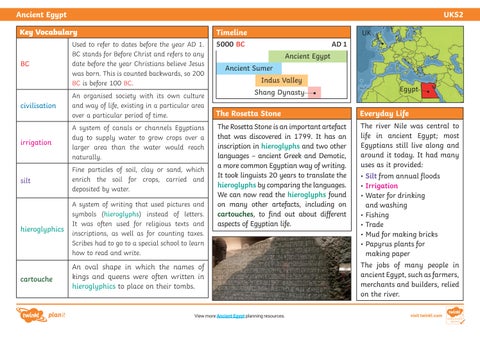
The Rosetta Stone is an important artefact that was discovered in 1799. It has an inscription in hieroglyphs and two other languages – ancient Greek and Demotic, a more common Egyptian way of writing. It took linguists 20 years to translate the hieroglyphs by comparing the languages. We can now read the hieroglyphs found on many other artefacts, including on cartouches, to find out about different aspects of Egyptian life.
The river Nile was central to life in ancient Egypt; most Egyptians still live along and around it today. It had many uses as it provided:
View more Ancient Egypt planning resources.
• Silt from annual floods • Irrigation • Water for drinking and washing • Fishing • Trade • Mud for making bricks • Papyrus plants for making paper The jobs of many people in ancient Egypt, such as farmers, merchants and builders, relied on the river. visit twinkl.com