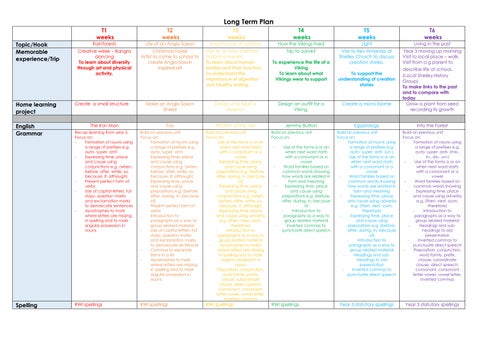
Long Term Plan Topic/Hook Memorable experience/Trip
Home learning project English Grammar
Spelling
T1 weeks
T2 weeks
T3 weeks
T4 weeks
T5 weeks
T6 weeks
Rainforests
Life of an Anglo Saxon
Importance of nutrition
How the Vikings lived
Light
Living in the past
Creative week – Bangra dancing To learn about diversity through art and physical activity.
Christmas Fayre Artist to come to school to create Anglo-Saxon inspired art
Trip to Jorvik?
Visit to Rev Amanda at Shelley Church to discuss creation stories.
Year 3 moving up morning Visit to local place – walk. Visit from a g parent to
Create a small structure
Make an Anglo Saxon Shield
Visit to or from Sheffield Hallam University To learn about human bodies and their function. To understand the importance of digestion and healthy eating.
To experience the life of a Viking To learn about what Vikings wear to support
Design and label a skeleton
Design an outfit for a Viking.
The Iron Man
Fox
Rhythm of the rain
Recap learning from year 2. Focus on: Formation of nouns using a range of prefixes e.g. auto- super- antiExpressing time, place and cause using conjunctions e.g. (when, before, after, while, so, because, if, although) Present perfect form of verbs Use of capital letters, full stops, question marks and exclamation marks to demarcate sentences Apostrophes to mark where letters are missing in spelling and to mark singular possession in nouns
Build on previous unit Focus on: Formation of nouns using a range of prefixes e.g. auto- super- antiExpressing time, place and cause using conjunctions e.g. (when, before, after, while, so, because, if, although) Expressing time, place and cause using prepositions e.g. (before, after, during, in, because of) Present perfect form of verbs Introduction to paragraphs as a way to group related material Use of capital letters, full stops, question marks and exclamation marks to demarcate sentences Commas to separate items in a list Apostrophes to mark where letters are missing in spelling and to mark singular possession in nouns
Build on previous unit Focus on: Use of the forms a or an when next word starts with a consonant or a vowel Expressing time, place and cause using prepositions e.g. (before, after, during, in, because of) Expressing time, place and cause using conjunctions e.g. (when, before, after, while, so, because, if, although) Expressing time, place and cause using adverbs e.g. (then, next, soon, therefore) Introduction to paragraphs as a way to group related material Apostrophes to make where letters are missing in spelling and to mark singular possession in nouns Preposition, conjunction, word family, prefix, clause, subordinate clause, direct speech, consonant, consonant letter vowel, vowel letter, inverted commas
Build on previous unit Focus on:
Jemmy Button
RWI spellings
RWI spellings
RWI spellings
RWI spellings
-
-
-
-
Use of the forms a or an when next word starts with a consonant or a vowel Word families based on common words showing how words are related in form and meaning Expressing time, place and cause using prepositions e.g. (before, after, during, in, because of Introduction to paragraphs as a way to group related material Inverted commas to punctuate direct speech
To support the understanding of creation stories
Create a micro biome
describe life at school. (Local Shelley History Group) To make links to the past and to compare with today Grow a plant from seed recording its growth
Egyptology
Into the Forest
Build on previous unit Focus on: Formation of nouns using a range of prefixes e.g. auto- super- anti- (un-) Use of the forms a or an when next word starts with a consonant or a vowel Word families based on common words showing how words are related in form and meaning Expressing time, place and cause using adverbs e.g. (then, next, soon, therefore) Expressing time, place and cause using prepositions e.g. (before, after, during, in, because of) Introduction to paragraphs as a way to group related material Headings and subheadings to aid presentation Inverted commas to punctuate direct speech
Build on previous unit Focus on: Formation of nouns using a range of prefixes e.g. auto- super- anti- (mis-, in-, dis-, un-) Use of the forms a or an when next word starts with a consonant or a vowel Word families based on common words showing Expressing time, place and cause using adverbs e.g. (then, next, soon, therefore) Introduction to paragraphs as a way to group related material Headings and subheadings to aid presentation Inverted commas to punctuate direct speech Preposition, conjunction, word family, prefix, clause, subordinate clause, direct speech, consonant, consonant letter vowel, vowel letter, inverted commas
Year 3 statutory spellings
Year 3 statutory spellings