Ready Steady Write Progression Overview Ready Steady Write Progression Overview EYFS The unit Reception will start from will be dependent on the need of the cohort. C D Vehicle Texts
A
B
The Something
Star in a Jar
Juniper Jupiter
Little Red
E
F
The Extraordinary Gardener
The Storm Whale
Writing Outcome & Writing Purpose Narrative: A Friendship & Animal Theme Purpose: To tell and write sentences around the theme
Narrative: A Star Theme Purpose: To tell and write sentences around the theme
Narrative: A Superhero Theme Purpose: To tell and write sentences around the theme
Narrative: A Traditional Tale Theme Purpose: To tell and write sentences around the theme
Narrative: A Plant Growing Theme Purpose: To tell and write sentences around the theme
Narrative: A Seaside Theme Purpose: To tell and write sentences around the theme
Recount: Animal Information Purpose: To inform
Information: Poster to find a lost star Purpose: To inform (and describe)
Information: A letter wanting to be a sidekick Purpose: To inform
Instructions: How to trap an animal Purpose: To instruct
Instructions: How to grow a garden plant / vegetable Purpose: To instruct
Poems: Sea creature poems Purpose: To describe
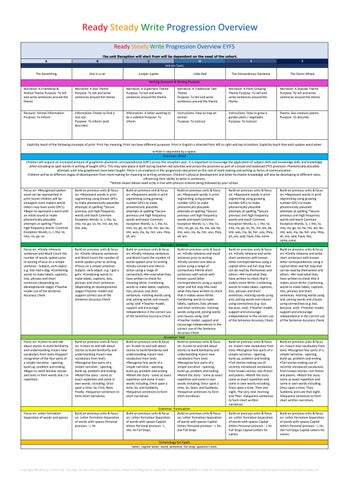
Explicitly teach of the following concepts of print: Print has meaning; Print can have different purposes; Print in English is directed from left to right and top to bottom. Explicitly teach that each spoken word when written is separated by a space. Grammar: Word Children will acquire an increased amount of grapheme-phoneme correspondences (GPC) across the reception year. It is important to encourage the application of subject skills and knowledge skills and knowledge when encoding to spell words in writing of taught GPCs. This may take place in both during teacher-led activities and across the provision as part of a broad and balanced EYFS provision. Phonemically plausible attempts until new graphemes have been taught. There is an emphasis in this progression document on the role of mark making and writing as forms of communication. Children will be at different stages of development from mark making for meaning to writing sentences. Children's physical development and letter formation knowledge will also be developing at different rates, influencing their ability to write in sentences. *Words shown below need to be in line with phonics scheme being followed by your school. Focus on: •Recognised spoken word can be represented in print (some children will be emergent mark makers whilst others may have some GPCs) •Begin to represent a word with an initial sound or make phonemically plausible attempts at spelling *Teach high frequency words: Common Exception Words; is, I, the, to, into, no, go, so
Build on previous units & focus on: •Represent words in print segmenting using known GPCs to make phonemically plausible attempts at spelling *Secure previous unit high frequency words and teach Common Exception Words; is, I, the, to, into, no, go, so, he, me, we, be, she, was
Focus on: •Orally rehearse sentences and Word Count the number of words spoken prior to writing •Focus on a simple sentence - Subject, verb object. e.g. Dan had a dog. •Combining words to make labels, captions, lists, phrases and short sentences (depending on developmental stage) •Teacher model use of the Sentence Accuracy Check
Build on previous units & focus on: •Orally rehearse sentences and Word Count the number of words spoken prior to writing •Focus on a simple sentence Subject, verb object. e.g. I got a gem. •Combining words to make labels, captions, lists, phrases and short sentences (depending on developmental stage) •Teacher model and support correct use of the Sentence Accuracy Check
Focus on: •Listen to and talk about stories to build familiarity and understanding •Learn new vocabulary from texts •Support recognition of the four parts of a simple narrative - opening, build up, problem and ending •Begin to retell familiar stories and texts in their words and / or repetition.
Build on previous units & focus on: •Listen to and talk about stories to build familiarity and understanding •Learn new vocabulary from texts •Recognise four parts of a simple narrative - opening, build up, problem and ending •Retell the story - some as exact repetition and some in own words. including; Once upon a time, So, First, Next, Finally. •Sequence sentences to form short narratives.
Focus on: Letter formation Separation of words and spaces
Build on previous units & focus on: Letter formation Separation of words with spaces Personal pronoun - I, he
Build on previous unit & focus on: •Represent words in print segmenting using growing number GPCs to make phonemically plausible attempts at spelling *Secure previous unit high frequency words and teach Common Exception Words; is, I, the, to, into, no, go, so, he, me, we, be, she, was, my, by, her, you, they, all, are
Build on previous units & focus on: •Represent words in print segmenting using growing number GPCs to make phonemically plausible attempts at spelling *Secure previous unit high frequency words and teach Common Exception Words; is, I, the, to, into, no, go, so, he, me, we, be, she, was, my, by, her, you, they, all, are
Grammar: Sentence Build on previous units & focus Build on previous units & focus on: •Orally rehearse sentences on: •Orally rehearse and recall and Word Count the number of sentence prior to writing words spoken prior to writing •Orally connect one idea or •Orally connect one idea or action using a range of action using a range of connectives •Write short connectives •Re-read what they sentences with words with have written to check for known sound letter meaning Write: Combining correspondences using a capital words to make labels, captions, letter and full stop •Re-read lists, phrases and short what they have written to check sentences. •Joining words using that it makes sense Write: and, joining words and clauses Combining words to make using 'and' •Teacher model, labels, captions, lists, phrases support and encourage and short sentences. •Joining independence in the correct use words using and, joining words of the Sentence Accuracy Check and clauses using 'and' •Teacher model, support and encourage independence in the correct use of the Sentence Accuracy Check Grammar: Text Build on previous units & focus Build on previous units & focus on: •Listen to and talk about on: •Listen to and talk about stories to build familiarity and stories to build familiarity and understanding •Learn new understanding •Learn new vocabulary from texts vocabulary from texts •Recognise four parts of a •Recognise four parts of a simple narrative - opening, simple narrative - opening, build up, problem and ending build up, problem and ending •Retell the story - some as exact •Retell the story - some as exact repetition and some in own repetition and some in own words including; Once upon a words including; Once upon a time, So, and Suddenly. time, So, Soon, and Suddenly. •Sequence sentences to form •Sequence sentences to form short narratives. short narratives.
Grammar: Punctuation Build on previous units & focus Build on previous units & focus on: Letter formation Separation on: Letter formation Separation of words with spaces Capital of words with spaces Capital letters Personal pronoun - I, letters Personal pronoun - I, he, she, he Full Stops she Full Stops
Build on previous units & focus on: •Represent words in print segmenting using growing number GPCs to make phonemically plausible attempts at spelling *Secure previous unit high frequency words and teach Common Exception Words; is, I, the, to, into, no, go, so, he, me, we, be, she, was, my, by, her, you, they, all, are, said, have, like, some
Build on previous units & focus on: •Represent words in print segmenting using growing number GPCs to make phonemically plausible attempts at spelling *Secure previous unit high frequency words and teach Common Exception Words; is, I, the, to, into, no, go, so, he, me, we, be, she, was, my, by, her, you, they, all, are, said, have, like, some,come
Build on previous units & focus on: •Orally rehearse and write: short sentences with known letter correspondences using a capital letter and full stop that can be read by themselves and others. •Re-read what they have written to check that it makes sense Write: Combining words to make labels, captions, lists, phrases and short sentences. •Joining words using and, joining words and clauses using connectives (e.g. but, because, and). •Teacher model, support and encourage independence in the correct use of the Sentence Accuracy Check
Build on previous units & focus on: •Orally rehearse and write: short sentences with known letter correspondences using a capital letter and full stop that can be read by themselves and others. •Re-read what they have written to check that it makes sense Write: Combining words to make labels, captions, lists, phrases and short sentences. •Joining words using and, joining words and clauses using connectives (e.g. but, because, and). •Teacher model, support and encourage independence in the correct use of the Sentence Accuracy Check
Build on previous units & focus on: •Learn new vocabulary from texts •Recognise four parts of a simple narrative - opening, build up, problem and ending •Tell stories making use of recently introduced vocabulary from known stories, non-fiction and poems. •Retell the story some as exact repetition and some in own words including; Once upon a time, Then one night, The very next morning and Then. •Sequence sentences to form short written narratives.
Build on previous units & focus on: •Learn new vocabulary from texts •Recognise four parts of a simple narrative - opening, build up, problem and ending •Tell stories making use of recently introduced vocabulary from known stories, non-fiction and poems. •Retell the story some as exact repetition and some in own words including; Once upon a time, Then, Suddenly and Late that night. •Sequence sentences to form short written narratives.
Build on previous units & focus on: Letter formation Separation of words with spaces Capital letters Personal pronoun - I, he Full Stops Capital Letters for names
Build on previous units & focus on: Letter formation Separation of words with spaces Capital letters Personal pronoun - I, he, she Full Stops Capital Letters for names
Terminology for Pupils letter, capital letter, word, sentence, full stop, question mark
Copyright ©Literacy Counts Ltd. You may use this resource freely in your school or setting but it cannot be reproduced, modified or used for commercial purposes without the express permission of Literacy Counts Ltd.