Scholes Junior and Infant School Geography Substantive Knowledge Progression Locational
Red denotes knowledge from the National curriculum taught within another area/subject Reception Year 1 Year 2 Year 3 Year 4 Year 5 Year 6
Key Stage 3
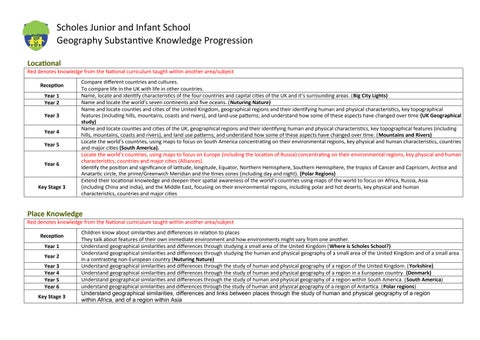
Compare different countries and cultures. To compare life in the UK with life in other countries. Name, locate and identify characteristics of the four countries and capital cities of the UK and it’s surrounding areas. (Big City Lights) Name and locate the world’s seven continents and five oceans. (Nuturing Nature) Name and locate counties and cities of the United Kingdom, geographical regions and their identifying human and physical characteristics, key topographical features (including hills, mountains, coasts and rivers), and land-use patterns; and understand how some of these aspects have changed over time (UK Geographical study) Name and locate counties and cities of the UK, geographical regions and their identifying human and physical characteristics, key topographical features (including hills, mountains, coasts and rivers), and land use patterns; and understand how some of these aspects have changed over time. (Mountains and Rivers) Locate the world’s countries, using maps to focus on South America concentrating on their environmental regions, key physical and human characteristics, countries and major cities (South America). Locate the world’s countries, using maps to focus on Europe (including the location of Russia) concentrating on their environmental regions, key physical and human characteristics, countries and major cities (Alliances). Identify the position and significance of latitude, longitude, Equator, Northern Hemisphere, Southern Hemisphere, the tropics of Cancer and Capricorn, Arctice and Anatartic circle, the prime/Greenwich Meridian and the times zones (including day and night). (Polar Regions) Extend their locational knowledge and deepen their spatial awareness of the world’s countries using maps of the world to focus on Africa, Russia, Asia (including China and India), and the Middle East, focusing on their environmental regions, including polar and hot deserts, key physical and human characteristics, countries and major cities
Place Knowledge
Red denotes knowledge from the National curriculum taught within another area/subject Reception Year 1 Year 2 Year 3 Year 4 Year 5 Year 6 Key Stage 3
Children know about similarities and differences in relation to places They talk about features of their own immediate environment and how environments might vary from one another. Understand geographical similarities and differences through studying a small area of the United Kingdom (Where is Scholes School?) Understand geographical similarities and differences through studying the human and physical geography of a small area of the United Kingdom and of a small area in a contrasting non-European country (Nuturing Nature) Understand geographical similarities and differences through the study of human and physical geography of a region of the United Kingdom. (Yorkshire) Understand geographical similarities and differences through the study of human and physical geography of a region in a European country. (Denmark) Understand geographical similarities and differences through the study of human and physical geography of a region within South America. (South America) understand geographical similarities and differences through the study of human and physical geography of a reigon of Antartica. (Polar regions) Understand geographical similarities, differences and links between places through the study of human and physical geography of a region within Africa, and of a region within Asia