Developing Experts – Progression of Knowledge Document Unit
YEAR 1
YEAR 2
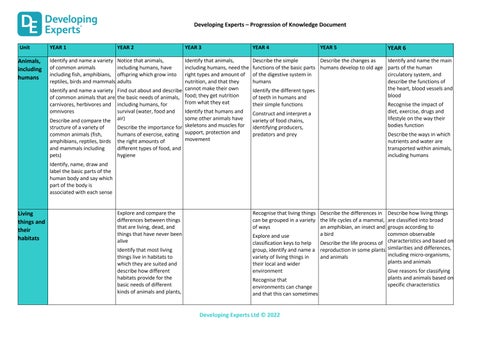
Animals, including humans
Identify and name a variety Notice that animals, of common animals including humans, have including fish, amphibians, offspring which grow into reptiles, birds and mammals adults
YEAR 3
YEAR 4
YEAR 5
Identify that animals, Describe the simple Describe the changes as including humans, need the functions of the basic parts humans develop to old age right types and amount of of the digestive system in nutrition, and that they humans cannot make their own Identify and name a variety Find out about and describe Identify the different types of common animals that are the basic needs of animals, food; they get nutrition of teeth in humans and from what they eat carnivores, herbivores and including humans, for their simple functions omnivores
Describe and compare the structure of a variety of common animals (fish, amphibians, reptiles, birds and mammals including pets)
survival (water, food and air)
YEAR 6 Identify and name the main parts of the human circulatory system, and describe the functions of the heart, blood vessels and blood Recognise the impact of diet, exercise, drugs and lifestyle on the way their bodies function
Identify that humans and some other animals have Describe the importance for skeletons and muscles for humans of exercise, eating support, protection and movement the right amounts of
Construct and interpret a variety of food chains, identifying producers, predators and prey
Explore and compare the differences between things that are living, dead, and things that have never been alive
Recognise that living things Describe the differences in Describe how living things can be grouped in a variety the life cycles of a mammal, are classified into broad of ways an amphibian, an insect and groups according to a bird common observable Explore and use classification keys to help Describe the life process of characteristics and based on group, identify and name a reproduction in some plants similarities and differences, including micro-organisms, variety of living things in and animals plants and animals their local and wider
different types of food, and hygiene
Describe the ways in which nutrients and water are transported within animals, including humans
Identify, name, draw and label the basic parts of the human body and say which part of the body is associated with each sense
Living things and their habitats
Identify that most living things live in habitats to which they are suited and describe how different habitats provide for the basic needs of different kinds of animals and plants,
environment
Recognise that environments can change and that this can sometimes
Developing Experts Ltd © 2022
Give reasons for classifying plants and animals based on specific characteristics