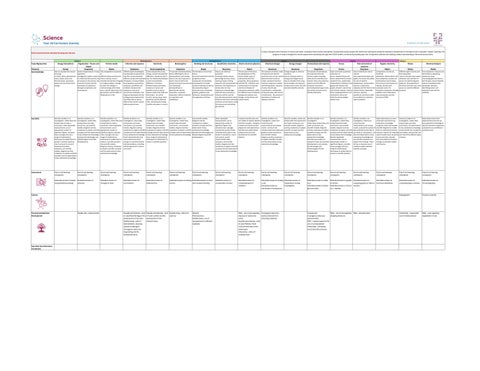
In years 10 pupils have 8 lessons of science per week, covering all three science disciplines. During these lessons pupils will revisit prior learning ensuring that learning is retrieved and re-encoded to aid in long term ‘deeper’ learning. The program of study is designed to ensure pupils move seamlessly through their GCSE studies, continuously building upon the 10 big ideas outlined and enabling a deep understanding of the world around them.
Brief overview how the intended learning over the year
Topic/Big Question Theme(s) Key Knowledge
Energy Calculations Energy
Trinity 2 Organisation - Tissues and Organs Organisms
How to calculate the amount of energy in kinetic stores, gravitational stores, elastic stores and thermal stores, work done, power and how these link to energy.
Particle model Matter
Michaelmas 1 Infection and response Electricity Organisms
Electromagnetism
Levels of organisation in living The arrangement of particles Different types of pathogens, Series and parallel circuits, organisms, in how diseases are spread and charge, current and potential the digestive system, nutrients different states and how this how this can be prevented difference, resistance, Ohm’s in a balanced diet and the role links to density, how to different causes and treatment law, the relationship between of enzymes in this process. the calculate the density of regular of diseases in humans before current and potential structure of plants and the an irregular objects, changes learning about vaccinations, difference in resistors, movement of substances of state, the changes in antibiotics, painkillers and filament lamps and diodes, through transpiration and internal energy when these antibiotic resistance the resistance in series and translocation. occur, specific latent heat and production and use of parallel circuits as well as gas pressure and the effect of monoclonal antibodies, new special resistors like LDRs and temperature on this. drugs are developed and the thermistors, AC and DC testing process diseases that current, wiring a plug, mains may affect plants, how to electricity and the National detect them and the natural Grid, calculating the energy defences plants have. transfer and power in circuits.
Bioenergetics Organisms
Michaelmas 2 Bonding and structures Quantitative chemistry Matter
The process of photosynthesis, The formation of ions from factors affecting the rate of atoms, photosynthesis and limiting how ionic bonds form and the factors, the uses of glucose in properties of ionic plants, how to test for the compounds, the formation presence of starch and how we and properties of simple can manipulate covalent molecules as well as photosynthesis in the properties of giant greenhouses, aerobic structures such as diamond, respiration, anaerobic graphite, graphene and respiration, effects of exercise fullerenes, nanoparticles and on respiration and the applications of these. metabolism.
Reactions
Lent 1
Lent 2
Atomic structure (physics)
Chemical changes
Energy changes
Homeostasis and response
Forces
Matter
Reactions
Reactions
Organisms
Forces
Trinity 1 Rate and extent of reactions Reactions
Scalar and vector quantities, How to identify the rate of interaction of reaction forces, resultant forces and from experimental data and how to determine the overall graphs, the factors that affect resultant force, acceleration, the rate of reaction interpretation of distance time (temperature, concentration, graphs and velocity time pressure, surface area, graphs, Newton’s second law catalysts) and link them to the and terminal velocity, reaction collision theory. Reversible times, stopping distances and reactions, dynamic momentum, forces and equilibrium and how to alter elasticity and investigate the conditions to maximise Hooke’s law. yield of products
Organic chemistry
Waves
Matter
Waves
Chemical Analysis Matter
How to use chemical The structure of the atom, The reactions of metals, metal Energy changes in chemical quantities the development of the compounds and how the reactions, including relative masses, atomic model, types of reactivity series can be used to how to represent them on percentage by mass, moles, radioactivity and their determine how to extract energy level diagrams and reacting masses, limiting properties, decay equations metals, represent chemical how to calculate them using reactants and concentration of and half-life, irradiation and reactions using word, symbol bond energies, the reactions solutions, the importance of contamination of materials and half-equations, reactions inside chemical cells, fuel cells conservation of mass. and how to dispose of of acids, the pH scale, and their benefits and risks. importance of percentage radioactive substances safely, neutralisation, making salts, yield and atom economy in the different uses of radiation, strong and weak acids and pH industry and the need for background radiation and concentration, the process of accurate measurements using dosage, nuclear fission and electrolysis of molten and titrations and how to calculate nuclear fusion. aqueous solutions. unknown concentrations using this process and calculating gas volumes.
The process of homeostasis, the responses from the nervous system including reflex actions and effects on reaction times, the endocrine systems and the different hormones involved in controlling blood sugar levels, the menstrual cycles and in fertility treatments.
Composition of crude oil, Different types of waves and fractional their properties, distillation, hydrocarbons and how to calculate wave speed, their properties, reactions of reflection and refraction of hydrocarbons and cracking. waves, the electromagnetic the structure and reactions of spectrum, the properties of alkenes, alcohols and the waves and their uses, how carboxylic acids. The waves are used for different formation of polymers through purposes. addition and condensation, natural polymers and the structure of DNA.
Pure substances, mixtures and formulations, separating substances using chromatography and how to test for gases, how to identify cations using flames tests, precipitate reactions, identifying anions and evaluative instrumental methods.
Key Skills
Identify variables in an Identify variables in an Identify variables in an investigation, collect data and investigation, collect data, investigation, collect data and analyse data to make a analyse data and make analyse data to make a conclusion, make repeatable conclusion, use scientific conclusion, make repeatable measurements, use an models, diagrams and key measurements, use an appropriate number of vocabulary to explain scientific appropriate number of significant figures, calculate concepts and link observations significant figures, calculate mean averages and use a to key substantive knowledge, mean averages and use a range of mathematical evaluate the advantages and range of mathematical techniques to enable them to disadvantages of scientific techniques to enable them to answer a scientific question. developments. answer a scientific question. Use SI units and to convert Use scientific models, measurements when diagrams and key vocabulary necessary, use scientific to explain scientific concepts models, diagrams and key and link observations to key vocabulary to explain scientific substantive knowledge. concepts and link observations to key substantive knowledge.
Identify variables in an Identify variables in an Identify variables in an Use scientific models, investigation, collect data, investigation, collect data, investigation, collect data, diagrams and key analyse data and make analyse data and make analyse data and make vocabulary to explain conclusions, use scientific conclusions, use scientific conclusions, use scientific scientific concepts and link models, diagrams and key models, diagrams and key models, diagrams and key observations to key vocabulary to explain scientific vocabulary to explain scientific vocabulary to explain scientific substantive knowledge, concepts and link observations concepts and link observations concepts and link observations describe the advantages and to key substantive knowledge. to key substantive knowledge. to key substantive knowledge. disadvantages of scientific Pupils should describe how Use a range of mathematical developments. new evidence has led to techniques to enable them to changes in scientific theories. answer a scientific question. Evaluate evidence, including ethical arguments to reach a conclusion.
Make repeatable Interpret scientific data and measurements, use an use models to explain abstract appropriate number of scientific concepts, recognise, significant figures and interpret and draw scientific calculate mean averages, diagrams to aid explanations. evaluate the quality of data Describe how experimental collected and be able to use evidence has led to the results in calculations. Use SI development of scientific units and to convert theories. measurements when necessary, use scientific models, diagrams and key vocabulary to explain scientific concepts and link observations to key substantive knowledge.
Identify variables in an investigation, collect and record accurate measurements and analyse results, construct and interpret data from tables and graphs to draw conclusions. Use scientific models, diagrams and key vocabulary to explain scientific concepts and link observations to key substantive knowledge.
Identify variables, collect and analyse data from experiment and make conclusions, use scientific models, diagrams and key vocabulary to explain scientific concepts and link observations to key substantive knowledge.
Identify variables in an Identify variables in an Identify variables in an Make observations to reach Identify variables in an investigation, investigation, collect data, investigation, collect and conclusions and link to key investigation, collect data, collect data, analyse data and analyse data and make record accurate substantive knowledge, analyse data and make make conclusions, use conclusions, use scientific measurements and analyse recognise, draw and interpret conclusions, link observations scientific models, diagrams models, diagrams and key results, evaluate the quality of scientific diagrams to enable to key substantive knowledge and key vocabulary to explain vocabulary to explain scientific data collected and be able to them to understand chemical using scientific key vocabulary scientific concepts and link concepts and link observations use results in calculations. Link reactions. Explain the methods and models, evaluate the uses observations to key to key substantive knowledge. data and observations to key used to tackle issues caused by and risks of the different types substantive knowledge. Mmake repeatable substantive knowledge and human activities, describe of waves. Describe how evidence is measurements, use an use scientific vocabulary to how new evidence has led to needed to make new scientific appropriate number of explain their findings. There changes to scientific models developments and evaluate significant figures, calculate will be an extensive use of and theories. the advantages and mean averages and use a models to explain abstract disadvantages of these range of mathematical scientific concepts. developments. techniques to enable them to answer a scientific question.
Make observations from experimental work and use key substantive knowledge to identify unknown compounds, evaluate the use of different analytical tests.
Assessment
End of unit learning checkpoint.
End of unit learning checkpoint.
End of unit learning checkpoint.
End of unit learning checkpoint.
End of unit learning checkpoint.
End of unit learning checkpoint.
End of unit learning checkpoint.
End of unit learning checkpoint.
End of unit learning checkpoint.
Extended answer on conservation of mass.
Extended answer on comparing types of radiation.
Extended answer on making Extended answer on a salt. temperature change Extended answer on investigation. electrolysis of substances.
Extended answer on reflex arcs. Extended answer on blood glucose levels.
Extended answer on graphs Extended answer on Extended answer on of motion. analysing graphs of rates of fractional distillation. Extended answer on forces reaction. on a skydiver.
Extended answer on comparing types of waves.
Extended answer on chromatography.
Radiographer
Forensic scientist
Citizenship - responsible use of mobile phones
FBVs - rules regarding ingredients in food
End of unit learning checkpoint.
End of unit learning checkpoint.
End of unit learning checkpoint.
End of unit learning checkpoint.
End of unit learning checkpoint.
Extended answer on kinetic Extended answer on and gravitaitonal energy. enzymes.
Extended answer on changes of state.
Extended answer on vaccinations.
Extended answer on National Grid.
Extended answer on limiting Extended answer on ionic factors. and covalent bonding.
End of unit learning checkpoint.
End of unit learning checkpoint.
Careers
Personal and Spiritual Development
Any other key information (if relevant)
Healthy diet - balanced diet
Equality and diversity - work Equality and diversity - work Healthy living - effects of of Lady Mary Montagu in the of Lewis Latimer and the exercise development of vaccines development of the Healthy living - work of filament lamp Semmelweiss, reducing spread of pathogens Courageous advocacy drug testing and the thalidomide story
Wisdom Perserverance Healthy living - use of nanoparticles in different materials
FBVs - rule of law regarding Courageous advocacy disposal of radioactive waste prodcued from waste extracting materials Equality and diversity - work of Leise Meitner, Marie Curie and the story of the radium girls Citizenship - ethics of irradated food
Compassion FBVs - rule of law regarding FBVs - industrial laws Courageous advocacy stopping distances period poverty FBVs - mutual respect in the use of contraceptives Citizenship - evaluating social and ethical issues
End of unit learning checkpoint.