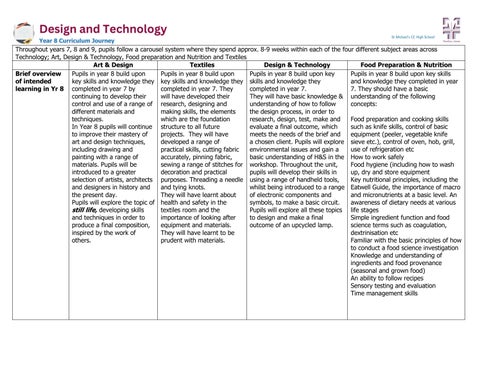

Throughout years 7, 8 and 9, pupils follow a carousel system where they spend approx. 8-9 weeks within each of the four different subject areas across Technology; Art, Design & Technology, Food preparation and Nutrition and Textiles Art & Design Textiles Design & Technology Food Preparation & Nutrition
Brief overview of intended learning in Yr 8
Pupils in year 8 build upon key skills and knowledge they completed in year 7 by continuing to develop their control and use of a range of different materials and techniques.
In Year 8 pupils will continue to improve their mastery of art and design techniques, including drawing and painting with a range of materials. Pupils will be introduced to a greater selection of artists, architects and designers in history and the present day.
Pupils will explore the topic of stilllife, developing skills and techniques in order to produce a final composition, inspired by the work of others.
Pupils in year 8 build upon key skills and knowledge they completed in year 7. They will have developed their research, designing and making skills, the elements which are the foundation structure to all future projects. They will have developed a range of practical skills, cutting fabric accurately, pinning fabric, sewing a range of stitches for decoration and practical purposes. Threading a needle and tying knots. They will have learnt about health and safety in the textiles room and the importance of looking after equipment and materials. They will have learnt to be prudent with materials.
Pupils in year 8 build upon key skills and knowledge they completed in year 7.
They will have basic knowledge & understanding of how to follow the design process, in order to research, design, test, make and evaluate a final outcome, which meets the needs of the brief and a chosen client. Pupils will explore environmental issues and gain a basic understanding of H&S in the workshop. Throughout the unit, pupils will develop their skills in using a range of handheld tools, whilst being introduced to a range of electronic components and symbols, to make a basic circuit. Pupils will explore all these topics to design and make a final outcome of an upcycled lamp.
Pupils in year 8 build upon key skills and knowledge they completed in year 7. They should have a basic understanding of the following concepts:
Food preparation and cooking skills such as knife skills, control of basic equipment (peeler, vegetable knife sieve etc.), control of oven, hob, grill, use of refrigeration etc
How to work safely
Food hygiene (including how to wash up, dry and store equipment
Key nutritional principles, including the Eatwell Guide, the importance of macro and micronutrients at a basic level. An awareness of dietary needs at various life stages
Simple ingredient function and food science terms such as coagulation, dextrinisation etc
Familiar with the basic principles of how to conduct a food science investigation Knowledge and understanding of ingredients and food provenance (seasonal and grown food)
An ability to follow recipes
Sensory testing and evaluation
Time management skills

Topic/Big Question
Theme(s) History of art- Looking at how still life has evolved over the year (Traditional/Historic/ Contemporary artists)
Formal Elements of Art:
Line, tone, texture, shape, colour, space
Artistic skills and techniques- Paul Cezanne and Sarah Graham
Key Knowledge

• How to use a sketchbook to plan and develop work.
• Annotate, reflect, refine and modify their work. Responding to feedback.
• Understand how to use a range of different materials –pencil crayons, felt pens (water-based) clay, paint and how to refine their use of these materials.
• Develop an understanding of the principles of working safely during practical lessons.
• Analyse the work of different artists, in
Promoting a Charity –creating a design which can be stencilled onto a bag and promote the charity.
Formal Elements of Art:
Line, shape, colour, pattern,
Artistic skills and techniques- Andy Warhol
• Key information about a chosen charity.
• Understanding of layout and imagery from existing promotional merchandise.
• Artist research- Pop Art and the work of Andy Warhol.
• Stencilling and screen-printing techniques
• How to make a stencil
• Colour mixing and painting
• Colour theoryComplementary colours
• Blending colours
• How to experiment with colour and layout.
Art Movement- Bauhaus
Environmental impacts

Food Safety
Food, Nutrition and Health
Food Commodities
Food Provenance
Food Choice
Food Science
Practical Skills
• Research into existing products
• Research into the impact of what humans are doing to our world to damage the earth to bring on Global warming?
• Introduction to what is the Bauhaus style.
• Develop skills in technical working drawing for their lamp
• What are the 6 Rs? What is Sustainable Development?
• Key properties, uses and function of Timber.
• Develop knowledge and understanding of using a wide range of hand tools and equipment.
• Develop knowledge and understanding of how to
• Food Safety Bacteria, temperature control and food storage
• Food Nutrition and Health 8 tips for healthy eating Protein
• Food Commodities
Meat Poultry Fish
Soya, tofu, beans, nuts and seeds
Milk and cheese
• Food Provenance
Food waste
Reared food
Caught food
Food processing (primary and secondary)
• Food Choice

order to produce their own interpretation.
• Undertake independent research and to work independently.
• Develop skills in oneand two-point perspective.
• Explore ways to develop their own ideas from a given starting point.
• Colour theory
• Colouring mixing and accurate, consistent application of paint.
Key Skills Materials:

• pencils (different grades/ tonal shading to make objects appear 3-demintional)
• Pencil shading
• Painting- How to mix and apply paint precisely and accurately, Techniques:
• Shading
• One- and two-point perspective.
• Drawing from observations
• Applying paint accurately and precisely.
• How to create a professional finish when stencilling.
• Learning about sustainability and fast fashion.
• Understanding how to minimise consumption of fabric and clothing and why it is important.
create a simple parallel circuit.
• Develop basic understanding of levers, links to the final product

Costing recipes and making recipes cheaper
Sensory evaluation, star profile
• Food Science Chemical raising agents' investigation
Reduction sauces Using acid to set protein
• Practical skills
Producing mainly medium skilled savoury dishes.
Practical Skills
• Researching a chosen charity. Working independently.
• Presenting research creatively.
• Drawing, developing and annotating designs
• Making stencils
• Using a craft knife safely
• Understand how to work in a safe environment
• Colour mixing and blending
• Printing designs with fabric paints and stencils.
• Research- Existing products/ the work of others/ art movementBauhaus.
• Developing skills in writing a design brief and design specification
• Developing technical drawing skills –Orthographic
• Generating a range of ideas based on research.
• Use a range of hand help tools, sander and pillar drill, safely and accurately.
• Develop knowledge and skills of how to create a simple parallel circuit.
• Dry frying
• Making reduction sauces
• Use of chemical raising agents
• Raising agents – steam
• Roll out ready-made pastry
• Shaping and finishing a dough
• Using acid to set protein
• Test for readiness
• Presenting attractively and portion control.

• Learning how to create an ‘eye catching’ design to promote a charity in a piece of promotional merchandise.
• Embelishing techniques with stitching, beads, sequins and buttons.
• Use CAD to create a decorative design for the lamp wrap.

Assessment Assessment ONEKnowledge checkpoint Two-point perspective

Assessment TWOLearning review
Composite taskFinal composition of Still life drawing.
Assessing how pupils have used all components which have been taught throughout the unit, to apply these knowledge and skills to complete a final composite task in the firm of a final piece.

Assessment ONEKnowledge checkpoint Research and design development
Assessment TWOLearning review Composite task- Final piece
Promotional merchandise for a charity.
Assessment ONE- Knowledge checkpoint Research and Design Development
Assessment TWO- Learning review
Composite taskFinal Outcome.
A fully functional lamp, which has been constructed using a range of tools and materials, incorporating all the components developed throughout the unit.
Assessment ONE- Knowledge checkpoint
Food investigation
Assessment TWO- Learning review
Composite task- Practical
Knowledge of how to apply practical skills
Work with accuracy, pay attention to presentation and produce a dish with a quality finish
Competently organise practical work and complete dish on time
Independently make judgements when testing dish to see if it is cooked
the KS4 Art, Textiles and Technology exhibition Electronic Engineers, Electrician, Architect, CAD engineer, Video Game Design
Food Technologist Microbiologist


Creativity- having the opportunity to flourish with their own creative thinking and skills.
Curiosity- New skills and techniques, Explore a range of artists from different cultures and countries.
Compassion, Service, Hope: raising awareness of a charity which is personal
Christian Values – Creativity, endurance, resilience, stewardship, hope Character Attributes – curiosity, respectful, reflective
Spirituality features in design and technology as it provides the platform for children to create artefacts that reflect their personal beliefs, values and experiences. Through designing and creating products, children can express their spirituality and explore their connection with nature, other people and their own emotions.

Christian Values – creativity, compassion, hope, stewardship Character Attributes – curiosity Spirituality – If we create for a higher purpose, we develop spiritually. For example, when considering the special dietary needs of others, when choosing ingredients, and making dishes.
Any other key information
KS3 Art Club
An opportunity to help make props for the production.
Textiles Club
An opportunity to help make costumes for the production.