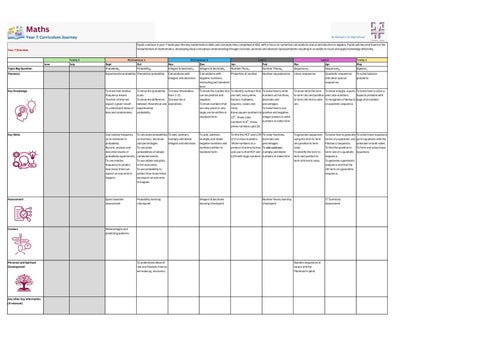
Pupils continue in year 7 build upon the key mathematical skills and concepts they completed at KS2, with a focus on numerical calculations and an introduction to algebra. Pupils will become fluent in the fundamentals of mathematics, developing deep conceptual understanding through concrete, pictorial and abstract representations resulting in an ability to recall and apply knowledge efficiently.
Year 7 Overview Trinity 2 July
Michaelmas 1 Oct Probability2
Topic/Big Question
Sept Probability1
Theme(s)
Experimental probability Theoretical probability
Key Knowledge
To know that relative frequency means 'fraction of time we expect a given result'. To understand ideas of bias and randomness.
June
Michaelmas 2 Nov Dec Integers & decimals2 Integers & decimals1 Calculations with integers and decimals
To know the probability To know timestables scale. from 1-12. To know the difference To know the 4 between theoretical and operations. experimental probability.
Jan Number Thory1
Lent 1 Feb Number Theory2
Calculations with Properties of number Number equivalencies negative numbers, estimating and standard form To know the number line To identify numbers that To know how to write can be positive and are odd, even,prime, numbers as fractions, negative. factors, multiples, decimals and To know numbers that squares, cubes and percentages. are very small or very roots. To know how to use large can be written in Know square numbers to positive and negative 2 standard form. integer powers to write 15 . Know cube 3 numbers in index form. numbers to 6 . Know
Mar Sequences1
Lent 2 Apr Sequences2
Linear sequences
Quadratic sequences and other special sequences
Trinity 1 May Algebra1 To solve balance problems
To know what the term To know triangle, square To know how to solve a balance problem with to term rule and position and cube numbers. to term (nth term) rules To recognise a Fibonacci bags and marbles. or quadratic sequence are.
prime numbers upto 29. Key Skills
Use relative frequency To calculate probabilties To add, subtract, as an estimate of as fractions, decimals multiply and divide probability. and percentages. integers and decimals. Record, analyse and To calculate describe results of probabilities of simple probability experiments. combined events. To use relative To use tables and grids frequency to predict to list outcomes. how many times we To use probability to expect an outcome to predict how many times happen. we expect an outcome to happen.
To add, subtract, multiply and divide negative numbers and numbers written in standard form.
Assessment
Sparx baseline assessment
Integers & decimals learning checkpoint
Careers
Meteorologist and predicting patterns
Personal and Spiritual Development
Any other key information (if relevant)
Probability learning checkpoint
To understand ideas of risk and lifestyle choices we make eg. insurance.
To find the HCF and LCM To order fractions, of 2 or more numbers. decimals and Write numbers as a percentages. product of prime factors To add subtract, and use to find HCF and multiply and divide LCM with large numbers numbers in index form
To generate sequences using the term to term and position to term rules. To identify the term to term and position to term (nth term) rules.
Number theory learning checkpoint
To know how to generate To solve linear equations terms of a quadratic and up to equations with the unknown on both sides. Fibonacci sequence. To form and solve linear To find the position to term rule of a quadratic equations. sequence To generate a geometric sequence and find the nth term of a geometric sequence.
Y7 Summary Assessment
Number sequences in nature and the Fibonnachi spiral