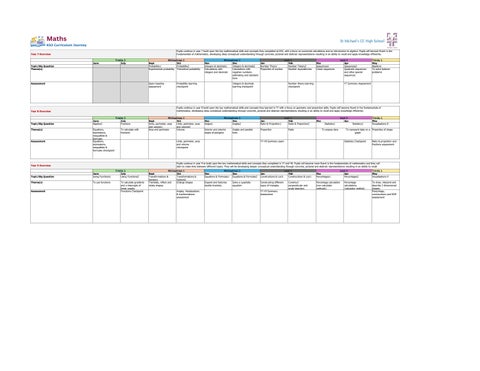
Pupils continue in year 7 build upon the key mathematical skills and concepts they completed at KS2, with a focus on numerical calculations and an introduction to algebra. Pupils will become fluent in the fundamentals of mathematics, developing deep conceptual understanding through concrete, pictorial and abstract representations resulting in an ability to recall and apply knowledge efficiently.
Year 7 Overview
June
Trinity 2 July
Topic/Big Question Theme(s)
Assessment
Sparx baseline assessment
Theme(s)
Assessment
June Algebra2 Equations, expressions, inequalities & formulae Equations, expressions, inequalities & formulae checkpoint
Trinity 2 July Fractions To calculate with fractions
Probability learning checkpoint
Integers & decimals learning checkpoint
Michaelmas 1 Sept Oct Units, perimeter, area Units, perimeter, area and volume1 and volume2 Area and perimeter Volume
Nov Angles1
Michaelmas 2 Dec Angles2
Interior and exterior anges of polygons
Angles and parallel lines
Mar Sequences1 Linear sequences
Lent 2 Apr Sequences2 Quadratic sequences and other special sequences
Number theory learning checkpoint
Trinity 1 May Algebra1 To solve balance problems
Y7 Summary Assessment
Jan Ratio & Proportion1 Proportion
Lent 1 Feb Ratio & Proportion2 Ratio
Lent 2 Apr
Mar Statistics1
Statistics2
To anayse dara
Trinity 1 May Visualisations 8
To represent data on a Properties of shape graph
Y7-Y8 Summary exam
Units, perimeter, area and volume checkpoint
Statistics Checkpoint
Ratio & proportion and fractions assessment
Pupils continue in year 9 to build upon the key mathematical skills and concepts they completed in Y7 and Y8. Pupils will become more fluent in the fundamentals of mathematics and they will start to make links between different topics. They will be developing deeper conceptual understanding through concrete, pictorial and abstract representations resulting in an ability to recall
Year 9 Overview
Topic/Big Question
June Using Functions1
Theme(s)
To use functions
Assessment
Michaelmas 2 Lent 1 Nov Dec Jan Feb Integers & decimals1 Integers & decimals2 Number Thory1 Number Theory2 Properties of number Number equivalencies Calculations with Calculations with integers and decimals negative numbers, estimating and standard form
Pupils continue in year 8 build upon the key mathematical skills and concepts they learned in Y7 with a focus on geometry and proportion skills. Pupils will become fluent in the fundamentals of mathematics, developing deep conceptual understanding through concrete, pictorial and abstract representations resulting in an ability to recall and apply knowledge efficiently;
Year 8 Overview
Topic/Big Question
Michaelmas 1 Sept Oct Probability1 Probability2 Experimental probability Theoretical probability
Trinity 2 July Using Functions2 To calculate gradients and y-intercepts of linear graphs Functions Checkpoint
Michaelmas 1 Sept Oct Transformations & Transformations & Vectors1 Vectors2 Translate, reflect and Enlarge shapes rotate shapes Angles, Visulaisations & tranformations assessment
Michaelmas 2 Nov Dec Equations & Formulae1 Equations & Formulae2
Jan Constructions & Loci1
Expand and factorise double brackets.
Constructing different types of triangles.
Solve a quadratic equation
Y7-Y9 Summary Assessment
Lent 1 Feb Constructions & Loci1 Construct perpendicular and angle bisectors
Mar Percentages1
Lent 2 Apr Percentages2
Percentage calculation (non calculator methods)
Percentage calculations (calculator methds)
Trinity 1 May Visualisations 9 To draw, interpret and describe 3 dimensional shapes. Perecntage, conctructions and EEIF assessment