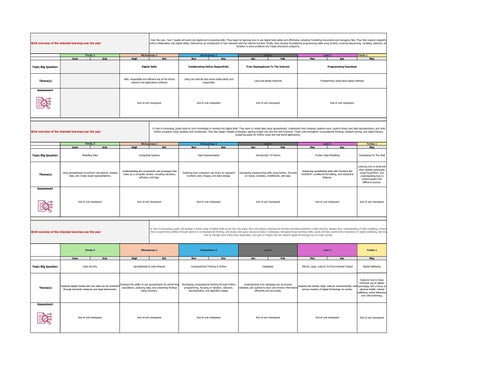
Over the year, Year 7 pupils will build core digital and computing skills. They begin by learning how to use digital tools safely and effectively, including formatting documents and managing files. They then explore respectful online collaboration and digital safety, followed by an introduction to how networks and the internet function. Finally, they develop foundational programming skills using Scratch, covering sequencing, variables, selection, and iteration to solve problems and create interactive programs.
Brief overview of the intended learning over the year
Trinity 2 June
Michaelmas 1 July
Sept
Michaelmas 2 Oct
Nov
Lent 1 Dec
Jan
Lent 2 Feb
Mar
Trinity 1 Apr
May
Topic/Big Question
Digital Skills
Collaborating Online Respectfully
From Sepmaphores To The Internet
Programming Essentials
Theme(s)
Safe, responsible and efficient use of the school network and applications software
Using the internet and social media safely and responsibly
Local and global networks
Programming using block based software
End of unit checkpoint
End of unit checkpoint
End of unit checkpoint
End of unit checkpoint
Assessment
In Year 8 computing, pupils build on prior knowledge to develop key digital skills. They learn to model data using spreadsheets, understand how computer systems work, explore binary and data representation, and write Python programs using variables and conditionals. They also design website prototypes, gaining insight into how the web functions. These units strengthen computational thinking, problem-solving, and digital literacy, preparing pupils for further study and real-world applications.
Brief overview of the intended learning over the year
Trinity 2 June
Michaelmas 1 July
Sept
Nov
Lent 2
Lent 1
Michaelmas 2 Oct
Dec
Jan
Feb
Mar
Apr
Trinity 1 May
Topic/Big Question
Modelling Data
Computing Systems
Data Representation
Introduction To Python
Further Data Modelling
Developing For The Web
Theme(s)
Using spreadsheets to perform calculations, analyse data, and create visual representations.
Understanding the components and processes that make up a computer system, including hardware, software, and logic.
Exploring how computers use binary to represent numbers, text, images, and data storage.
Developing programming skills using Python, focusing on inputs, variables, conditionals, and logic.
Advancing spreadsheet skills with functions like VLOOKUP, conditional formatting, and interactive features.
Learning how to build and style website prototypes using PowerPoint, and understanding how to embed assets from different sources.
End of unit checkpoint
End of unit checkpoint
End of unit checkpoint
End of unit checkpoint
End of unit checkpoint
End of unit checkpoint
Assessment
In Year 9 Computing, pupils will develop a broad range of digital skills across four key areas: they will explore cybersecurity threats and data protection in data security, deepen their understanding of data modelling, enhanc their programming abilities through python in computational thinking, and design and query structured data in databases. Alongside these technical skills, pupils will also examine the importance of digital wellbeing, learning how to manage their online lives responsibly, and gain an insight into the impacts digital technology has on wider society.
Brief overview of the intended learning over the year
Trinity 2 June
Michaelmas 1 July
Sept
Michaelmas 2 Oct
Nov
Lent 1 Dec
Topic/Big Question
Data Security
Spreadsheets & Data Anlaysis
Computational Thinking & Python
Theme(s)
Explores digital threats and how data can be protected through technical measures and legal frameworks.
Develops the ability to use spreadsheets for performing calculations, analysing data, and presenting findings using functions.
Developing computational thinking through Python programming, focusing on iteration, selection, decomposition, and algorithm design.
End of unit checkpoint
End of unit checkpoint
End of unit checkpoint
Jan
Lent 2 Feb
Databases
Mar
Trinity 1 Apr
Ethical, Legal, Cultural & Environmental Impact
May Digital Wellbeing
Explores how to make informed use of digitial Understanding how databases are structured, Explores the ethical, legal, cultural, environmental, and technology with a focus on validated, and queried to store and retrieve information privacy impacts of digital technology on society. physical health, mental efficiently and accurately. wellbeing, online behaviour and critical thinking.
Assessment
End of unit checkpoint
End of unit checkpoint
End of unit checkpoint