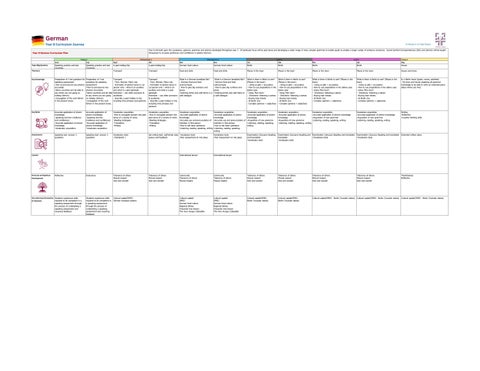
Year 8 will build upon the vocabulary, opinions, grammar and phonics developed throughout year 7. Of particular focus will be past tense and developing a wider range of more complex grammar to enable pupils to employ a larger variety of sentence structures. Sound Symbol Correspondences (SSC) and phonics will be taught throughout to increase proficiency and confidence in spoken German.
Year 8 German Curriculum Plan
Topic/Big Question
Trinity 2 June July Speaking practice and test Speaking practice and test Countries Countries
Sept A past holiday/trip
Michaelmas 1 Oct A past holiday/trip
Transport
Theme(s)
Nov German food culture
Michaelmas 2 Dec German food culture
Jan Berlin
Lent 1 Feb Berlin
Mar Berlin
Lent 2 Apr Berlin
Trinity 1 May House
Transport
Food and drink
Food and drink
Places in the town
Places in the town
Places in the town
Places in the town
House and home
What is there in Berlin to see? (Places in the town) - Using es gibt + accusative - How to use prepositions in the dative case - Using ‘Man kann’ - Directions: following a satnav - Buying train tickets - At Berlin Zoo - Complex opinions + adjectives
What is there in Berlin to see? (Places in the town) - Using es gibt + accusative - How to use prepositions in the dative case - Using ‘Man kann’ - Directions: following a satnav - Buying train tickets - At Berlin Zoo - Complex opinions + adjectives
In a Berlin home (types, rooms, activities) - My town and house (applying all grammar knowledge to be able to write an extended piece about where you live)
Vocabulary acquisition. -Accurate application of phonic knowledge. -Acquisition of new grammar -Listening, reading, speaking, writing
Writing -Reflective -Creative thinking skills
Key Knowledge
Preparation of 3 set questions for Preparation of 3 set Transport speaking assessment questions for speaking - Time, Manner, Place rule. -How to pronuounce key phonics assessment - Formation of perfect tense in 1st accurately -How to pronuounce key person only – what is an auxiliary -Name countries and be able to phonics accurately and what is a past participle say where you are going on -Name countries and be able Extension – use other pronouns & holiday (fahren) to say where you are going auxiliaries -Conjugation of the verb fahren on holiday (fahren) - Describe a past holiday or trip in the present tense. -Conjugation of the verb including time phrases and opinions. fahren in the present tense.
Transport - Time, Manner, Place rule. - Formation of perfect tense in 1st person only – what is an auxiliary and what is a past participle Extension – use other pronouns & auxiliaries - Describe a past holiday or trip including time phrases and opinions.
What is a German breakfast like? - German food and food culture/meals - How to give big numbers and prices -Ordering drinks and café items in a café dialogue
What is a German breakfast like? - German food and food culture/meals - How to give big numbers and prices -Ordering drinks and café items in a café dialogue
What is there in Berlin to see? (Places in the town) - Using es gibt + accusative - How to use prepositions in the dative case - Using ‘Man kann’ - Directions: following a satnav - Buying train tickets - At Berlin Zoo - Complex opinions + adjectives
What is there in Berlin to see? (Places in the town) - Using es gibt + accusative - How to use prepositions in the dative case - Using ‘Man kann’ - Directions: following a satnav - Buying train tickets - At Berlin Zoo - Complex opinions + adjectives
Key Skills
Accurate application of phonic knowledge. -Speaking German (resilience and confidence) -Accurate application of phonic knowledge. -Vocabulary acquisition.
Accurate application of phonic knowledge. -Speaking German (resilience and confidence) -Accurate application of phonic knowledge. -Vocabulary acquisition.
Vocabulary acquisition. -How to conjugate present into past tense of a variety of verbs. -Reading strategies. -Translation. -Writing
Vocabulary acquisition. -How to conjugate present into past tense of a variety of verbs. -Reading strategies. -Translation. -Writing
Vocabulary acquisition. Vocabulary acquisition. -Accurate application of phonic -Accurate application of phonic knowledge. knowledge. -Accurate use and pronunciation of -Accurate use and pronunciation of möchten in first person möchten in first person -How to ask basic questions. -How to ask basic questions. -Listening, reading, speaking, writing -Listening, reading, speaking, writing
Vocabulary acquisition. -Accurate application of phonic knowledge. -Acquisition of new grammar -Listening, reading, speaking, writing
Vocabulary acquisition. Vocabulary acquisition. -Accurate application of phonic -Accurate application of phonic knowledge. knowledge. -Acquisition of new grammar -Acquisition of new grammar -Listening, reading, speaking, writing -Listening, reading, speaking, writing
Assessment
Speaking test: answer 3 questions
Speaking test: answer 3 questions
Vocabulary tests -Checkpoint 1
Set writing task- self/whole class Vocabulary tests assess and feedback. -Peer assessment on role plays
Examination (January) Reading and translation -Vocabulary tests
Examination (January) Reading and Examination (January) Reading and translation Examination (January) Reading and translation Extended written piece translation -Vocabulary tests -Vocabulary tests -Vocabulary tests
Careers
Personal and Spiritual Development
Reflective
Any other key information Students experience skills required to be competent in a (if relevant) speaking assessment through the process of undertaking a speaking assessment and receiving feedback.
Endurance
Tolerance of others Mutual respect Awe and wonder
Students experience skills required to be competent in a speaking assessment through the process of undertaking a speaking assessment and receiving feedback.
Cultural capital/SMSC: German transport system.
Tolerance of others Mutual respect Awe and wonder
Vocabulary tests -Peer assessment on role plays
International lawyer
International lawyer
Community Tolerance of others Mutual respect
Community Tolerance of others Mutual respect
Tolerance of others Mutual respect Awe and wonder
Tolerance of others Mutual respect Awe and wonder
Tolerance of others Mutual respect Awe and wonder
Cultural capital/ SMSC: German food culture Regional dishes. Character tree lesson: The Very Hungry Caterpillar
Cultural capital/ SMSC: German food culture Regional dishes. Character tree lesson: The Very Hungry Caterpillar
Cultural capital/SMSC: Berlin (Youtube videos)
Cultural capital/SMSC: Berlin (Youtube videos)
Cultural capital/SMSC: Berlin (Youtube videos) Cultural capital/SMSC: Berlin (Youtube videos) Cultural capital/SMSC: Berlin (Youtube videos)
Tolerance of others Mutual respect Awe and wonder
Thankfulness Reflective