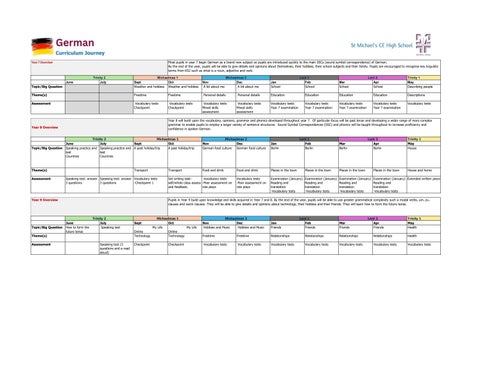
Most pupils in year 7 begin German as a brand new subject so pupils are introduced quickly to the main SSCs (sound symbol correspondence) of German. By the end of the year, pupils will be able to give details and opinions about themselves, their hobbies, their school subjects and their family. Pupils are encouraged to recognise key linguistic terms from KS2 such as what is a noun, adjective and verb.
Year 7 Overview
Topic/Big Question
Michaelmas 1 Sept Oct Weather and hobbies Weather and hobbies
Nov A bit about me
Michaelmas 2 Dec A bit about me
Theme(s)
Freetime
Freetime
Personal details
Personal details
Education
Education
Education
Education
Descriptions
Assessment
Vocabulary tests Checkpoint
Vocabulary tests Checkpoint
Vocabulary tests Mixed skills assessment
Vocabulary tests Mixed skills assessment
Vocabulary tests Year 7 examination
Vocabulary tests Year 7 examination
Vocabulary tests Year 7 examination
Vocabulary tests Year 7 examination
Vocabulary tests
June
Trinity 2 July
Trinity 2 Michaelmas 1 June July Sept Oct Speaking practice and Speaking practice and A past holiday/trip A past holiday/trip test test Countries Countries
Theme(s) Assessment
Transport Speaking test: answer Speaking test: answer Vocabulary tests 3 questions 3 questions -Checkpoint 1
Year 9 Overview
Topic/Big Question
Mar School
Lent 2 Apr School
Trinity 1 May Describing people
Transport
Michaelmas 2 Nov Dec German food culture German food culture
Jan Berlin
Food and drink
Food and drink
Places in the town
Places in the town
Places in the town
Places in the town
Vocabulary tests -Peer assessment on role plays
Examination (January) Reading and translation -Vocabulary tests
Examination (January) Reading and translation -Vocabulary tests
Examination (January) Reading and translation -Vocabulary tests
Examination (January) Extended written piece Reading and translation -Vocabulary tests
Set writing taskVocabulary tests self/whole class assess -Peer assessment on and feedback. role plays
Lent 1 Feb Berlin
Mar Berlin
Lent 2 Apr Berlin
Trinity 1 May House
House and home
Pupils in Year 9 build upon knowledge and skills acquired in Year 7 and 8. By the end of the year, pupils will be able to use greater grammatical complexity such a modal verbs, um..zu.. clauses and wenn clauses. They will be able to give details and opinions about technology, their hobbies and their friends. They will learn how to form the future tense.
June How to form the future tense
Trinity 2 July Speaking test
Theme(s) Assessment
Lent 1 Feb School
Year 8 will build upon the vocabulary, opinions, grammar and phonics developed throughout year 7. Of particular focus will be past tense and developing a wider range of more complex grammar to enable pupils to employ a larger variety of sentence structures. Sound Symbol Correspondences (SSC) and phonics will be taught throughout to increase proficiency and confidence in spoken German.
Year 8 Overview
Topic/Big Question
Jan School
Speaking test (3 questions and a read aloud)
Michaelmas 1 Oct My Life My Life Online Online Technology Technology
Michaelmas 2 Nov Dec Hobbies and Music Hobbies and Music
Jan Friends
Freetime
Freetime
Relationships
Relationships
Relationships
Relationships
Health
Checkpoint
Vocabulary tests
Vocabulary tests
Vocabulary tests
Vocabulary tests
Vocabulary tests
Vocabulary tests
Vocabulary tests
Sept
Checkpoint
Lent 1 Feb Friends
Mar Friends
Lent 2 Apr Friends
Trinity 1 May Health