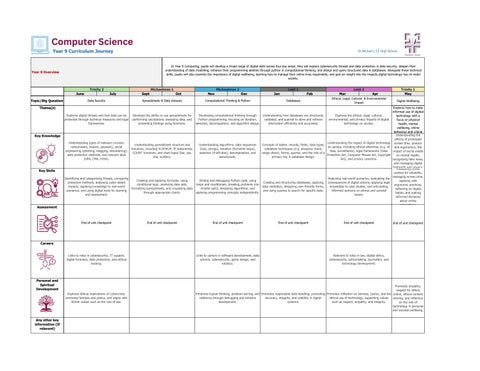
In Year 9 Computing, pupils will develop a broad range of digital skills across four key areas: they will explore cybersecurity threats and data protection in data security, deepen their understanding of data modelling, enhance their programming abilities through python in computational thinking, and design and query structured data in databases. Alongside these technical skills, pupils will also examine the importance of digital wellbeing, learning how to manage their online lives responsibly, and gain an insight into the impacts digital technology has on wider society.
Year 9 Overview
Trinity 2 June Topic/Big Question Theme(s)
Key Knowledge
Key Skills
Assessment
Michaelmas 1 July
Data Security
Sept
Michaelmas 2 Oct
Spreadsheets & Data Anlaysis
Nov
Lent 1 Dec
Computational Thinking & Python
Jan
Lent 2 Feb
Databases
Mar
Apr
Ethical, Legal, Cultural & Environmental Impact
Trinity 1 May Digital Wellbeing
Explores how to make informed use of digitial Explores digital threats and how data can be Develops the ability to use spreadsheets for Developing computational thinking through Understanding how databases are structured, Explores the ethical, legal, cultural, technology with a protected through technical measures and legal performing calculations, analysing data, and Python programming, focusing on iteration, validated, and queried to store and retrieve environmental, and privacy impacts of digital focus on physical frameworks. presenting findings using functions. selection, decomposition, and algorithm design. information efficiently and accurately. technology on society. health, mental wellbeing, online behaviour and critical Understanding the effects of prolonged Understanding types of malware (viruses, Understanding the impact of digital technology screen time, posture Understanding spreadsheet structure and Understanding algorithms, data sequences Concepts of tables, records, fields, data types, ransomware, trojans, spyware), social on society, including ethical dilemmas (e.g. AI and ergonomics, the functions, including VLOOKUP, IF statements, (lists, strings), iteration (for/while loops), validation techniques (e.g. presence check, engineering (phishing, blagging, shouldering), bias, surveillance), legal frameworks (Data impact of social media COUNT functions, and chart types (bar, pie, selection (if-elif-else), decomposition, and range check), forms, queries, and the role of a data protection methods, and relevant laws Protection Act, Computer Misuse Act, Copyright on mental health, line, scatter). pseudocode. primary key in database design. (DPA, CMA, FOIA). Act), and privacy concerns. recognising fake news, and managing digital footprints and privacy. Evaluating online content for reliability, managing screen time, Identifying and categorising threats, comparing Analysing real-world scenarios, evaluating the Creating and applying formulas, using Writing and debugging Python code, using applying safe protection methods, analysing cyber-attack Creating and structuring databases, applying consequences of digital actions, applying legal conditional logic, analysing data sets, loops and conditionals, breaking problems into ergonomic practices, impacts, applying knowledge to real-world data validation, designing user-friendly forms, knowledge to case studies, and articulating formatting spreadsheets, and visualising data smaller parts, designing algorithms, and reflecting on digital scenarios, and using digital tools for learning and using queries to search for specific data. informed opinions on ethical and societal through appropriate charts. applying programming concepts independently. habits, and making and assessment. issues. informed decisions about online interactions.
End of unit checkpoint
End of unit checkpoint
End of unit checkpoint
End of unit checkpoint
End of unit checkpoint
End of unit checkpoint
Careers Links to roles in cybersecurity, IT support, digital forensics, data protection, and ethical hacking.
Links to careers in software development, data science, cybersecurity, game design, and robotics.
Explores ethical implications of cybercrime, promotes fairness and justice, and aligns with British values such as the rule of law.
Promotes empathy, respect for others Enhances logical thinking, problem-solving, and Promotes responsible data handling, promoting Promotes reflection on fairness, justice, and the online, ethical content resilience through debugging and iterative accuracy, integrity, and usability in digital ethical use of technology, supporting values sharing, and reflection development. systems. such as respect, empathy, and integrity. on the role of technology in personal and societal wellbeing.
Personal and Spiritual Development
Any other key information (If relevant)
Relevant to roles in law, digital ethics, cybersecurity, policymaking, journalism, and technology development.