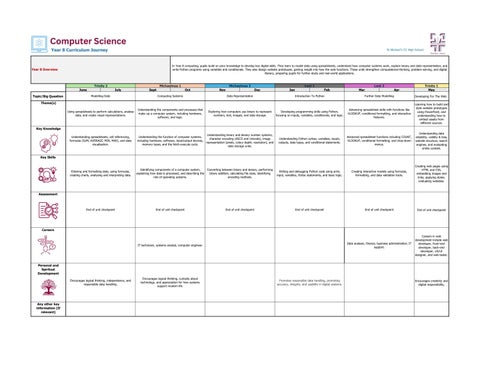
In Year 8 computing, pupils build on prior knowledge to develop key digital skills. They learn to model data using spreadsheets, understand how computer systems work, explore binary and data representation, and write Python programs using variables and conditionals. They also design website prototypes, gaining insight into how the web functions. These units strengthen computational thinking, problem-solving, and digital literacy, preparing pupils for further study and real-world applications.
Year 8 Overview
Trinity 2 June Topic/Big Question
Michaelmas 1 July
Sept
Michaelmas 2 Oct
Nov
Lent 1 Dec
Jan
Lent 2 Feb
Mar
Apr
Trinity 1 May
Modelling Data
Computing Systems
Data Representation
Introduction To Python
Further Data Modelling
Developing For The Web
Using spreadsheets to perform calculations, analyse data, and create visual representations.
Understanding the components and processes that make up a computer system, including hardware, software, and logic.
Exploring how computers use binary to represent numbers, text, images, and data storage.
Developing programming skills using Python, focusing on inputs, variables, conditionals, and logic.
Advancing spreadsheet skills with functions like VLOOKUP, conditional formatting, and interactive features.
Learning how to build and style website prototypes using PowerPoint, and understanding how to embed assets from different sources.
Understanding spreadsheets, cell referencing, formulas (SUM, AVERAGE, MIN, MAX), and data visualisation.
Understanding the function of computer systems, including hardware, software, input/output devices, memory types, and the fetch-execute cycle.
Understanding binary and denary number systems, character encoding (ASCII and Unicode), image representation (pixels, colour depth, resolution), and data storage units.
Understanding Python syntax, variables, inputs, outputs, data types, and conditional statements.
Advanced spreadsheet functions including COUNT, VLOOKUP, conditional formatting, and drop-down menus.
Understanding data reliability, validity & bias, website structure, search engines, and evaluating online content.
Entering and formatting data, using formulas, creating charts, analysing and interpreting data.
Identifying components of a computer system, explaining how data is processed, and describing the role of operating systems.
Converting between binary and denary, performing binary addition, calculating file sizes, identifying encoding methods.
Writing and debugging Python code using print, input, variables, if/else statements, and basic logic.
Creating interactive models using formulas, formatting, and data validation tools.
Creating web pages using HTML and CSS, embedding images and links, applying styles, evaluating websites.
End of unit checkpoint
End of unit checkpoint
End of unit checkpoint
End of unit checkpoint
End of unit checkpoint
End of unit checkpoint
Data analysis, finance, business administration, IT support.
Careers in web development include web developer, front-end developer, back-end developer, UX/UI designer, and web tester.
Theme(s)
Key Knowledge
Key Skills
Assessment
Careers
IT technician, systems analyst, computer engineer.
Personal and Spiritual Development Encourages logical thinking, independence, and responsible data handling.
Any other key information (If relevant)
Encourages logical thinking, curiosity about technology, and appreciation for how systems support modern life.
Promotes responsible data handling, promoting accuracy, integrity, and usability in digital systems.
Encourages creativity and digital responsibility,