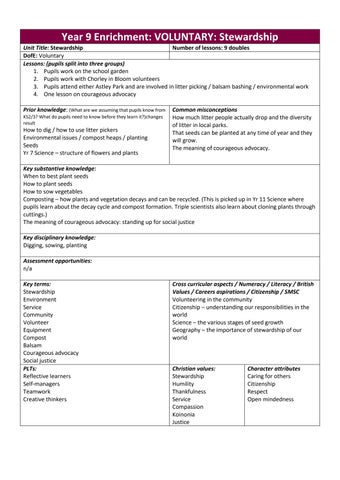
Year 9 Enrichment: VOLUNTARY: Stewardship
Unit Title: Stewardship
DofE: Voluntary
Lessons: (pupils split into three groups)
1. Pupils work on the school garden
2. Pupils work with Chorley in Bloom volunteers
Number of lessons: 9 doubles
3. Pupils attend either Astley Park and are involved in litter picking / balsam bashing / environmental work
4. One lesson on courageous advocacy
Prior knowledge: (What are we assuming that pupils know from KS2/3? What do pupils need to know before they learn it?)changes result
How to dig / how to use litter pickers
Environmental issues / compost heaps / planting
Seeds
Yr 7 Science – structure of flowers and plants
Key substantive knowledge:
When to best plant seeds
How to plant seeds
How to sow vegetables
Common misconceptions
How much litter people actually drop and the diversity of litter in local parks
That seeds can be planted at any time of year and they will grow.
The meaning of courageous advocacy
Composting – how plants and vegetation decays and can be recycled. (This is picked up in Yr 11 Science where pupils learn about the decay cycle and compost formation. Triple scientists also learn about cloning plants through cuttings.)
The meaning of courageous advocacy: standing up for social justice
Key disciplinary knowledge:
Digging, sowing, planting
Assessment opportunities: n/a
Key terms:
Stewardship
Environment Service
Community Volunteer Equipment
Compost
Balsam
Courageous advocacy
Social justice
PLTs:
Reflective learners
Self-managers
Teamwork
Creative thinkers
Cross curricular aspects / Numeracy / Literacy / British Values / Careers aspirations / Citizenship / SMSC
Volunteering in the community
Citizenship – understanding our responsibilities in the world
Science – the various stages of seed growth
Geography – the importance of stewardship of our world
Christian values: Stewardship
Humility
Thankfulness Service
Compassion
Koinonia
Justice
Character attributes
Caring for others
Citizenship
Respect
Open mindedness
Hinterland: (“Hinterland” refers to the supporting details, the examples, anecdotes and experiments that students don’t need to remember accurately, but that furnish the richness of their understanding and contribute to the building of tacit knowledge)
How to dig and tend home gardens
Social injustice in the community (Chorley A&E / poverty in the local community / clothes mountain)
Lesson Objective: Lesson Outcomes:
To tend the school garden
Pupils can:
• recognise weeds from plants
• dig and clear weeds from the garden
• till the soil
• plant seeds in the ground and in trays where necessary
• water and tend the plants as necessary
• sow the vegetables and fruit when ready
• remove the waste and put into the correct compost bin
The vegetables are taken to the Help the Homeless Charity in Chorley.
Pupils have made jam from the raspberries picked which have been given to the governors and local community.
To care for the school grounds Pupils can:
• sow seeds
• transplant plants grown in modules or seed trays
• clear leaves and debris from the school gardens
• cut down weeds including clearing paths of weeds
• prune and trim bushes
• compost vegetation
Key strategies (key subject knowledge and pedagogical subject knowledge) Assessment opportunities
Key substantive:
• what weeds look like and the best way to dig them up
• how to successfully plant and water seedlings
• when and how to pick the vegetables so they are not damaged N/A
Key substantive
• how to best dig up weeds
• how to clear a path
• how to use gardening equipment
• how to successfully prune a bush / flowers
To assist at Astley Park Pupils take part in varied activities whilst at the park.
Pupils can:
• pick litter and clean areas of vegetation
• sweep leaves
• weed gardens
To work with Chorley in Bloom to tend the council’s community gardens. (The gardens contain vegetables and fruit which are available free to anyone in the community who needs them)
To spend one lesson discussing courageous advocacy and learning about standing up for social justice.
Pupils take part in various activities:
Pupils can:
• paint walls
• sow and plant seeds and vegetables
• weed and clear paths
• build and mend fences
Pupils learnt about various community projects and the meaning of courageous advocacy.
Pupils can:
• write a formal letter standing up for a cause in their local area they feel strongly about.
• Know how to air their views in the correct way to their local MP.
Key substantive:
• how to serve the local community
• how to show stewardship and look after our world
Key substantive:
• what a weed looks like
• how to paint successfully
• how to mend a fence
Key substantive:
• How to write a formal letter
• what key issues there are in their local area.