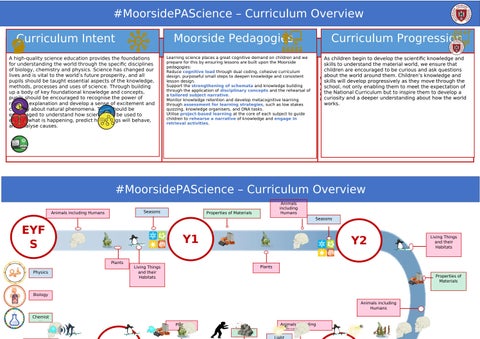
#MoorsidePAScience – Curriculum Overview Curriculum Intent A high-quality science education provides the foundations for understanding the world through the specific disciplines Working Scientifically of biology, chemistry and physics. Science has changed our lives and is vital to the world’s future prosperity, and all We support children to develop their scientific thinking through pupils should be taught essential aspects of the knowledge, careful investigation, analysis and evaluation. This means that methods, uses ofto science. building children useprocesses variety of and approaches answer Through relevant scientific up a bodyThese of keytypes foundational knowledge and concepts, questions. of scientific enquiry include: pupils should be encouraged to recognise the power of rational explanation develop a sense of excitement and Observing and over time Pattern seeking curiosity about natural phenomena. They should be Comparative and Identifying, encouraged to understand how science can be used classifying to fair testing and grouping explain what is happening, predict how things will behave, and analyse causes.
Moorside Pedagogies Scientific Drivers
Curriculum Progression
Learning science places a great cognitive demand on children and we prepare for this by ensuring lessons are built upon the Moorside pedagogies: Reduce cognitive load through dual coding, cohesive curriculum design, purposeful small steps to deepen knowledge and consistent We support children to make sense of substantive content lesson design. and encode it for long-term learning. and They will build up a Support the strengthening of schemata knowledge building schemata and declarative facts that provide a sense of through the application of disciplinary concepts and the rehearsal of a tailored subject narrative. scientific context. The substantive concepts promote Monitor knowledge and develop metacognitive learning children to narrowretention their study and identify links with prior through assessment for learning strategies, such as low stakes knowledge. quizzing, knowledge organisers, and DNA tasks. Utilise project-based learning at the core of each subject to guide children to rehearse a narrative of knowledge and engage in retrieval activities.
As children begin to develop the scientific knowledge and skills to understand the material world, we ensure that Scientist children are Apprentice encouraged to be curious and ask questions about the world around them. Children’s knowledge and We recognise that studying science requires commitment to the skills will develop progressively as they move through the discipline of science. We value our children as apprentice scientists school, not only enabling to meet expectation and encourage children to askthem questions and the develop their ownof the about National Curriculum but to inspire them to develop a ideas functions, relationships and interactions they observe curiosity and a deeper understanding about how the world in the world around them. Our ‘apprentice scientists’ will: works.
Substantive Scientific Knowledge
Research using secondary sources
Be inquisitive learners able to ask their own scientific questions Become independent learners by exploring their own answers to scientific questions Acquire specific skills and knowledge to think scientifically Understand the use and implications of science to explore the world around them
#MoorsidePAScience – Curriculum Overview Seasons
Animals including Humans
Animals including Humans
Properties of Materials
Seasons
EYF S
Y1 Plants
Physics
Y2 Plants
Living Things and their Habitats
Properties of Materials
Biology Animals including Humans Chemist ry
Living Things and their Habitats
Plants Rocks
Animals including Humans