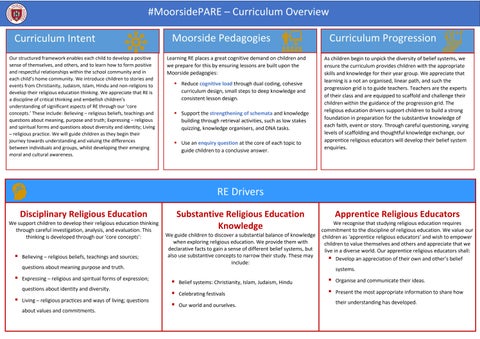
#MoorsidePARE – Curriculum Overview Curriculum Intent Our structured framework enables each child to develop a positive sense of themselves, and others, and to learn how to form positive and respectful relationships within the school community and in each child’s home community. We introduce children to stories and events from Christianity, Judaism, Islam, Hindu and non-religions to develop their religious education thinking. We appreciate that RE is a discipline of critical thinking and embellish children’s understanding of significant aspects of RE through our ‘core concepts.’ These include: Believing – religious beliefs, teachings and questions about meaning, purpose and truth; Expressing – religious and spiritual forms and questions about diversity and identity; Living – religious practice. We will guide children as they begin their journey towards understanding and valuing the differences between individuals and groups, whilst developing their emerging moral and cultural awareness.
Moorside Pedagogies Learning RE places a great cognitive demand on children and we prepare for this by ensuring lessons are built upon the Moorside pedagogies: Reduce cognitive load through dual coding, cohesive curriculum design, small steps to deep knowledge and consistent lesson design. Support the strengthening of schemata and knowledge building through retrieval activities, such as low stakes quizzing, knowledge organisers, and DNA tasks. Use an enquiry question at the core of each topic to guide children to a conclusive answer.
Curriculum Progression As children begin to unpick the diversity of belief systems, we ensure the curriculum provides children with the appropriate skills and knowledge for their year group. We appreciate that learning is a not an organised, linear path, and such the progression grid is to guide teachers. Teachers are the experts of their class and are equipped to scaffold and challenge their children within the guidance of the progression grid. The religious education drivers support children to build a strong foundation in preparation for the substantive knowledge of each faith, event or story. Through careful questioning, varying levels of scaffolding and thoughtful knowledge exchange, our apprentice religious educators will develop their belief system enquiries.
RE Drivers Disciplinary Religious Education We support children to develop their religious education thinking through careful investigation, analysis, and evaluation. This thinking is developed through our ‘core concepts’:
Believing – religious beliefs, teachings and sources; questions about meaning purpose and truth.
Substantive Religious Education Knowledge We guide children to discover a substantial balance of knowledge when exploring religious education. We provide them with declarative facts to gain a sense of different belief systems, but also use substantive concepts to narrow their study. These may include:
Apprentice Religious Educators We recognise that studying religious education requires commitment to the discipline of religious education. We value our children as ‘apprentice religious educators’ and wish to empower children to value themselves and others and appreciate that we live in a diverse world. Our apprentice religious educators shall: Develop an appreciation of their own and other’s belief systems.
Expressing – religious and spiritual forms of expression;
Belief systems: Christianity, Islam, Judaism, Hindu
Organise and communicate their ideas.
questions about identity and diversity.
Celebrating festivals
Present the most appropriate information to share how
Living – religious practices and ways of living; questions
Our world and ourselves.
about values and commitments.
their understanding has developed.