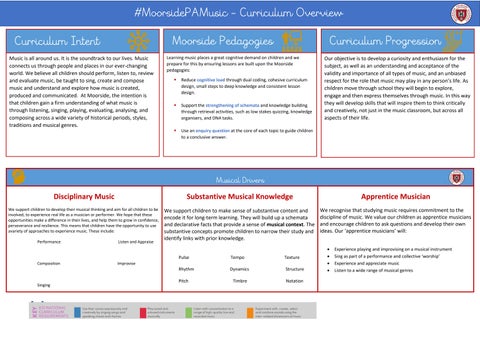
Music is all around us. It is the soundtrack to our lives. Music connects us through people and places in our ever-changing world. We believe all children should perform, listen to, review and evaluate music, be taught to sing, create and compose music and understand and explore how music is created, produced and communicated. At Moorside, the intention is that children gain a firm understanding of what music is through listening, singing, playing, evaluating, analysing, and composing across a wide variety of historical periods, styles, traditions and musical genres.
Learning music places a great cognitive demand on children and we prepare for this by ensuring lessons are built upon the Moorside pedagogies:
Reduce cognitive load through dual coding, cohesive curriculum design, small steps to deep knowledge and consistent lesson design.
Support the strengthening of schemata and knowledge building through retrieval activities, such as low stakes quizzing, knowledge organisers, and DNA tasks.
Use an enquiry question at the core of each topic to guide children to a conclusive answer.
Our objective is to develop a curiosity and enthusiasm for the subject, as well as an understanding and acceptance of the validity and importance of all types of music, and an unbiased respect for the role that music may play in any person’s life. As children move through school they will begin to explore, engage and then express themselves through music. In this way they will develop skills that will inspire them to think critically and creatively, not just in the music classroom, but across all aspects of their life.
Disciplinary Music
Substantive Musical Knowledge
Apprentice Musician
We support children to develop their musical thinking and aim for all children to be involved, to experience real life as a musician or performer. We hope that these opportunities make a difference in their lives, and help them to grow in confidence, perseverance and resilience. This means that children have the opportunity to use avariety of approaches to experience music. These include:
We support children to make sense of substantive content and encode it for long-term learning. They will build up a schemata and declarative facts that provide a sense of musical context. The substantive concepts promote children to narrow their study and identify links with prior knowledge.
We recognise that studying music requires commitment to the discipline of music. We value our children as apprentice musicians and encourage children to ask questions and develop their own ideas. Our ‘apprentice musicians’ will:
Performance
Composition
Singing
Listen and Appraise
Pulse
Tempo
Texture
Rhythm
Dynamics
Structure
Timbre
Notation
Improvise
Pitch
Experience playing and improvising on a musical instrument Sing as part of a performance and collective ‘worship’ Experience and appreciate music Listen to a wide range of musical genres