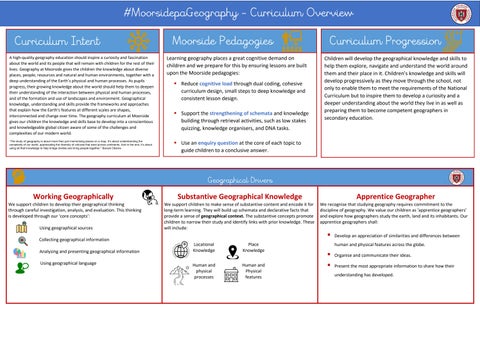
A high-quality geography education should inspire a curiosity and fascination about the world and its people that will remain with children for the rest of their lives. Geography at Moorside gives the children the knowledge about diverse places, people, resources and natural and human environments, together with a deep understanding of the Earth’s physical and human processes. As pupils progress, their growing knowledge about the world should help them to deepen their understanding of the interaction between physical and human processes, and of the formation and use of landscapes and environment. Geographical knowledge, understanding and skills provide the frameworks and approaches that explain how the Earth’s features at different scales are shapes, interconnected and change over time. The geography curriculum at Moorside gives our children the knowledge and skills base to develop into a conscientious and knowledgeable global citizen aware of some of the challenges and complexities of our modern world. “The study of geography is about more than just memorising places on a map. It’s about understanding the
complexity of our world, appreciating the diversity of cultures that exist across continents. And in the end, it’s about using all that knowledge to help bridge divides and bring people together.” Barack Obama
Working Geographically We support children to develop their geographical thinking through careful investigation, analysis, and evaluation. This thinking is developed through our ‘core concepts’: Using geographical sources Collecting geographical information Analysing and presenting geographical information Using geographical language
Learning geography places a great cognitive demand on children and we prepare for this by ensuring lessons are built upon the Moorside pedagogies: Reduce cognitive load through dual coding, cohesive curriculum design, small steps to deep knowledge and consistent lesson design. Support the strengthening of schemata and knowledge building through retrieval activities, such as low stakes quizzing, knowledge organisers, and DNA tasks.
Children will develop the geographical knowledge and skills to help them explore, navigate and understand the world around them and their place in it. Children’s knowledge and skills will develop progressively as they move through the school, not only to enable them to meet the requirements of the National Curriculum but to inspire them to develop a curiosity and a deeper understanding about the world they live in as well as preparing them to become competent geographers in secondary education.
Use an enquiry question at the core of each topic to guide children to a conclusive answer.
Substantive Geographical Knowledge We support children to make sense of substantive content and encode it for long-term learning. They will build up schemata and declarative facts that provide a sense of geographical context. The substantive concepts promote children to narrow their study and identify links with prior knowledge. These will include:
Apprentice Geographer We recognise that studying geography requires commitment to the discipline of geography. We value our children as ‘apprentice geographers’ and explore how geographers study the earth, land and its inhabitants. Our apprentice geographers shall:
Locational Knowledge Human and physical processes
Place Knowledge Human and Physical features
Develop an appreciation of similarities and differences between human and physical features across the globe.
Organise and communicate their ideas. Present the most appropriate information to share how their understanding has developed.