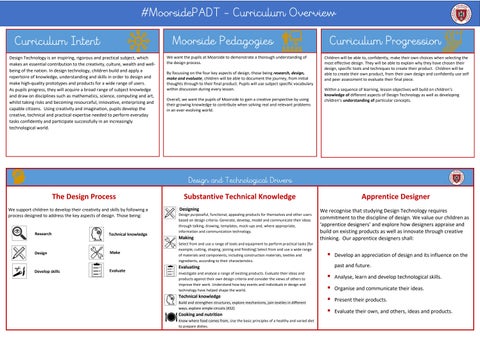
Design Technology is an inspiring, rigorous and practical subject, which makes an essential contribution to the creativity, culture, wealth and wellbeing of the nation. In design technology, children build and apply a repertoire of knowledge, understanding and skills in order to design and make high-quality prototypes and products for a wide range of users. As pupils progress, they will acquire a broad range of subject knowledge and draw on disciplines such as mathematics, science, computing and art, whilst taking risks and becoming resourceful, innovative, enterprising and capable citizens. Using creativity and imagination, pupils develop the creative, technical and practical expertise needed to perform everyday tasks confidently and participate successfully in an increasingly technological world.
The Design Process We support children to develop their creativity and skills by following a process designed to address the key aspects of design. Those being:
Research
Technical knowledge
Design
Make
Develop skills
Evaluate
We want the pupils at Moorside to demonstrate a thorough understanding of the design process. By focussing on the four key aspects of design, those being research, design, make and evaluate, children will be able to document the journey, from initial thoughts through to their final product. Pupils will use subject specific vocabulary within discussion during every lesson. Overall, we want the pupils of Moorside to gain a creative perspective by using their growing knowledge to contribute when solving real and relevant problems in an ever-evolving world.
Children will be able to, confidently, make their own choices when selecting the most effective design. They will be able to explain why they have chosen their design, specific tools and techniques to create their product. Children will be able to create their own product, from their own design and confidently use self and peer assessment to evaluate their final piece. Within a sequence of learning, lesson objectives will build on children’s knowledge of different aspects of Design Technology as well as developing children’s understanding of particular concepts.
Substantive Technical Knowledge Designing Design purposeful, functional, appealing products for themselves and other users based on design criteria. Generate, develop, model and communicate their ideas through talking, drawing, templates, mock-ups and, where appropriate, information and communication technology.
Making Select from and use a range of tools and equipment to perform practical tasks [for example, cutting, shaping, joining and finishing] Select from and use a wide range of materials and components, including construction materials, textiles and ingredients, according to their characteristics.
Apprentice Designer We recognise that studying Design Technology requires commitment to the discipline of design. We value our children as ‘apprentice designers’ and explore how designers appraise and build on existing products as well as innovate through creative thinking. Our apprentice designers shall:
Develop an appreciation of design and its influence on the past and future.
Evaluating Investigate and analyse a range of existing products. Evaluate their ideas and products against their own design criteria and consider the views of others to improve their work. Understand how key events and individuals in design and technology have helped shape the world.
Analyse, learn and develop technological skills.
Organise and communicate their ideas.
Technical knowledge
Present their products.
Evaluate their own, and others, ideas and products.
Build and strengthen structures, explore mechanisms, join textiles in different ways, explore simple circuits (KS2)
Cooking and nutrition Know where food comes from, Use the basic principles of a healthy and varied diet to prepare dishes.