Cycle B (2, 4, 6) Aspect
Living Things and Their Habitats
Class
1
2
3
4
Theme(s)
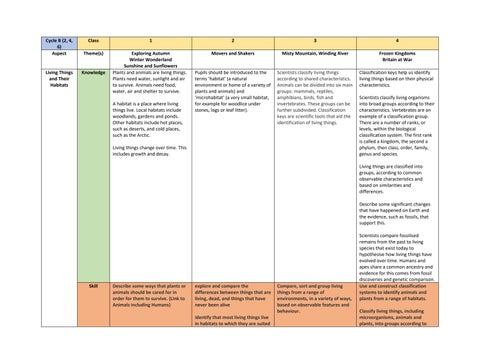
Exploring Autumn Winter Wonderland Sunshine and Sunflowers Plants and animals are living things. Plants need water, sunlight and air to survive. Animals need food, water, air and shelter to survive.
Movers and Shakers
Misty Mountain, Winding River
Frozen Kingdoms Britain at War
Pupils should be introduced to the terms ‘habitat’ (a natural environment or home of a variety of plants and animals) and ‘microhabitat’ (a very small habitat, for example for woodlice under stones, logs or leaf litter).
Scientists classify living things according to shared characteristics. Animals can be divided into six main groups: mammals, reptiles, amphibians, birds, fish and invertebrates. These groups can be further subdivided. Classification keys are scientific tools that aid the identification of living things.
Classification keys help us identify living things based on their physical characteristics.
Knowledge
A habitat is a place where living things live. Local habitats include woodlands, gardens and ponds. Other habitats include hot places, such as deserts, and cold places, such as the Arctic. Living things change over time. This includes growth and decay.
Scientists classify living organisms into broad groups according to their characteristics. Vertebrates are an example of a classification group. There are a number of ranks, or levels, within the biological classification system. The first rank is called a kingdom, the second a phylum, then class, order, family, genus and species. Living things are classified into groups, according to common observable characteristics and based on similarities and differences. Describe some significant changes that have happened on Earth and the evidence, such as fossils, that support this.
Skill
Describe some ways that plants or animals should be cared for in order for them to survive. (Link to Animals including Humans)
explore and compare the differences between things that are living, dead, and things that have never been alive identify that most living things live in habitats to which they are suited
Compare, sort and group living things from a range of environments, in a variety of ways, based on observable features and behaviour.
Scientists compare fossilised remains from the past to living species that exist today to hypothesise how living things have evolved over time. Humans and apes share a common ancestry and evidence for this comes from fossil discoveries and genetic comparison. Use and construct classification systems to identify animals and plants from a range of habitats. Classify living things, including microorganisms, animals and plants, into groups according to