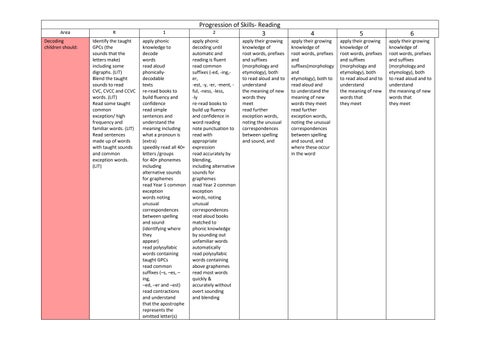
Area Decoding children should:
R
1
Identify the taught GPCs (the sounds that the letters make) including some digraphs. (LIT) Blend the taught sounds to read CVC, CVCC and CCVC words. (LIT) Read some taught common exception/ high frequency and familiar words. (LIT) Read sentences made up of words with taught sounds and common exception words. (LIT)
apply phonic knowledge to decode words read aloud phonicallydecodable texts re-read books to build fluency and confidence read simple sentences and understand the meaning including what a pronoun is (extra) speedily read all 40+ letters /groups for 40+ phonemes including alternative sounds for graphemes read Year 1 common exception words noting unusual correspondences between spelling and sound (identifying where they appear) read polysyllabic words containing taught GPCs read common suffixes (–s, –es, – ing, –ed, –er and –est) read contractions and understand that the apostrophe represents the omitted letter(s)
Progression of Skills- Reading 2 3 apply phonic decoding until automatic and reading is fluent read common suffixes (-ed, -ing,er, -est, -y, -er, -ment, ful, -ness, -less, -ly re-read books to build up fluency and confidence in word reading note punctuation to read with appropriate expression read accurately by blending, including alternative sounds for graphemes read Year 2 common exception words, noting unusual correspondences read aloud books matched to phonic knowledge by sounding out unfamiliar words automatically read polysyllabic words containing above graphemes read most words quickly & accurately without overt sounding and blending
apply their growing knowledge of root words, prefixes and suffixes (morphology and etymology), both to read aloud and to understand the meaning of new words they meet read further exception words, noting the unusual correspondences between spelling and sound, and
4
5
apply their growing knowledge of root words, prefixes and suffixes(morphology and etymology), both to read aloud and to understand the meaning of new words they meet read further exception words, noting the unusual correspondences between spelling and sound, and where these occur in the word
apply their growing knowledge of root words, prefixes and suffixes (morphology and etymology), both to read aloud and to understand the meaning of new words that they meet
6 apply their growing knowledge of root words, prefixes and suffixes (morphology and etymology), both to read aloud and to understand the meaning of new words that they meet