Year 7
Year 7
Building Bricks
Melodically Speaking
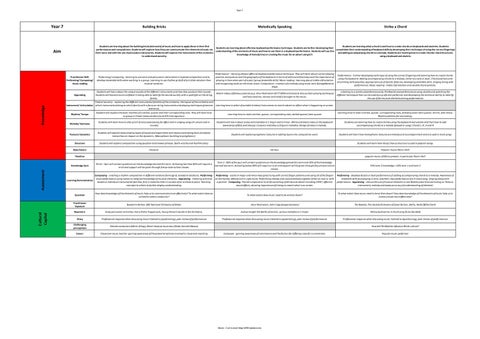
Students are learning about the building bricks (elements) of music and how to apply these in their first Students are learning what a chord is and how to create chords on keyboards and ukuleles. Students Students are learning about effective keyboard performance technique. Students are further developing their performances and compositions. Students will explore how they can communicate the elements of music via consolidate their understanding of keyboard skills by developing their technique of using the correct fingerings understanding of the elements of music and how to use them in a keyboard performance. Students will use this their voice and with the use of percussion instruments. Students will explore the instruments of the orchestra and adding accompanying chords to a melody. Students are learning how to create chords/ chord structures knowledge of melody lines in creating the music for an advert using ICT. to understand sonority. using a keyboard and ukulele.
Aim
Practitioner Skill: Performing/ Composing/ music reading
Performing/ composing - learning to use voice and percussion instruments in layered composition and to develop emsemble skills when working in a group. Learning to use rhythm grids firstly in blob notation then musical notation.
Performance - learning aboout effective keyboard performance technique. They will learn about correct playing position and posture and the geography of the keyboard in terms of white and black keys and the importance of playing in time when part of a pair/ group (ensemble skills) Music reading - learning about treble clef notation and recognising notes on the music stave. Composition - creation of a melody using music tech (GarageBand on iPad).
Students will learn about the unique sounds of the different instruments and how they produce their sounds. Watch videos of famous pianists (e.g. Artur Rubinstein DO IT NOW activities) to discuss their playing techniques Students will become more confident in being able to identify the sounds aurally with a spotlight on the string and how emotion, tension and relief is brought to the music. family. Timbre/ sonority - exploring the different instrumental families of the orchestra, the layout of the orchestra and Instrument/ Articulation which instruments belong to which family with a focus on string instruments and playing techniques (pizzicato Learning how to select of suitable timbres/ instruments to match advert to reflect what is happening on screen. and arco).
Knowledge
Appraising
Listening to a variety of performances by The Beatles and performances using ukulele and watching the different techniques that can be used by a proficient performer and developing the technical ability to identify the use of the musical elements during performances
Students will explore the basic rhythms of crotchet, quaver and their corresponding rests. They will learn how to group in 4 beat measures (bars) and 4/4 time signature.
Learning how to read crotchet, quaver, corresponding rests, dotted quaver/ semi quaver
Learning how to read crotchet, quaver, corresponding rests, dotted quaver/ semi quaver, minim, semi-breve. Rhythm patterns for strumming.
Melody/ Harmony
Students will learn how to alter pitch of voice expressively for effect and in singing songs (in unison and in rounds)
Students will learn about scales and melodies in C major and D minor. White and black notes on the keyboard (awareness of flats and sharps). Conjunct melodies vs Disjunct melodies. Range of notes in melody.
Students are learning how to create chords using the keyboard and ukulele and then how to add accompanying chords to a melody (played or sung). Chords I, IV, V and VI
Texture/ Dynamics
Students will explore texture being layers of sound and experiment with texture and seeing that ultimately texture has an impact on the dynamics. (Monophonic building to polyphonic).
Students will explore polyphonic textures in adding layers into composition work.
Students will learn how homophonic textures are melody and accompaniment and are used in most songs
Structure
Students will explore composition using question and answer phrases. (both vocally and rhythmically).
Style/Genre
Classical
Knowledge Quiz
Assessment
Performance - Further developing technique of using the correct fingering and learning how to create chords using the keyboard. Adding accompanying chords to a melody, either as a solo or duet. Chord positions and strumming skills (ukulele), appropriate use of stylistic features, developing ensemble skills. Singing along with performance. Music reading - treble clef notation and ukulele chord symbols.
Rhythm/ Tempo
Students will learn how Verse/ chorus structure is used in popular songs. Various
Timeline
Cultural Capital
Strike a Chord
Learning Demonstration
Popular music/ Rock n Roll popular music of 60s to present, in particular Rock n Roll
Term1 - Quiz will contain questions on the knowledge learned this term. Achieving less than 80% will require a re-sit and support will be given through free private tuition classes.
Term 2 - 80% of the quiz will contain questions on the knowledge gained this term and 20% of the knowledge learned last term. Achieving below 80% will require a re-sit and support will be given through free private tuition classes.
Composing - creating a rhythm composition in different notation forms (grid, standard notation). Performing - Performing - scales in major and minor keys (practicing with correct finger patterns and using all of the fingers vocal performance using names to integrate knowledge of musical elements. Appraising - listening activities on the hands). Melody line in right hand. Performing melody and countermelody together either on own or with based on individual instrumental families, first in isolation then in context of an orchestral piece. Teaching a partner. Composing - Paired composition to brief consisiting of 60 second advert including IDENT, effective concepts to others to further display understanding. sound effects, showing importance of timing to match what is on screen.
70% term 3 knowledge + 30% term 1 and term 2
Performing - (keyboard) solo or duet performance of adding accompanying chords to a melody. Awareness of ensemble skills and playing in time. (ukulele) class performance of a 4 chord song. Singing along with performance. Appraising - discuss the use of musical elements in one Beatles piece (Concentrating on Texture, instruments, melody and assess accuracy of understanding of element)
Question
How does knowledge of the elements of music help us to communicate more effectively? To what extent does an orchestra need a conductor?
To what extent does music need to be written down?
To what extent does music need to be written down? How does knowledge of the elements of music help us to communicate more effectively?
Practitioner Exposure
Benjamin Britten, BBC National Orchestra of Wales
Artur Rubinstein, John Cage (prepared piano)
The Beatles, The Ukulele Orchestra of Great Britain, McFly, Walk Off the Earth
Repetoire
body percussion activities, Harry Potter Puppet pals, Young Person's Guide to the Orchestra,
Joshua Fought the Battle of Jericho, various melodies in C major
Yellow Submarine, 4 chord song (to be decided)
Oracy
Professional response when discussing music listened to (questioning), peer review of performances
Professional response when discussing music listened to (questioning), peer review of performances
Professional response when discussing music listened to (questioning), peer review of performances
Challenging perceptions
Female conductors (Marin Allsop), Black classical musicians (Sheku Kanneh Mason)
Career
Classroom music teacher- gaining awareness of the potential salaries involved in classroom teaching
How did The Beatles influence Bitish culture? Composer - gaining awareness of commisions and the factors for differing rates for a commision.
Music - Curriculum Map WEB Update.xlsx
Popular music performer