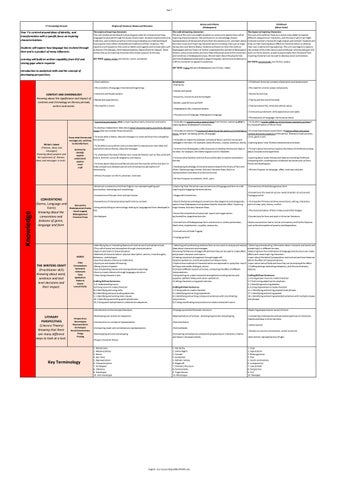
Year 7
Y7 Knowledge Strands
Heroes and Villains (Shakespeare)
Childhood (Oliver Twist)
The craft of inspiring characters The aim of this unit is to enable students to continue to explore the craft of inspiring characterisations. We will build on our knowledge of early representations of heroes and villains from the previous unit, and learn about the many nuances of inspiring characterisation including roles such as tragic heroes, foils and femme fetales. Students will build on their KS2 work on Shakespeare and the Tudors to further understand the context of Renaissance theatre, culture and society and how these influenced some of the characters and narratives in Shakespeare's plays. We will learn about the play format, and how Shakespeare employed a range of linguistic and structural devices to craft his characters to appeal to audiences.
The impact of inspiring Characters This unit will use Oliver Twist as a central class reader to explore different viewpoints on characters, and the way in which we might interpret a writer's choices through analysis and context. Students will draw on their learning about effective characterisation to develop their own creative writing responses. This unit also begins to explore the context of the 19th Century and childhood- while building on KS2 work on the Victorians, as well as exploring further the idea of how inspiring characters can be used to develop social commentary.
Origins of Literature: Beasts and Monsters
Year 7 is centred around ideas of identity, and transformation with a specific focus on inspiring characterisations. Students will explore how language has evolved through time and is a product of many influences. Learning will build on written capability from KS2 and closing gaps where required.
The origins of inspiring characters This unit reinforces the idea of a chronological order for Literature and how language has evolved through the study of early texts. Students explore early oral traditions, and contexts as well as continuing to develop an understanding of how popular texts reflect the beliefs and traditions of their inception. The repertoire will expand on KS2 work on Myths and Legends and include texts such as Homer's The Odyssey, Ovid's Metamorphosis, Beowulf and Sir Gawain. There will be a focus on inspiring characters that remain popular to this day. KEY TEXTS: poetry, prose, non-fiction, comic, animation
KEY TEXTS: prose (novel), non-fiction, poetry
KEY TEXTS: drama extracts (Shakespeare), non-Fiction, media
Introduction to analytical skills and the concept of developing perspectives. > Oral traditions
Renaissance > Patriarchy
> The evolution of language: International beginnings
> Childhood: Victorian contexts of education and employment > The need for a moral: power and poverty
> Gender and power
CONTEXT AND CHRONOLOGY Knowing about the significance and impact of contexts and chronology on literary periods, writers and works.
> Hierarchy and feudal systems
> Hierarchy and class > Hierarchy, monarchy and Divine Right
> Beliefs and superstitions
> Charity and the role of the state > Beliefs, superstitions and faith
> The need for a moral
> Charles Dickens' life, times and ethical values > Shakespeare's life, times and theatre. > Crime and punishment- child exploitation and rights > The evolution of language- Shakespeare's language > The evolution of Language- the Victorian Serial
> Summarise and explain what is inspiring about early characters and events.
> To be able to explain using a range of ideas from the text, exploring what is inspiring about Shakespeare's characters.
Knowledge
>To develop independent ideas about 'what' the writer wants us to think, feel and know when we consider these characters. > To be able to express the nuances of what the writer wants us to think feel or know, using an increasing variety of language. Know what themes and > To know what a theme, idea and message is in a text and how this is shaped by > To be able to make links between contextual factors and the morals and messages are, and how the context. messages in the texts. For example, ideas of honour, loyalty, ambition, family. to identify them. Writer's Intent > To be able to use synthesis and summary skills to express your own ideas and (Themes, ideas and evaluations about themes, ideas and messages > To know how Shakespeare crafts characters to develop themes and ideas in Summarise messages) his texts. For example, the theme of good vs evil in Macbeth. identify Knowing about purpose and > To understand the idea of 'theme' and 'universal themes' such as: fate, pride and explain the expression of themes, Hubris, Heroism, justice & vengeance, and beauty. > To know what Symbols and motifs are and be able to explore examples in understand ideas and messages in texts . the text. explore > To know about ideas around Monstrosity and the monster within and start to track make comparisons between period and contemporary perceptions of > Developing knowledge of characterisations beyond the binary of hero and craft monstrosity. villain. Exploring tragic heroes, foils and character flaws. Build on representations and ideas around monstrosity. > Writers Purpose: to inform, entertain, motivate > Writers Purpose: to entertain, thrill, warn
CONVENTIONS (Genre, Language and Form) Knowing about the conventions and features of genre, language and form
Epic poetry Shakespearean Drama Greek tragedy Bildungsroman Victorian Prose
>Historical conventions of written English: non-standard spelling and punctuation, etymology and morphology
> Exploring 'how' the writer uses conventions of language and form to craft inspiring and engaging characterisations.
>Conventions of the epic form and epic heroes
> Stagecraft Conventions.
>Conventions of characterisation (with links to context)
> Revisit the binary archetypal conventions of protagonists and antagonistsexplore how Shakespeare manipulates these for dramatic effect. Exploring tragic heroes, foils and character flaws.
>Using and building on terminology relating to Language and form developed in KS2. >Archeytypes
> To be able to explain what you think Dickens' wanted to achieve in his characterisation of 'Oliver Twist'. > To know how Dickens' exploration of themes reflects the social context and preoccupations of the period. Themes include: poverty, crime, good vs evil. >Learning about 'why' Dickens characterises as he does. > To learn about how writers explore the theme of childhood as ideas about innocence and experience. >Learning about wider themes and ideas surrounding childhoodcomparing with contemporary childhood narratives such as Harry Potter and Rooftoppers. > Writers Purpose: to campaign, affect, motivate, educate
>Conventions of the bildungsroman form >Conventions of a novel structure- revisit dramatic structure and Freytag pyramid > To know the Primary narrative conventions: setting, characters, point of view, plot, theme, conflict. > The characterisation of foils in Nancy and Artful Dodger.
> Know the conventions of a play text- layout and organisation: act/scene/line, stage directions etc.
>Conventions for form and style in Victorian literature.
> Conventions of Shakespearean form and structure- iambic pentameter, blank verse, enjambment, couplets, ceasura etc.
>Genre conventions: Satire, Social commentary and Gothic features such as the atmosphere of poverty and desperation.
> Conventions of Greek Tragedy > Freytag pyramid
WORDS
THE WRITERS CRAFT (Practitioner skill) Knowing about word, sentence and text level decisions and their impact.
LITERARY PERSPECTIVES (Literary Theory) Knowing that there are many different ways to look at a text.
Class Connotations Synonyms Antonyms Tone Symbolism Patterns Sound Lexical Fields
Perspectives Stereotypes Representation Archetypes Social Commentary Propp Freytag
Key Terminology
>Identifying key or interesting features of a text at word and sentence level. >The craft of mood and atmosphere through characterisation >Explicit and implicit characterisation >Methods of characterisation: physical description, actions, inner thoughts, behaviour, and dialogue. >Use of vocabulary choices to create tone >Synonyms and shades of meaning >Recap of parts of speech >Use of expanding clauses and varying sentence openings. >How to create inference through language a structure > Describing character traits Crafting Brilliant Sentences 1.1 Understanding nouns 1.2 Using nouns to create character 2.1 Identifying and using verbs 3.1 Identifying and punctuating adjectives. 5.1 Identifying and writing main clauses. 10.1 Identifying and writing participle phrases. 10.2 Using participle phrases to create action sequences.
> Selecting and synthesising evidence from across a text to analyse and express ideas about characters and messages. >Knowing the features of stagecraft and how they can be used to create effect and present character and nuance. >Creating mood and atmosphere through stagecraft. >Explore symbolism, motifs and patterns of ideas in texts. > Explore how methods of characterisation are expressed in a play text. Use of soliloquy and asides, dialogue, action. >Compare different versions of scenes, comparing the effect of different interpretations. >Using settings to create mood and atmosphere including tension and suspense- pathetic fallacy and colour symbolism. >Crafting characters using poetic devices. Crafting Brilliant Sentences 2.2 Using verbs to create character 6.1 Identifying and writing imperatives. 8.1 Identifying and writing compound sentences with coordinating conjunctions. 8.2 Using coordinating conjunctions to create a character's voice.
> Selecting and evaluating information about character and events and presenting it in different formats. >Exploring how the combination of language and structure can create effects and create inspiring characters. >Learn about the idea of juxtaposition and contrast and how these can add to the effect of characterisations. >Learn about lexical fields and how they can be employed for effect. > Crafting settings- extending metaphors, and the use of sensory features. Crafting Brilliant Sentences 1.4 Using proper nouns to create character 3.2 Positioning adjectives for emphasis. 4.1 Identifying and using adverbs. 6.3 Using imperatives to create character. 11.1 Identifying and writing prepositional phrases. 17.1 Identifying and writing speech. 18.1 Identifying and writing extended sentences with multiple clauses and phrases.
>Introduction to the concept of analysis.
>Freytag's pyramid of dramatic structure
>Exploring perspectives on social criticism
>Developing own analytical viewpoints
>Representations of women - stereotyping and anti-stereotyping,
> Comparing contemporary and period perspectives on characters, themes and ideas in Victorian texts.
>Introduction to concept of representation
>Feminist theory
>Comparing classic and contemporary representations
>Femme fetales
>Stereotyping and anti-stereotyping
>Comparing contemporary and period perspectives on characters, themes and ideas in renaissance texts.
>Anti-Semitic representations of Fagin
1. Patriarchy 2. Divine Rights 3. Context 4. Symbolism 5. Pathetic Fallacy 6. Stagecraft 7. Dramatic Structure 8. Femme Fetale 9. Tragic Heroes 10. Monologue
1. Class 2. Exploitation 3. Bildungsroman 4. Plot 5. Social commentary 6. Juxtaposition 7. Lexical field 8. Perspective 9. Foil 10. Messages
> Fallen women > Dickens as a social commentator, writer as activist.
>Propp's character theory 1. Monstrosity 2. Metamorphosis 3. Moral 4. Epic Hero 5. Representation 6. Characterisation 7. Archetypes 8. Inference 9. Stereotype 10. Anti-stereotype
English - Curriculum Map WEB UPDATE.xlsx