Knowledge
Year 7
Year 7
Portraiture & Formal elements
Japanese Art
Abstract Cells
Aim
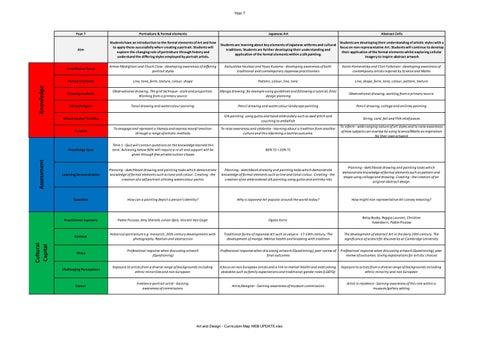
Students have an introduction to the formal elements of Art and how to apply these successfully when creating a portrait. Students will explore the changing role of portraiture through history and understand the differing styles employed by portrait artists.
Students are learning about key elements of Japanese artforms and cultural traditions. Students are further developing their understanding and application of the formal elements within a silk painting.
Students are developing their understanding of artistic styles with a focus on non-representative Art. Students will continue to develop their application of the formal elements whilst exploring cellular imagery to inspire abstract artwork
Practitioner focus
Armeo Modigliani and Chuck Close - developing awareness of differing portrait styles
Katsushika Houksai and Yayoi Kusama - developing awareness of both traditional and contemporary Japanese practitioners
Karen Kamenetsky and Clint Fulkerson - developing awareness of contempoary artists inspired by Science and Maths
Formal elements
Line, tone, form, texture, colour, shape
Pattern, colour, line, tone
Line, shape, form, tone, colour, pattern, texture
Drawing methods
Observational drawing. The grid technque - scale and proportion. Working from a primary source
Manga drawing; for example using guidelines and following a tutorial, final design planning
Observational drawing, working from a primary source
2D techniques
Tonal drawing and watercolour painting
Pencil drawing and watercolour landscape painting
Pencil drawing, collage and anilinky painting
Silk painting using gutta and hand embroidery such as seed stitch and couching to embellish
String, card, foil and PVA relief pieces To inform - wide ranging nature of art styles and to raise awareness of how subjects can overlap by using Science/Maths as inspiration for their own artwork
Cultural Capital
Assessment
Mixed media / Textiles Purpose
To enagage and represent a likeness and express mood/ emotion through a range of artistic methods
To raise awareness and celebrate - learning about a tradition from another culture and this informing a textiles outcome.
Knowledge Quiz
Term 1 - Quiz will contain questions on the knowledge learned this term. Achieving below 80% will require a re-sit and support will be given through free private tuition classes
80% T2 + 20% T1
Learning Demonstration
Planning - sketchbook drawing and painting tasks which demonstrate knowledge of formal elements such as tone and colour. Creating - the creation of a self portrait ulitising watercolour paints
Planning - sketchbook drawing and painting tasks which demonstrate knowledge of formal elements such as line and tonal colour. Creating - the creation of an embroidered silk painting using gutta and anilinky inks
Planning - sketchbook drawing and painting tasks which demonstrate knowledge of formal elements such as pattern and shape using collage and drawing. Creating - the creation of an original abstract design
Question
How can a painting depict a person's identity?
Why is Japanese Art popular around the world today?
How might non representative Art convey meaning?
Practitioner Exposure
Pablo Picasso, Amy Sherald, Julian Opie, Vincent Van Gogh
Ogata Korin
Betsy Busby, Reggie Laurent, Christine Yukenbarri, Pablo Picasso
Context
Historical portraiture e.g. monarch, 20th century developments with photography. Realism and abstraction
Traditional forms of Japanese Art such as ukiyo-e - 17-19th century. The development of manga. Mental health and breaking with tradition
The development of abstract Art in the early 20th century. The significance of scienctific discoveries at Cambridge University
Oracy
Professional response when discussing artwork (Questioning)
Professional response when discussing artwork (Questioning), peer review of final outcomes
Professinoal response when discussing artwork (Questioning), peer review of outcomes. Giving explanations for artistic choices
Challenging Perceptions
Exposure to artists from a diverse range of backgrounds including ethnic minorities and non European
A focus on non European artists and a link to mental health and overcoming obstables such as family expectations and traditional gender roles (LGBTQ)
Exposure to artists from a diverse range of backgrounds including ethnic minority and non European
Career
Freelance portrait artist - Gaining awareness of commissions
Artist/designer - Gaining awareness of museum commissions
Artist in residence - Gaining awareness of this role within a museum/gallery setting
Art and Design - Curriculum Map WEB UPDATE.xlsx