MATHS Geometry: Position and Direction – first quadrant, four quadrants, translations, reflections. Decimals – 3 decimal places; multiply and divide by 10, 100, 1000; multiply and divide decimals by integers; decimals as fractions; converting decimals to fractions and fractions to decimals; using division to solve problems. Percentages – fractions to percentages, equivalent FDP, order FDP, percentage of an amount, missing values. Algebra – find a rule, forming expressions, substitution, formulae, forming equations, finding pairs of values. Perimeter, Area and Volume – area and perimeter, area of a triangle, area of a parallelogram, volume counting cubes, volume of a cuboid. Ratio - Using ratio language, ratio and fractions, using the ratio symbol, calculating ratio, using and calculating scale factors, ratio and proportion problems. Converting Units – convert and calculate with metric measures, miles and kilometres, imperial measures.
RE Christmas – We will explore the story of the birth of Christ from the Gospel of St. Matthew and the Gospel of St. Luke. We will learn about the images of Christ that are found in the Prologue to the Gospel of St. John. Baptism & Confirmation Celebrations of the Holy Spirit – We will learn about the receiving of the Holy Spirit though both Baptism and Confirmation. We will revise the actions, signs and symbols used in both Sacraments, the meaning of each and its connection to the Sacraments. Lent – We will be developing our knowledge and understanding of the important Lenten activities of prayer, fasting and almsgiving, and questioning why these traditions might still be important activities for Christians today. We will also explore the Church’s teaching on forgiveness through the Sacrament of Reconciliation. Holy Week – We will learn about the passion of Jesus, from the events that took place in the Garden of Gethsemane through to the death of Jesus on the cross. We will explore why Christians have described the death of Jesus as a sacrifice. Easter – We will study the Easter story from the perspective of Thomas and explore why, at first, Thomas did not believe in the Resurrection of Christ. We will also learn about the promise of Eternal Life and the association of this belief to Baptism and the celebration of a Christian funeral.
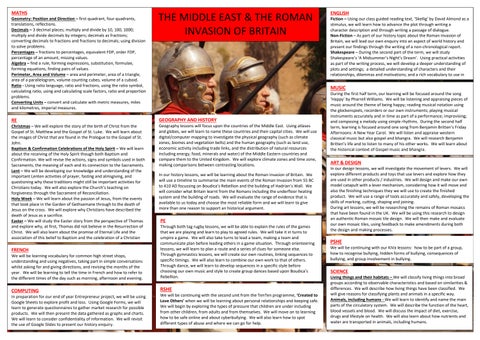
THE MIDDLE EAST & THE ROMAN INVASION OF BRITAIN
GEOGRAPHY AND HISTORY Geography lessons will focus upon the countries of the Middle East. Using atlases and globes, we will learn to name these countries and their capital cities. We will use digital/computer mapping to investigate the physical geography (such as climate zones, biomes and vegetation belts) and the human geography (such as land use, economic activity including trade links, and the distribution of natural resources including energy, food, minerals and water) of the Middle Eastern countries and compare them to the United Kingdom. We will explore climate zones and time zone, making comparisons between contrasting locations. In our history lessons, we will be learning about the Roman invasion of Britain. We will use a timeline to summarise the main events of the Roman Invasion from 55 BC to 410 AD focussing on Boudica’s Rebellion and the building of Hadrian’s Wall. We will consider what Britain learnt from the Romans including the underfloor heating system and the building of roads. We will evaluate the range of evidence that is available to us today and choose the most reliable form and we will learn to give more than one reason to support an historical argument.
PE
We will be learning vocabulary for common high street shops, understanding and using negatives, taking part in simple conversations whilst asking for and giving directions, and revising the months of the year. We will be learning to tell the time in French and how to refer to the different times of the day such as morning, afternoon and evening.
COMPUTING
RSHE
In preparation for our end of year Entrepreneur project, we will be using Google Sheets to explore profit and loss. Using Google Forms, we will learn to generate questionnaires to gather market research for possible products. We will then present the data gathered as graphs and charts. We will learn to consider confidentiality of information. We will revisit the use of Google Slides to present our history enquiry.
Fiction – Using our class guided reading text, ‘Skellig’ by David Almond as a stimulus, we will learn how to advance the plot through writing a character description and through writing a passage of dialogue. Non-Fiction – As part of our history topic about the Roman invasion of Britain, we will lead our own enquiry into an aspect of world history and present our findings through the writing of a non-chronological report. Shakespeare – During the second part of the term, we will study Shakespeare’s ‘A Midsummer’s Night’s Dream’. Using practical activities as part of the writing process, we will develop a deeper understanding of plots and settings; a detailed understanding of characters and their relationships, dilemmas and motivations; and a rich vocabulary to use in our writing.
MUSIC
Through both tag rugby lessons, we will be able to explain the rules of the games that we are playing and learn to play to agreed rules. We will take it in turns to umpire a game. We will also take turns to lead a team, making a team and communicate plan before leading others in a game situation. Through orienteering lessons, we will learn to plan a route and a series of clues for someone else. Through gymnastics lessons, we will create our own routines, linking sequences to specific timings. We will also learn to combine our own work to that of others. Through dance, we will learn to develop sequences in a specific style before choosing our own music and style to create group dances based upon Boudica’s Rebellion.
FRENCH
ENGLISH
We will be continuing with the second unit from the TenTen programme, ‘Created to Love Others’ when we will be learning about personal relationships and keeping safe. We will begin by exploring the types of pressure that children are under including from other children, from adults and from themselves. We will move on to learning how to be safe online and about cyberbullying. We will also learn how to spot different types of abuse and where we can go for help.
During the first half term, our learning will be focused around the song ‘Happy’ by Pharrell Williams. We will be listening and appraising pieces of music around the theme of being happy; reading musical notation using the glockenspiels, recorders or our own instruments; playing musical instruments accurately and in time as part of a performance; improvising; and composing a melody using simple rhythms. During the second half term, learning is focused around one song from Benjamin Britten’s Friday Afternoons: A New Year Carol. We will listen and appraise western classical music but also gospel and bhangra. We will research Benjamin Britten’s life and to listen to many of his other works. We will learn about the historical context of Gospel music and bhangra.
ART & DESIGN
In our design lessons, we will investigate the movement of levers. We will explore different products and toys that use levers and explore how they are used in other products / industries. We will design and make our own model catapult with a lever mechanism, considering how it will move and also the finishing techniques they we will use to create the finished product. We will use a range of tools accurately and safely, developing the skills of marking, cutting, shaping and joining. During art lessons, we will be researching the remains of Roman mosaics that have been found in the UK. We will be using this research to design an authentic Roman mosaic tile design. We will then make and evaluate our own mosaic tiles, using feedback to make amendments during both the design and making processes.
PSHE
We will be continuing with our KiVa lessons: how to be part of a group, how to recognise bullying, hidden forms of bullying, consequences of bullying, and group involvement in bullying.
SCIENCE
Living things and their habitats – We will classify living things into broad groups according to observable characteristics and based on similarities & differences. We will describe how living things have been classified. We will give reasons for classifying plants and animals in a specific way. Animals, including humans - We will learn to identify and name the main parts of the circulatory system. We will describe the function of the heart, blood vessels and blood. We will discuss the impact of diet, exercise, drugs and lifestyle on health. We will also learn about how nutrients and water are transported in animals, including humans.