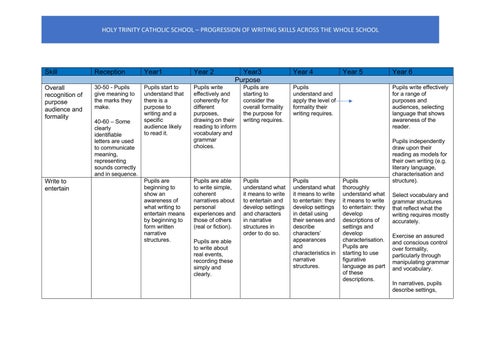
HOLY TRINITY CATHOLIC SCHOOL – PROGRESSION OF WRITING SKILLS ACROSS THE WHOLE SCHOOL
Skill
Reception
Year1
Year 2
Overall recognition of purpose audience and formality
30-50 - Pupils give meaning to the marks they make.
Pupils start to understand that there is a purpose to writing and a specific audience likely to read it.
Pupils write effectively and coherently for different purposes, drawing on their reading to inform vocabulary and grammar choices.
Pupils are starting to consider the overall formality the purpose for writing requires.
Pupils are able to write simple, coherent narratives about personal experiences and those of others (real or fiction).
Pupils understand what it means to write to entertain and develop settings and characters in narrative structures in order to do so.
Write to entertain
40-60 – Some clearly identifiable letters are used to communicate meaning, representing sounds correctly and in sequence.
Pupils are beginning to show an awareness of what writing to entertain means by beginning to form written narrative structures.
Pupils are able to write about real events, recording these simply and clearly.
Year3 Purpose
Year 4
Year 5
Pupils understand and apply the level of formality their writing requires.
Pupils understand what it means to write to entertain: they develop settings in detail using their senses and describe characters’ appearances and characteristics in narrative structures.
Year 6 Pupils write effectively for a range of purposes and audiences, selecting language that shows awareness of the reader.
Pupils thoroughly understand what it means to write to entertain: they develop descriptions of settings and develop characterisation. Pupils are starting to use figurative language as part of these descriptions.
Pupils independently draw upon their reading as models for their own writing (e.g. literary language, characterisation and structure). Select vocabulary and grammar structures that reflect what the writing requires mostly accurately. Exercise an assured and conscious control over formality, particularly through manipulating grammar and vocabulary. In narratives, pupils describe settings,