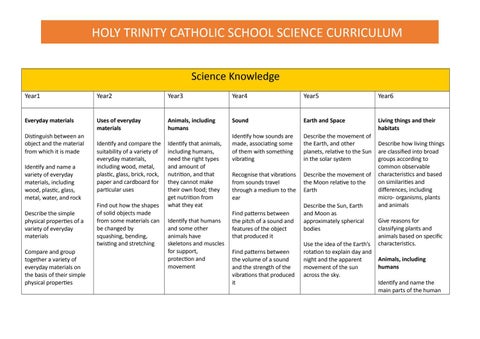
HOLY TRINITY CATHOLIC SCHOOL SCIENCE CURRICULUM Science Knowledge Year1
Year2
Year3
Year4
Year5
Year6
Everyday materials
Uses of everyday materials
Animals, including humans
Sound
Earth and Space
Living things and their habitats
Identify and compare the suitability of a variety of everyday materials, including wood, metal, plastic, glass, brick, rock, paper and cardboard for particular uses
Identify that animals, including humans, need the right types and amount of nutrition, and that they cannot make their own food; they get nutrition from what they eat
Identify how sounds are made, associating some of them with something vibrating
Describe the movement of the Earth, and other planets, relative to the Sun in the solar system
Recognise that vibrations from sounds travel through a medium to the ear
Describe the movement of the Moon relative to the Earth
Distinguish between an object and the material from which it is made Identify and name a variety of everyday materials, including wood, plastic, glass, metal, water, and rock Describe the simple physical properties of a variety of everyday materials Compare and group together a variety of everyday materials on the basis of their simple physical properties
Find out how the shapes of solid objects made from some materials can be changed by squashing, bending, twisting and stretching
Identify that humans and some other animals have skeletons and muscles for support, protection and movement
Find patterns between the pitch of a sound and features of the object that produced it Find patterns between the volume of a sound and the strength of the vibrations that produced it
Describe the Sun, Earth and Moon as approximately spherical bodies Use the idea of the Earth’s rotation to explain day and night and the apparent movement of the sun across the sky.
Describe how living things are classified into broad groups according to common observable characteristics and based on similarities and differences, including micro- organisms, plants and animals Give reasons for classifying plants and animals based on specific characteristics. Animals, including humans Identify and name the main parts of the human