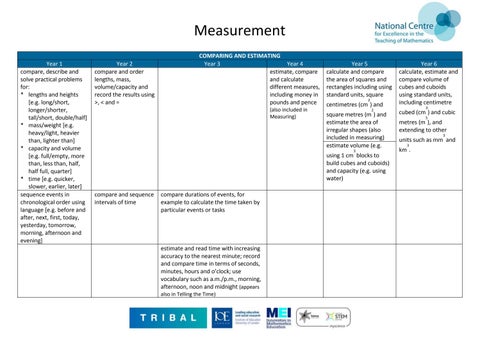
Measurement Year 1 compare, describe and solve practical problems for: * lengths and heights [e.g. long/short, longer/shorter, tall/short, double/half] * mass/weight [e.g. heavy/light, heavier than, lighter than] * capacity and volume [e.g. full/empty, more than, less than, half, half full, quarter] * time [e.g. quicker, slower, earlier, later] sequence events in chronological order using language [e.g. before and after, next, first, today, yesterday, tomorrow, morning, afternoon and evening]
Year 2 compare and order lengths, mass, volume/capacity and record the results using >, < and =
COMPARING AND ESTIMATING Year 3 Year 4 estimate, compare and calculate different measures, including money in pounds and pence (also included in Measuring)
Year 5 calculate and compare the area of squares and rectangles including using standard units, square 2
centimetres (cm ) and 2
square metres (m ) and estimate the area of irregular shapes (also included in measuring) estimate volume (e.g. 3
using 1 cm blocks to build cubes and cuboids) and capacity (e.g. using water) compare and sequence intervals of time
compare durations of events, for example to calculate the time taken by particular events or tasks
estimate and read time with increasing accuracy to the nearest minute; record and compare time in terms of seconds, minutes, hours and o’clock; use vocabulary such as a.m./p.m., morning, afternoon, noon and midnight (appears also in Telling the Time)
Year 6 calculate, estimate and compare volume of cubes and cuboids using standard units, including centimetre 3
cubed (cm ) and cubic 3
metres (m ), and extending to other 3
units such as mm and 3
km .