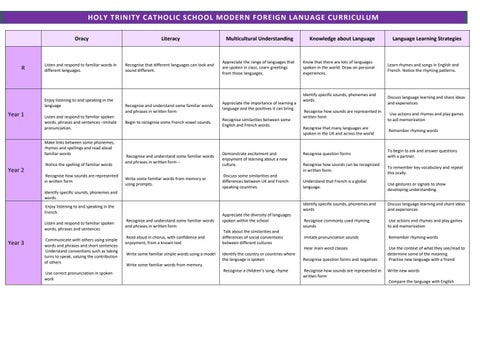
HOLY TRINITY CATHOLIC SCHOOL MODERN FOREIGN LANUAGE CURRICULUM
R
Oracy
Literacy
Multicultural Understanding
Knowledge about Language
Listen and respond to familiar words in different languages.
Recognise that different languages can look and sound different.
Appreciate the range of languages that are spoken in class. Learn greetings from those languages.
Know that there are lots of languages spoken in the world. Draw on personal experiences.
Enjoy listening to and speaking in the language
Year 1
Listen and respond to familiar spoken words, phrases and sentences –Imitate pronunciation. Make links between some phonemes, rhymes and spellings and read aloud familiar words
Year 2
Notice the spelling of familiar words Recognise how sounds are represented in written form
Recognise and understand some familiar words and phrases in written form Begin to recognise some French vowel sounds.
Demonstrate excitement and enjoyment of learning about a new culture.
Write some familiar words from memory or using prompts.
Discuss some similarities and differences between UK and French speaking countries.
Enjoy listening to and speaking in the French
Year 3
Communicate with others using simple words and phrases and short sentences Understand conventions such as taking turns to speak, valuing the contribution of others Use correct pronunciation in spoken work
Recognise similarities between some English and French words.
Recognise and understand some familiar words and phrases in written form –
Identify specific sounds, phonemes and words.
Listen and respond to familiar spoken words, phrases and sentences
Appreciate the importance of learning a language and the positives it can bring.
Recognise and understand some familiar words and phrases in written form Read aloud in chorus, with confidence and enjoyment, from a known text Write some familiar simple words using a model Write some familiar words from memory.
Appreciate the diversity of languages spoken within the school Talk about the similarities and differences of social conventions between different cultures Identify the country or countries where the language is spoken Recognise a children’s song, rhyme
Identify specific sounds, phonemes and words. Recognise how sounds are represented in written form
Language Learning Strategies
Learn rhymes and songs in English and French. Notice the rhyming patterns.
Discuss language learning and share ideas and experiences Use actions and rhymes and play games to aid memorization
Recognise that many languages are spoken in the UK and across the world
Remember rhyming words
Recognise question forms
To begin to ask and answer questions with a partner.
Recognise how sounds can be recognized in written form. Understand that French is a global language.
To remember key vocabulary and repeat this orally. Use gestures or signals to show developing understanding.
Identify specific sounds, phonemes and words
Discuss language learning and share ideas and experiences
Recognise commonly used rhyming sounds
Use actions and rhymes and play games to aid memorization
Imitate pronunciation sounds
Remember rhyming words
Hear main word classes
Use the context of what they see/read to determine some of the meaning Practise new language with a friend
Recognise question forms and negatives Recognise how sounds are represented in written form
Write new words Compare the language with English