HOLY TRINITY CATHOLIC SCHOOL- ART AND DESGIN PROGRESSION OF SKILLS AND KNOWLEDGE
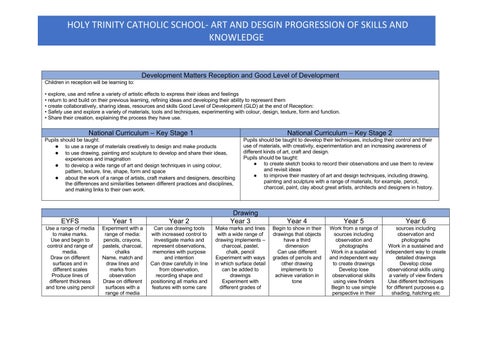
Development Matters Reception and Good Level of Development Children in reception will be learning to: • explore, use and refine a variety of artistic effects to express their ideas and feelings • return to and build on their previous learning, refining ideas and developing their ability to represent them • create collaboratively, sharing ideas, resources and skills Good Level of Development (GLD) at the end of Reception: • Safely use and explore a variety of materials, tools and techniques, experimenting with colour, design, texture, form and function. • Share their creation, explaining the process they have use.
National Curriculum – Key Stage 1
National Curriculum – Key Stage 2
Pupils should be taught: ● to use a range of materials creatively to design and make products ● to use drawing, painting and sculpture to develop and share their ideas, experiences and imagination ● to develop a wide range of art and design techniques in using colour, pattern, texture, line, shape, form and space ● about the work of a range of artists, craft makers and designers, describing the differences and similarities between different practices and disciplines, and making links to their own work.
Pupils should be taught to develop their techniques, including their control and their use of materials, with creativity, experimentation and an increasing awareness of different kinds of art, craft and design. Pupils should be taught: ● to create sketch books to record their observations and use them to review and revisit ideas ● to improve their mastery of art and design techniques, including drawing, painting and sculpture with a range of materials, for example, pencil, charcoal, paint, clay about great artists, architects and designers in history.
EYFS
Year 1
Year 2
Use a range of media to make marks. Use and begin to control and range of media. Draw on different surfaces and in different scales Produce lines of different thickness and tone using pencil
Experiment with a range of media: pencils, crayons, pastels, charcoal, chalks Name, match and draw lines and marks from observation Draw on different surfaces with a range of media
Can use drawing tools with increased control to investigate marks and represent observations, memories with purpose and intention Can draw carefully in line from observation, recording shape and positioning all marks and features with some care
Drawing Year 3 Make marks and lines with a wide range of drawing implements – charcoal, pastel, chalk, pencil Experiment with ways in which surface detail can be added to drawings Experiment with different grades of
Year 4
Year 5
Year 6
Begin to show in their drawings that objects have a third dimension Can use different grades of pencils and other drawing implements to achieve variation in tone
Work from a range of sources including observation and photographs Work in a sustained and independent way to create drawings Develop lose observational skills using view finders Begin to use simple perspective in their
sources including observation and photographs Work in a sustained and independent way to create detailed drawings Develop close observational skills using a variety of view finders Use different techniques for different purposes e.g. shading, hatching etc