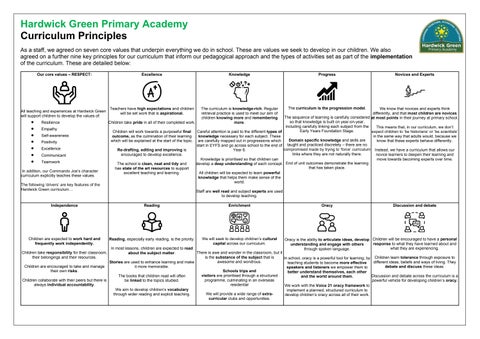
Hardwick Green Primary Academy Curriculum Principles As a staff, we agreed on seven core values that underpin everything we do in school. These are values we seek to develop in our children. We also agreed on a further nine key principles for our curriculum that inform our pedagogical approach and the types of activities set as part of the implementation of the curriculum. These are detailed below: Our core values – RESPECT:
All teaching and experiences at Hardwick Green will support children to develop the values of:
• • • • • • •
Resilience Empathy Self-awareness Positivity Excellence Communicant Teamwork
In addition, our Commando Joe’s character curriculum explicitly teaches these values. The following ‘drivers’ are key features of the Hardwick Green curriculum…
Excellence
Knowledge
Progress
Teachers have high expectations and children will be set work that is aspirational.
The curriculum is knowledge-rich. Regular retrieval practice is used to meet our aim of children knowing more and remembering more.
The curriculum is the progression model.
Novices and Experts
We know that novices and experts think differently, and that most children are novices The sequence of learning is carefully considered at most points in their journey at primary school. so that knowledge is built on year-on-year, Children take pride in all of their completed work. including carefully linking each subject from the This means that, in our curriculum, we don’t Early Years Foundation Stage. Children will work towards a purposeful final Careful attention is paid to the different types of expect children to ‘be historians’ or ‘be scientists’ outcome, as the culmination of their learning knowledge necessary for each subject. These in the same way that adults would, because we Domain specific knowledge and skills are which will be explained at the start of the topic. are carefully mapped out in progressions which know that these experts behave differently. start in EYFS and go across school to the end of taught and practiced discretely – there are no compromised made by trying to ‘force’ curriculum Instead, we have a curriculum that allows our Re-drafting, editing and improving is Year 6. links where they are not naturally there. encouraged to develop excellence. novice learners to deepen their learning and Knowledge is prioritised so that children can move towards becoming experts over time. The school is clean, neat and tidy and develop a deep understanding of each concept. End of unit outcomes demonstrate the learning that has taken place. has state of the art resources to support excellent teaching and learning. All children will be expected to learn powerful knowledge that helps them make sense of the world. Staff are well read and subject experts are used to develop teaching.
Independence
Reading
Enrichment
Children are expected to work hard and frequently work independently.
Reading, especially early reading, is the priority.
We will seek to develop children’s cultural capital across our curriculum.
Oracy
Discussion and debate
Oracy is the ability to articulate ideas, develop Children will be encouraged to have a personal response to what they have learned about and understanding and engage with others what they are experiencing. through spoken language.
In most lessons, children are expected to read There is awe and wonder in the classroom, but it about the subject matter. is the substance of the subject that is In school, oracy is a powerful tool for learning; by Children learn tolerance through exposure to awesome and wondrous. Stories are used to enhance learning and make different ideas, beliefs and ways of living. They teaching students to become more effective Children are encouraged to take and manage it more memorable. debate and discuss these ideas. speakers and listeners we empower them to their own risks. Schools trips and better understand themselves, each other visitors are prioritised through a structured The books that children read will often Discussion and debate across the curriculum is a and the world around them. Children collaborate with their peers but there is programme, culminating in an overseas be linked to the topics studied. powerful vehicle for developing children’s oracy. always individual accountability. residential We work with the Voice 21 oracy framework to We aim to develop children’s vocabulary implement a planned, structured curriculum to We will provide a wide range of extrathrough wider reading and explicit teaching. develop children’s oracy across all of their work. curricular clubs and opportunities.
Children take responsibility for their classroom, their belongings and their resources.