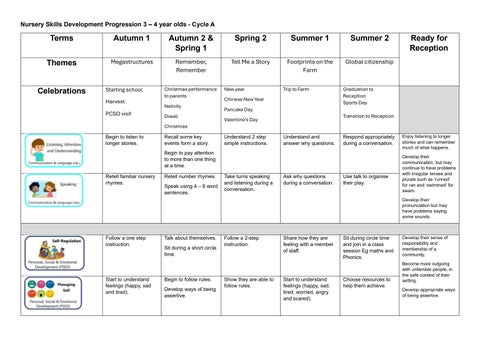
Terms Autumn 1 Autumn 2 & Spring 1 Spring 2 Summer 1
Themes Megastructures
Celebrations Starting school
Harvest
Remember, Remember Tell Me a Story
PCSO visit Christmas performance to parents
Nativity
Diwali
Christmas New year
Chinese New Year
Pancake Day
Valentine’s Day
Begin to listen to longer stories.
Recall some key events form a story.
Begin to pay attention to more than one thing at a time.
Retell familiar nursery rhymes.
Understand 2 step simple instructions.
Summer 2 Ready for Reception
Footprints on the Farm Global citizenship
Trip to Farm
Graduation to Reception
Sports Day
Transition to Reception
Understand and answer why questions. Respond appropriately during a conversation.
Retell number rhymes. Speak using 4 – 6 word sentences.
Take turns speaking and listening during a conversation.
Ask why questions during a conversation. Use talk to organise their play.
Enjoy listening to longer stories and can remember much of what happens.
Develop their communication, but may continue to have problems with irregular tenses and plurals such as ‘runned’ for ran and ‘swimmed’ for swam.
Develop their pronunciation but may have problems saying some sounds.
Follow a one step instruction.
Start to understand feelings (happy, sad and tired).
Talk about themselves. Sit during a short circle time.
Begin to follow rules. Develop ways of being assertive.
Follow a 2-step instruction.
Share how they are feeling with a member of staff.
Sit during circle time and join in a class session Eg maths and Phonics.
Develop their sense of responsibility and membership of a community.
Show they are able to follow rules.
Start to understand feelings (happy, sad, tired, worried, angry and scared).
Choose resources to help them achieve.
Become more outgoing with unfamiliar people, in the safe context of their setting.
Develop appropriate ways of being assertive.


Begin to take turns. Play with one child, extending and contributing during play.
Take turns during role play.
Play with one or more children, extending and contributing during play.
Begin to understand how someone might feel.
Show confidence with others during a social situation.
Remember rules without needing an adult to remind them.
Be increasingly independent as they get dressed and undressed, e.g. putting on coats and doing up zips.
Be increasingly independent in meeting their own care needs.e.g. brushing teeth, using the toilet, washing and drying their hands.
Make healthy choices about food, drink, activity and toothbrushing.
Talk with others to solve conflicts.
Explore moving their body in different ways.
Use a one-handed tool.
Begin Dough Disco.
Moves body to music showing when they can stop and start.
Control a ball in different ways, balance on a variety of equipment and climb.
Makes snips in paper using scissors.
Begin Squiggle Wiggle.
Show a preference for a dominant hand.
Jum and land safely from a height.
Move safely with confidence and imagination, communicating ideas through movement.
Begin to hold a pencil with a modified tripod grip to show control.
Begin name writing if ready.
Demonstrate a growing independence putting on a coat and shoes, begin to do zips.
Follow instructions in simple races, running at speed and an obstacle course.
Choose the right resources to carry out their own plan.
Collaborate with others to manage large items e.g. moving a long plank safely, carrying large hollow blocks.
Show ability to use a knife and fork.
Join in with repeated phrases for familiar stories.
Express simple likes about a shared story.
Answers who and what questions linked to stories shared. Express simple likes and dislikes about a shared story.
Uses new vocabulary in their play. Uses new vocabulary in their conversations. Understand the five key concepts about print
• print has meaning
• print has different purposes
• page sequencing –English texts are
Discriminates between sounds in the environment. Develops book handling skills. Can clap syllables.
Begin Monster Phonics.
Draws a straight line.
Begin Dough Disco.
Draws curved lines in clockwise and anticlockwise directions.
Begin Squiggle Wiggle.
Ascribes meaning to marks during play.
Recognise rhymes. Engage in extended conversations about stories, learning new vocabulary.
Responds to focus texts through mark making.
Begin name writing if ready.
Begin to record some sounds in sequence.
Begin to identify initial sounds.
read from left to right and top to bottom
• different parts of a book have a name
Develop phonological awareness so they can
Write some or all of their name.
• spot and suggest rhymes
• count or clap syllables in a word
• recognise words with the same initial sound e.g. money and mother.
Write some or all of their name.
Write some letters accurately.
Recognition of up to 3 objects.
Counts accurately to 3.
Subitising of up to 2 objects.
Can count 5 objects from a larger group.
Subitising of up to 3 objects.
Composition of 4 and 5.
Begins to recognise colours and how to match and sort.
Counts accurately to 5.
AB pattern, begins to understand ABC pattern.
Rote counts accurately to 10.
Begins to compare quantities within 5, recognising 6.
Use more or less. Compare numbers within 5.
Height and length
Mass Capacity
Sequencing Positional language
Begin to recognise and understand shapes.
Can use key language total and altogether. What comes before and after?
Say one number for each item in order – 1,2,3,4,and 5.
Know the last number reached when counting a small set of objects tells you how many there are in total (cardinal principle).
Solves problems with numbers up to 5.
Talk about and explore 2d and 3d shapes e.g. circle, triangle, rectangle and cuboid and use informal and mathematical language: sides, corners, straight, flat and round.
Talk about their immediate family and their role in the family.
Talk about the concept of growing up.
Comments on recent photos and pictures of celebrations in their own life e.g. this is me at….
Begin to make sense of their own life-story and family’s history.
Find out about the past, exploring changes over time.
Comments on fictional/historical figures or familiar objects or situations from the past.

Know who is in their family and why they are special to them.
Explore changes in Autumn.
Show interest in different occupations.
Know about people who help us and understand how people help us.
Know about family celebrations. Know about events celebrated by different groups of people e.g pancake day
Explore what happens on cold winter days.
Continue developing positive attitudes between people.
Talk about the differences between materials and changes they notice.
Begin to make sense of their own life story and family history
Knows that Easter has been celebrated for many years.
Know who celebrates Easter and why Easter is celebrated.
Know about the events celebrated by different groups of people.
Changes in Spring.
Explore how things work.
Explore and talk about different forces they can feel.
Talk about differences between materials and changes they notice
Comments on fictional/historical figures or familiar objects or situations from the past e.g. St Georges Day
Share and understand how they have grown and changed.
Show interest in different occupations.
Continue to develop positive attitudes about the differences between people.
Know that there are different countries in the world and talk about the differences they have experienced or seen in photos.
Plant seeds and care for growing plants
Celebrate St Georges Day.
Celebrate leaving Nursery and starting Reception.
Explore changes in Summer.
Show interest in different occupations
Talk about what they see, using a wide vocabulary.
Begin to understand the need to respect and care for the natural environment and all living things.
Know that directions can be followed and lead to different places.
Know that a map has places and features on it and know what it is used for.
Begin to understand the need to respect and care for the natural environment and all living things.
Begin to understand the need to respect and care for the environment and all living things.
Talk about the features on a map and follow directions to get to a different place.
Use their senses in hands-on exploration of natural materials.
Explore collections of materials with similar and different properties.
Talk about what they see, using a wide vocabulary.
Talks about different body parts and what is unique about me.
Talks about the pets they have and the features of different animals.
Know that there are different countries in the world and talks about differences they have experienced or seen in photos.
Uses their senses to explore.
Explores collections of materials with similar/different properties.
Use all their senses in hands on exploration of natural materials.
Woodland/park animals – labelling habitats, getting ready for winter.
Examines animals to find out more about them.
Talk about the differences between materials and changes they notice.
Uses their senses to explore.

Asks an adult to help them with technology.
Uses a touchscreen to open and close apps.
Finds the correct app with adult support.
Listens to and plays digital stories. Talks about different digital devices. Online safety.
Know that there are different countries in the world and talks about differences they have experienced or seen in photos.
Uses basic scientific vocabulary to describe parts of animals.
Explains a simple lifecycle of an animal.
Uses their senses to explore and takes care of them.
Plant seeds and care for growing plants.
Understand the key lifecycle of a plant and animal.
Explore and talk about different forces they can feel.
Explore how things work.
Uses pretend technology in role play.
Makes toys work using buttons/switches Online safety
Takes a photograph. Puts simple instructions in order. Creates a sequence of instructions. Online safety.
Takes turns on a digital device.
Makes music on an ipad. Online safety.
Talks about ways to stay safe when using a digital device.
Tells a trusted adult if something on the screen upsets them.
Knows passwords help keep information safe online
Creates rules for using technology responsibly.
Join different materials together.
Make choices about materials to use when creating.
Create closed shapes with continuous lines.
Create a card experimenting with colour and texture.
Represents feelings, noises and movements through drawing.
Explore colour mixing. Begin to develop complex stories using small world sets.
Make imaginative and complex ‘small worlds’
Join in with simple repetitive rhymes and songs.
Perform songs in a Christmas performance.
Explore sounds that can be made from percussion.
Follow adult instructions/signals when playing instruments.
Create own music. Share likes and dislikes about a piece of music.
withs blocks and construction kits. Explore different materials freely, to develop ideas about how to use them and what to make.
Draw with increasing complexity and detail, such as representing a face with a circle and including details and emotions in their drawing.