Communication and Language
Statutory guidance from the EYFS Framework for Communication and Language
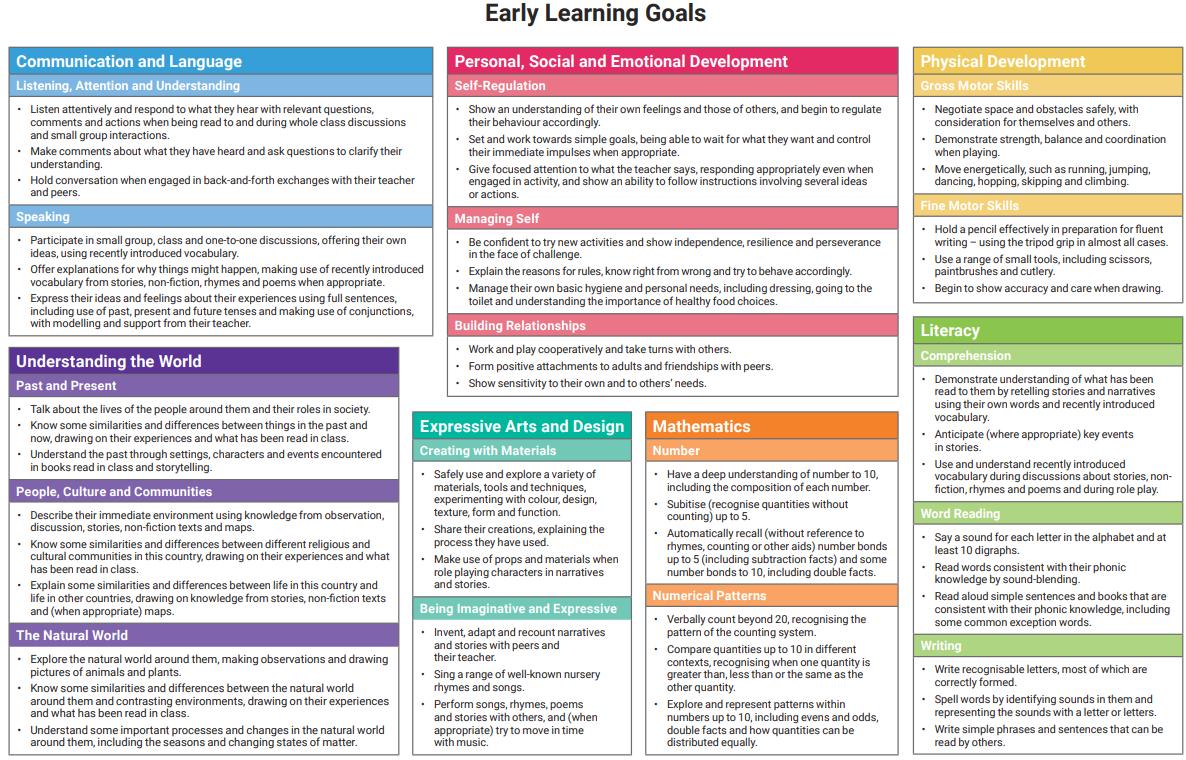
The development of children’s spoken language underpins all seven areas of learning and development. Children’s back-and-forth interactions from an early age form the foundations for language and cognitive development. The number and quality of the conversations they have with adults and peers throughout the day in a language-rich environment is crucial. By commenting on what children are interested in or doing, and echoing back what they say with new vocabulary added, practitioners will build children's language effectively. Reading frequently to children, and engaging them actively in stories, non-fiction, rhymes and poems, and then providing them with extensive opportunities to use and embed new words in a range of contexts, will give children the opportunity to thrive. Through conversation, storytelling and role play, where children share their ideas with support and modelling from their teacher, and sensitive questioning that invites them to elaborate, children become comfortable using a rich range of vocabulary and language structures.
The national curriculum for English reflects the importance of spoken language in pupils’ development across the whole curriculum – cognitively, socially and linguistically. Spoken language underpins the development of reading and writing. The quality and variety of language that pupils hear and speak are vital for developing their vocabulary and grammar and their understanding for reading and writing. Teachers should therefore ensure the continual development of pupils’ confidence and competence in spoken language and listening skills. Pupils should develop a capacity to explain their understanding of books and other reading, and to prepare their ideas before they write. They must be assisted in making their thinking clear to themselves as well as to others, and teachers should ensure that pupils build secure foundations by using discussion to probe and remedy their misconceptions. Pupils should also be taught to understand and use the conventions for discussion and debate. All pupils should be enabled to participate in and gain knowledge, skills and understanding associated with the artistic practice of drama. Pupils should be able to adopt, create and sustain a range of roles, responding appropriately to others in role. They should have opportunities to improvise, devise and script drama for one another and a range of audiences, as well as to rehearse, refine, share and respond thoughtfully to drama and theatre performances. Statutory requirements which underpin all aspects of spoken language across the 6 years of primary education form part of the national curriculum.
The Reception year provides the foundation for communication and language skills children will build upon in Year one.
Ongoing Communication and Language skills developed through the year.
Children will continue to learn new vocabulary and its meaning.
Children will continue to use new vocabulary in conversations and discussions – with teachers and peers.
Children will continue to learn new rhymes, poems and songs – some of which they can recite from memory.
Development of Listening Skills
Intent
Vocabulary
Impact
Children are beginning to listen to other children in their setting. They during story time and show an interest in the books being used.
Listen, reading, wait, story, carpet time, join in, hand up, question, song, rhyme, poem.
Carpet time with verbal and visual reminders to listen to others daily and
Children are listening more on the carpet and when being spoken to by their teacher and peers. Children continue to listen to new stories that are shared with them.
Listen, reading, wait, turn, story, carpet time, join, in, hand up, question, song, rhyme, poem.
Carpet time with verbal and visual reminders to listen to others, daily and
Children’s listening skills are continuing to develop and they are listening in lots of different situations such as carpet time, assembly, phonics and other lessons.
Listen, looking, thinking time, reading, wait turn, join in, question, song, rhyme, poem.
Carpet time with verbal and visual reminders to listen to others, daily and weekly
Children listen when both in and out of school and pay attention to the person talking. When out of school they know it is important to listen to keep safe- such as cars or Stranger Danger.
Listen, wait, turn, carpet time, join in, question, song, rhyme, poem, safe, safety, road safety, fire alarm.
Children’s listening skills continue to develop, they can listen in a range of situations and can listen while taking part in a guided task while remaining on task
Listen, wait, turn, instruction, patience, join in, questions
Carpet time, group work, asking children about stories or work they are completing.
Children show good listening skills and can listen to one another, adults and new people with great skill.
Listen, wait, turn, instruction, patience, join in, question.
Carpet time, groups work, assembly time, asking children questions and modelling questions.
weekly songs, music and stories shared.
weekly songs, rhymes, music and stories shared.
songs, rhymes, music and stories shared.
Development of Attention Skills
Intent
Vocabulary
Impact
Children sit on the carpet and show some attention –this may only be for a short time. Children can pay attention to one thing at a time.
Carpet, sitting, listening, joining in.
Carpet time, assembly time, visual and verbal reminders to sit and listen.
Children pay more attention on the carpet and during guided tasks. Children understand why they need to pay attention.
Carpet, sitting, listening, joining in, part of a group.
Carpet time, group work, playing in provision, visual and verbal reminders to sit and listen.
Children show a good level of attention and concentration. Children are attentive during classroom tasks – both guided and independent.
Carpet, sitting, listening, joining in, part of a group. Quiet, quietly.
Carpet time, group work, playing in provision, visual and verbal reminders to sit and listen.
Development of Responding Skills
Intent
Vocabulary
Impact
Children join in with story time, rhymes, poems. Children respond appropriately when asked eg smart sitting on the carpet
Carpet, sitting, listening, joining in, story time, book reading
Story time, carpet time, asking children to join in with stories, rhymes and making predictions about texts
Development of Understanding
Children follow simple 1 step instructions. Children understand appropriate why questions.
Children respond to questions based on a text that has been read Children discuss events in stories and asking questions about these. Children respond to other children and the adults in the setting.
Carpet, sitting, listening, joining in, story time, book fiction and non fiction book
Children make predictions about what might happen next in the story. Children discuss both fiction and non fiction books. Children continuing to build a rapport with friends.
Carpet, sitting, listening, joining in, story time, book fiction and non fiction book, why, how
Discussions around listening and safety such as fire alarms, road safety
Children follow clear instructions with two parts. Instruction, telling, listen, follow, why, question, explain, because
Children take turns when speaking and responding to their peers and adults with clear understanding of what is being said.
Children can maintain attention in different contexts. Children show attention to both peers and adults.
Carpet, sitting, listening, joining in, part of a group. Quiet, quietly.
Carpet time, group work, playing in provision, visual and verbal reminders to sit and listen.
Children are developing their attention skills to both listen and continue with an activity.
Sitting, listening, joining in, help, assembly.
Carpet time assembly time, group work, playing in provision, visual and verbal reminders to sit and listen.
Children pay attention to others in play. Children show good levels of attention during learning tasks. Join in, game, pretend, friend, new, game, different.
Carpet time assembly time, group work, playing in provision, visual and verbal reminders to sit and listen.
Children converse with pupils and adults in the setting during the day and their play. Children use talk to resolve conflict, discuss their ideas and give reason Children using newly learnt vocabulary in their responses.
Join in, friends, pretend, compromise. Turn taking, fair, why, how, fiction, non fiction.
Children keep play going by conversing and extending conversation. Children ask and answer questions.
Join in, friends, pretend, compromise, turn take, fair, why, how, fiction, non fiction, what, where, when, what could we do next.
Children playing in provision with support of adults in regards to conversing if needed.
Children ask questions and for clarification on new knowledge. Children explain themselves if misunderstood. Questions, why, what, when, how, explain, listen heard, because
Modelling discussions on the carpet and answering questions and explaining reason eg using because.
Children ask questions to clarify understanding and confirm knowledge. Children show a good understanding of texts that have been read to them through their recall.
Children follow clear instructions with three parts. Children use new knowledge and vocab in conversation and play Children show an understanding of questions
Children can retell a story showing a good understanding. Children understand and use a large number of words and new vocabulary in their
Intent
Vocabulary Impact
Instruction, telling, listen, follow, why, question, explain, because
Asking and encouraging children to answer why questions, giving children simple clear instructions.
Asking and encouraging children to answer why questions giving children clear instructions with two parts e.g. get your coat and then sit on the carpet
Turn taking, listening, instruction, telling, listen, follow, why, question, explain, because
Modelling conversations with children and staff, giving children opportunities to talk with new people e.g. asking a doctor questions
Explain, because, why, when, what, how, don’t, understand, retell, vocabulary linked to book language.
Modelling asking and answering questions, asking children questions in a variety of situations, retelling stories as a class through puppets, role playing, verbally and story mapping.
Development of Speaking Skills
Children speak in simple sentences. Children can say simple rhymes and sing songs and poems. Children speak to the adults and children in the class, they talk to other children during their play.
Sentence, songs, joining in, rhymes, poems, Good morning, right, now, pass me, lets get.
Impact
Giving children lots of opportunities to talk during carpet time, group tasks, playing, and general discussions, Observations of children, Daily and weekly songs and rhymes built up across the year, children playing in provision every day.
Children use expression to communicate meaning. Children start conversations and speaking to familiar adults. Children take turns and telling past events. Children learn about rhyme and alliteration.
Conversation, turn taking, why, because, and, cat, hat, good morning how are you.
Adults modelling the use of intonation and exploring expression during guided reading sessions. Giving children lots of opportunities to talk during carpet time, group tasks, playing, and general discussions, Observations of children, Daily and weekly songs and rhymes built up across the year, children playing in provision every day. Learning about rhyme and listening to words that rhyme and creating their own.
Children use talk to pretend play. Children explain things through speech. Children describe things through speech. Children talk in the past tense.
Pretend this is, ran, fell, why, because, I think, this morning, last night.
Giving children lots of opportunities to talk during carpet time, group tasks, playing, and general discussions, Observations of children, Daily and weekly songs and rhymes built up across the year, children playing in provision every day, adults supporting children verbally to use the past tense, recapping activities and the day through conversation or the use of a visual timetable.
Children use talk to clarify their thinking and ideas. Children speak in well-formed sentences. Children use speech to reason and problem solve. Children verbally tell stories.
I think, because, why, when, does, and, because, next, after that, let’s try.
Adults modelling and supporting children to resolve problems, giving children lots of opportunities to talk during carpet time, group tasks, playing, and general discussions, Observations of children, Daily and weekly songs and rhymes built up across the year, children playing in provision every day.
through their talk and actions,
Instructions, listening, follow, explain, repeat, non – fiction, how, why, where, when, because.
Give children multiple instructions to follow verbally, explore a variety of texts together and their features discussions around vocabulary and its meaning, ask and answer questions.
Children explain how things work, what has happened and why. Children solve problems, reasoning with others and fixing friendship issues through speech. Children add detail to their sentences. Children describe things that have happened in their life to others.
I think, because, why, when, does, and, because, next, after that, let’s try, feelings, experience, went to, going to, please, thank you,
Adults guiding children to solve their problems, sequencing stories pictorially and verbally as a class, discussing feelings through conversations and stories, encouraging children to articulate their own feelings.
conversations and during discussions.
Book specific vocabulary, animals, man made, soon, early, late square, triangle, circle, soft, hard, smooth.
Modelling retelling stories in a variety of means, model categorising words explore a range of adjectives and how these can be used to verbally describe and also be used in writing.
Children create an imaginary story of their own in play. Children speak clearly in wellformed sentences. Children use new vocabulary in different contexts. Children use past, present, and future tenses in conversation with peers and adults.
Play, pretend, topic specific vocabulary, now, then, before, after, if, because, so, could,
Small world props available daily to allow children to act out stories, support from adults to use the correct tense and speak in full sentences, conversations through whole class inputs, guided group work and 1:1 with peers and adults in the class to happen daily.
Personal, Social and Emotional Development
Statutory guidance from the EYFS Framework for PRED.
Personal, social and emotional development (PSED) is crucial for children to lead healthy and happy lives and is fundamental to their cognitive development. Underpinning their personal development are the important attachments that shape their social world. Strong, warm and supportive relationships with adults enable children to learn how to understand their own feelings and those of others. Children should be supported to manage emotions, develop a positive sense of self, set themselves simple goals, have confidence in their own abilities, to persist and wait for Children’s what they want and direct attention as necessary. Through adult modelling and guidance, they will learn how to look after their bodies, including healthy eating, and manage personal needs independently. Through supported interaction with other children, they learn how to make good friendships, co-operate and resolve conflicts peaceably. These attributes will provide a secure platform from which children can achieve at school and in later life.
The Reception year provides the foundation for personal, social and emotional skills the children will build upon in Year one.
Children will continue to develop their PSED skills once they move into Year 1 and beyond as they study ‘The National Curriculum.’
Children will continue to learn about individuality and expressing themselves. They will learn about the wider world and how their actions affect others and what the consequences for their actions will be – whether that be a reward or a sanction. Children will continue to build friendships and learn about their community and those from other communities. They will continue to learn about SRE and how to keep their bodies safe, as well as healthy eating.
PSED plays a part in all lifelong skills. Autumn 1 Autumn 2 Spring 1
Development of Expressing Feelings
(Self-Regulation)
Children talk about their feelings to trusted adults or special friends.
Feelings, emotions, happy, sad, angry, good, bad.
Books read focus on feelings and emotions. Class discussions on emotions, relating to starting school.
Children are sharing more often or may comfort a friend who is upset. Children identify their own emotions and name them.
Feelings, emotions, happy, sad, angry, upset, cry
Books read around sharing, friendships and conflicts. Adults model resolving conflict. Adults ask children to express their feelings.
Children know who they can talk when they are very upset and know some ways to calm themselves down if needed. Children are becoming proud of themselves when they achieve things such as pupil of the week.
Proud, pride, happy breathing, feel, feelings, emotions, happy, sad
Adults give time to present any achievements and children knowing they can talk to their teachers about the achievements they have made.
Children have an adult in school they trust and will talk to. Children talk about their interests and likes and dislikes at school.
Choice, explain, say, worry, sad, help
Adults prompt children to explain to the choices they have made. Children spend time with adults in their classroom so they feel comfortable to talk about any concerns they may have.
Children try and share, take turns, reason and look after one another. They apologise if they hurt someone accidently or make someone else upset.
Sorry, upset, sad, accident, help
Adults model apologies and explain to children when an apology is necessary.
Children show emotional maturity ready for the emotional resilience needed for KS1. Children can use reason and resolutions with other children to keep games and play fair.
Emotion, feeling, happy, sad, frustration, explain, why, turn taking, my turn, your turn
Adults provide children with a range of strategies to deal with anger and other emotions.
Development of Managing Behaviour
(Self-Regulation)
Children may come into school upset but can be comforted by adults. Children listen to the rules and expectation and begin to follow them.
Upset, sad, feeling, emotion, rules, safety.
Children begin to take turns and share resources and are developing patience and understanding that there is more than just them in the class.
Children know and follow the behavioural expectations of the school.
Rules, following, behaviour (language related to the behaviours policy)
Children are beginning to understand why listening is important to help us learn and keep us safe.
Listening, waiting, trusted adults, friend, friendship, safe, safety.
Children will without question follows instructions from their teachers or school adults.
Listening, rules, following, safety (language relating to the behaviour policy)
Children are developing in independence and can manage their behaviour in a range of situations in school.
Intent
Vocabulary Implementation
Development of Self Awareness, Keeping Healthy
Adults support children who are upset. School behavioural expectations explained to the children. Rules explained as well as the reason behind them –books shared linked to rules.
Sharing, taking turns, my turn, your turn, patience, waiting.
Adults model sharing, adults support children to share.
Behaviour expectations are consistently shared with the class.
Adults to model and explain why we listen and why it is important. Stories shared around listening.
Adults give children clear instructions in a range of situations to follow.
Independence, getting on, planning, changing, keeping on trying, reflecting, Challenges available to the class. A wide selection of provision available for children to choose between. Adults prompt children to explain their progress in their play.
Children are developing an awareness of themselves and are forming their own opinions. Children are beginning to learn the classroom rules and are following these with some reminders.
Like, dislike, rules, listening, safe, behaviour.
Prompt children to explain what they like and dislike. Rules and expectations explained to the class. Prompts to follow the rules – verbally and pictorially.
Children are doing things for themselves – because they want to. They will say what they are doing and why they are doing it too.
Why, explain, language linked to provision and prior learning.
Prompts to discuss what they are doing and give a reason why.
Children have a good understanding of the behaviour expectations and guide others to follow. They are proud of what they can do and their achievements.
Happy, proud, like, better, improve, good, bad, right, wrong, behave, rules, follow.
Children given time to talk to adults or as a ‘show and tell’ to explain their achievements. Children discussing the rules and knowing right from wrong.
Children know what makes them happy and do these things, they know what keeps them healthy and will do these things when possible.
Show and tell, proud, happy, achieve, healthy, physical activity, tooth brushing, screen time.
Stories and lessons based on keeping healthy including tooth brushing, physical activity, screen time and healthy eating. Make links to food grown on the farm.
Children tell adults and their peers what they have achieved and what they can do now, they are happy with themselves and proud of what they have achieved at school.
Happy, good, like, proud, I can, better.
Children given time to talk to adults or as a ‘show and tell’ to explain their achievements.
Children are proud of who they are and what they can do. They talk about themselves positively.
Individual, me, my, I can, happy, good, like, better.
Discussions with adults on their achievements in Reception and how they have progressed since joining school.
Children are becoming more independent at coming into school in the morning and getting ready for home at home time. They are using the toilet independently most od the
Children are using their preferences to choose what they would like to do at school. Children can put their coats on and are becoming more confident
Children are becoming much more independent –getting things for home, eating their dinner and snacks, asking for help, getting a drink when they want one. Children
Children look after themselves at school (personal and hygiene needs). Children develop resilience and
Children are confident to try new things. They continue to develop their resilience and perseverance independently. Children
Children continue to look after themselves and understand what healthy choices are. Children have developed resilience, independence and perseverance to support
Development of Independence
(Managing Self)
Intent
Vocabulary
Implementation
Development of Social Skills
(Building Relationships)
Intent Vocabulary Implementation
time at school. They know it is okay to ask for help and will do so.
Get, book bag, water bottle, pack-up, timetable, toilet, wiping, listening.
Visual and verbal reminders to organise themselves. Reminders to use the toilet, although children should be going independently but may need some verbal support. Adults give children simple and clear 1 step instructions such as “Get your bag”.
Children are building new positive relationships with pupils and staff in their new setting. They may begin to play alongside other children if ready.
Friend, teacher, peer, class, others, happy, talk, conversation, play, group, roleplay, small world.
Giving children lots of opportunities to talk during carpet time, group tasks, playing, and general discussions.
Conversations modelled by adults.
and skilled in using buttons and zips.
Play, playing, area names of the classroom, help, please, dress, undress, clothing names, listening, next.
Children are given the choice to play in the area they would like to in the classroom. Adults to build up relationships with the class so they feel comfortable to ask for help. Verbal and pictorial reminders and support to get changed.
Children are building on the relationships started last term. They are talking to children and adults in their setting and beginning to ask for help if they need it.
Friend, class, teachers, help, please, talk, conversation.
Adults modelling respectful conversations, adults building positive relationships so children feel comfortable to ask for help.
independently making healthy food choices such as at dinner time.
Toilet, food, drink, knife, fork, help, tired, poo, healthy, treat food.
Adults to build a good relationship with the class so they feel comfortable to ask for help or express their needs. Lessons and activities based around heathy and unhealthy foods. Make links to food grown on the farm.
perseverance independently.
Dress, undress, zip, button, help, try again, tricky, hard, challenge, safe, road safety, look both ways, listening.
Children being asked to independently dress themselves. Children given challenges in class.
Children having to explain how to be safe on roads and paths or being taken out of school as a class on a walk.
Children have friendships and may have a special friend. They play with these children in and out of the classroom and are happy to
Talk, friends, friend names, play, classroom area names.
Children provided with lots of opportunities to play with others and make friends with other children.
Children are building relationships through play and talk and converse to many of their peers.
I think, because, why, when, please, turns, next, shall we, pretend.
Adults modelling negotiation, children supported to negotiate and play. Lots of opportunities for children to play.
can continue to look after and care for themselves.
Like, dislike, why, explain, reason, resilience, try again, rule, road safety, directions, listen, next, after that.
Regular new activities introduced to the class. Discussions around resilience and perseverance. Discussions around road safety or a class walk.
them through transition and the next step in their school journey.
Challenge, harder, next level, healthy, food groups, fats, proteins, carbohydrates, dairy, food names, physical activity. Challenges in the classroom and during adult guided work. Discussions and lessons around keeping healthy.
Children continue to build strong bonds with other children in their school and care for their peers e.g. getting them tissues, asking them to join in with a game.
Do you, like, dislike, your turn, my turn, minutes, shall we.
Stories around considering others, prompts to share, collaborate with other children if necessary.
Children know if they have hurt someone’s feelings and will apologies without being asked. Children know some children might like or dislike the things they do and that it is okay. Children look after each other and want to help their friends. Your turn, my turn, you can have it, share, sad, happy, friend.
Stories around conflict, responsibility, individuality and needs of others.
Development of Communication
Children will develop their personal, social and emotional skills throughout the Reception year and these skills are taught through significantly adult modelling and guidance.
Children will pick up on language used, vocabulary, mannerisms, tone of voice, verbal and non-verbal communications and therefore adapt these into their own communication.
Teacher, peer, friends, class, nicely, turn taking, having a go.
Adults model conversations to other adults as well as to the whole class, small groups of children and 1:1 with children too. Adults use specific facial expressions to convey emotions for children to see as well as using appropriate language and vocabulary that they would like for the children to also use. Adults will model positive engagements.
PSHE Overview
Physical Development
Statutory Guidance from the EYFS Framework for Physical Development
Physical activity is vital in children’s all-round development, enabling them to pursue happy, healthy and active lives10. Gross and fine motor experiences develop incrementally throughout early childhood, starting with sensory explorations and the development of a child’s strength, co-ordination and positional awareness through tummy time, crawling and play movement with both objects and adults. By creating games and providing opportunities for play both indoors and outdoors, adults can support children to develop their core strength, stability, balance, spatial awareness, co-ordination and agility. Gross motor skills provide the foundation for developing healthy bodies and social and emotional well-being. Fine motor control and precision helps with hand-eye co-ordination, which is later linked to early literacy. Repeated and varied opportunities to explore and play with small world activities, puzzles, arts and crafts and the practice of using small tools, with feedback and support from adults, allow children to develop proficiency, control and confidence. The National Curriculum (2014) states that…
Pupils should master basic movements including running, jumping, throwing and catching, as well as developing balance, agility and co-ordination, and begin to apply these in a range of activities participate in team games, developing simple tactics for attacking and defending perform dances using simple movement patterns.
All schools must provide swimming instruction either in key stage 1 or key stage 2
The Reception year provides the foundation for physical skills children will build upon in Year one.
Autumn 1 Autumn 2 Spring 1 Spring 2 Summer 1 Summer 2
General yearly Physical Development progression
Development Matters
Guidance 2021
Intent
Vocabulary
Implementation
• Children will develop overall body strength, co-ordination, balance and agility to support lessons in dance, gymnastics and sport.
• Children will develop their fine motor skills to use a range of tools safely and confidently.
• Children will always have access to pencils, paint brushes, scissors, knives, forks and spoons.
• Children will develop a good posture when sitting at a table (classroom and dinnertimes)
• Children will develop a good pencil grip ready for Y1 writing expectations.
Children will further develop the skills they need to manage the school day successfully: lining up and queuing, mealtimes, personal hygiene.
Line up, wash hands, wait, sit down, carpet time, dinner time, and toilet.
Adults support children to learn the school day and routines. Children go for dinner, Children toilet independently.
Children will revise and refine the fundamental movement skills they have already acquired.
Roll, crawl, walk, jump, run, hop, skip, climb, balance, skill, careful.
P.E Lessons, physical activities in the outdoor area – both child initiated and adult guided.
Children will further develop and refine a range of ball skills. Develop confidence, competence, precision, and accuracy when engaging in activities that involve a ball.
Throwing, catching, kicking, passing, batting, aiming, confidently, precisely, accurately, ball, racket, hands, face, eyes.
P.E Lessons, physical activities in the outdoor area – both child initiated and adult guided, balls in outdoor area.
Children will know and talk about the different factors that support their overall health and wellbeing.
Physical activity, health eating, food groups, tooth brushing, screen time, bedtime routine, road safety.
Planned lessons, guided discussions and continuous provision based around keeping heathy through a range of factors.
Children will combine different movements with ease and fluency.
Dance, move, movement, star shape, pike, straddle, tuck, levels, low, standing, tall.
P.E Lessons, physical activities in the outdoor area – both child initiated and adult guided, balls in outdoor area.
Children will confidently and safely use a range of large and small apparatus indoors and outside, alone and in a group.
Safe, safely, rules, pencil, pen, scissors, paintbrush, bike, scooter, blocks.
Children have daily access to a range of large and small apparatus both indoors and outdoors.
Begin to use their core muscle strength to achieve good posture when sitting on the floor or at the table.
Begin to safely use tools and equipment.
Sit, sitting up, straight, smart sitting, posture, floor, carpet, table, pen, pencil, scissors, ball, racket, rope, cone.
Children sit at tables, sit on the carpet, children have access to a range of tools and equipment such as
Begin to develop overall body; strength, balance, co-ordination, balance and agility. Experiment moving in different ways.
Sit, sitting up, straight, smart sitting, balance, follow me, climb, slither, crawl, skip, jump, hop, side step.
Focus on strength and balance – using equipment to climb, moving around the outdoor area in different ways.
Continue to develop overall body strength, balance and coordination.
Developing in ability when dancing to music.
Strength, balance, coordination, climb, dance, dance move, music.
Focus on strength and balance – using equipment to climb, listening to music and experimenting with moving their body, copying
Negotiates space successfully and can adjust speed and direction.
Showing increasing control with a ball.
Using equipment safely with consideration to others.
Move in a range of ways confidently including running, jumping, dancing, hopping, skipping and climbing.
Space, surroundings, aware, speed, direction, control, ball, looking, racket, hands, eyes.
Negotiating around a range of obstacles at different speeds.
Equipment, ball, cones, safety, careful, running, jumping, stepping, dancing, hopping, skipping, climbing.
Children have access to a range of tools and equipment such as pens, scissors, balls, rackets,
Negotiate space and obstacles safely.
Show strength, balance and coordination when playing.
Move energetically in a range of different ways.
Space, carefully, aware, surroundings, direction, speed, strength, coordination, play, playing, running, jumping, hopping, skipping, climbing, moving, travelling.
Adults prompt children to run safely, adults support
pens, scissors, balls, rackets, cones to use.
dance moves and creating their own.
cones to use – children reminded to use this carefully around other children.
children with gross motor skills by setting up activities and children have access to the equipment at all times.
Fine Motor Development Intent
Vocabulary Implementation
Children use pencils and other equipment comfortably for them.
Children make snips in paper either using one hand or two.
Pencils, tools, equipment, safely, hand, scissors, dough disco, snips.
Pencils available for children at all times, scissors available for children to use, activities for children that include mark making, name writing and snipping paper. Dough disco and squiggle. Daily handwriting lessons as part of Letterjoin – children introduced to new formations to copy and then use during writing activities.
Children continue to develop their fine motor skills.
Children begin to learn correct letter formations and use these in their writing.
Pen, pencils, scissors, paintbrush, letter formation, letters, rhymes, writing.
Fine motor activities in the class as well as adult guided activities – drawing, writing, cutting, tracing etc. Daily handwriting lessons as part of Letterjoin –children introduced to new formations to copy and then use during writing activities.
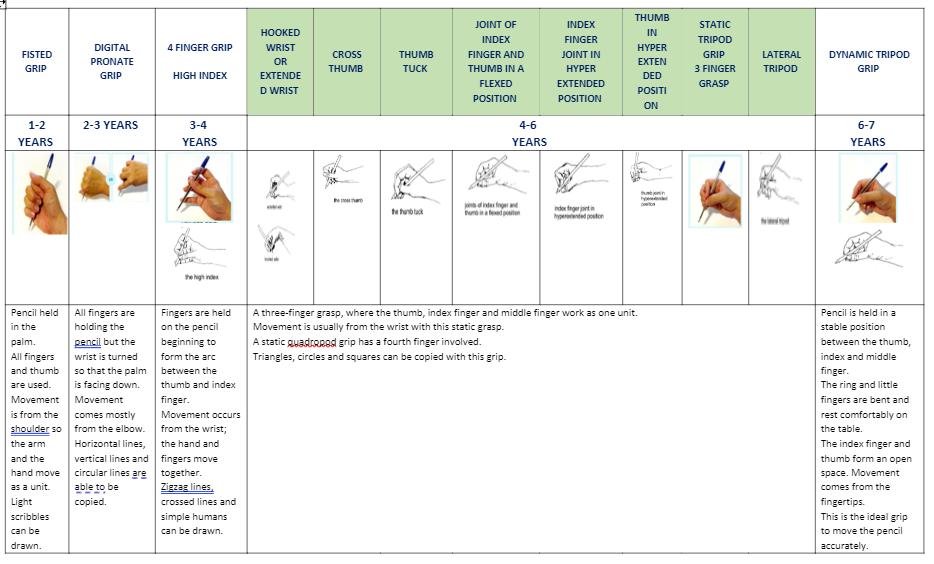
Develop an effective pencil grip.
Develop skill when using tools including scissors.
Pencil, grip, hand, fingers, skill, scissors, snips, control.
Adults support children to develop their pencil grip –verbally, moving fingers, pencil grips if children need support. Scissors and small tools available in provision for children as well as guided activities using these materials.
Children form recognisable letters with an effective pencil grip.
Letters, trace, rhymes, pencil grip.
Children are taught letter formations, incorrect formations being corrected and teachers supporting children to correct these. Adults support children to develop their pencil grip –verbally, moving fingers, pencil grips if children need support.
Confidently using scissors and small tools.
Begin to use a tripod grip to draw and write accurately.
Scissors, small tools, tripod, fingers, draw, pencils.
Adults support children to develop their pencil grip –verbally, moving fingers, pencil grips if children need support. Scissors and small tools available in provision for children as well as guided activities using these materials.
Children use the tripod grip.
Use a range of small tools. Show accuracy when drawing.
Tripod, pencil, grip, skill, tools, pen, pencil, scissors, weaving, threading, accuracy, drawing, detail, tracing.
Adults support children to develop their pencil grip –verbally, moving fingers, pencil grips if children need support. Scissors and small tools available in provision for children as well as guided activities using these materials.
Literacy
Statutory Guidance from the EYFS Framework (2021) for Literacy:
It is crucial for children to develop a life-long love of reading. Reading consists of two dimensions: language comprehension and word reading. Language comprehension (necessary for both reading and writing) starts from birth. It only develops when adults talk with children about the world around them and the books (stories and non-fiction) they read with them, and enjoy rhymes, poems and songs together. Skilled word reading, taught later, involves both the speedy working out of the pronunciation of unfamiliar printed words (decoding) and the speedy recognition of familiar printed words. Writing involves transcription (spelling and handwriting) and composition (articulating ideas and structuring them in speech, before writing).
The Year 1 expectations in Literacy/English from the National Curriculum.
Where are children going?
Year 1 – Reading (Word Reading)
Apply phonic knowledge and skills as the route to decode words-respond speedily with the correct sound to graphemes (letters or groups of letters) for all 40+ phonemes, including, where applicable, alternative sounds for graphemes read accurately by blending sounds in unfamiliar words containing GPCs that have been taught read common exception words, noting unusual correspondences between spelling and sound and where these occur in the word read words containing taught GPCs and –s, –es, –ing, –ed, –er and –est endings read other words of more than one syllable that contain taught GPCs read words with contractions [for example, I’m, I’ll, we’ll], and understand that the apostrophe represents the omitted letter(s) read books aloud, accurately, that are consistent with their developing phonic knowledge and that do not require them to use other strategies to work out words reread these books to build up their fluency and confidence in word reading.
Year 1 Reading (Comprehension)
Develop pleasure in reading, motivation to read, vocabulary and understanding by: listening to and discussing a wide range of poems, stories and non-fiction at a level beyond that at which they can read independently being encouraged to link what they read or hear to their own experiences becoming very familiar with key stories, fairy stories and traditional tales, retelling them and considering their particular characteristics recognising and joining in with predictable phrases learning to appreciate rhymes and poems, and to recite some by heart discussing word meanings, linking new meanings to those already known understand both the books they can already read accurately and fluently and those they listen to by: drawing on what they already know or on background information and vocabulary provided by the teacher checking that the text makes sense to them as they read, and correcting inaccurate reading discussing the significance of the title and events making inferences on the basis of what is being said and done predicting what might happen on the basis of what has been read so far participate in discussion about what is read to them, taking turns and listening to what others say explain clearly their understanding of what is read to them.
Year 1 (Transcript)
Pupils should be taught to spell words containing each of the 40+ phonemes already taught common exception words the days of the week name the letters of the alphabet: naming the letters of the alphabet in order using letter names to distinguish between alternative spellings of the same sound add prefixes and suffixes: using the spelling rule for adding –s or –es as the plural marker for nouns and the third person singular marker for verbs using the prefix un– using –ing, –ed, –er and –est where no change is needed in the spelling of root words [for example, helping, helped, helper, eating, quicker, quickest] apply simple spelling rules and guidance, as listed in English Appendix 1 write from memory simple sentences dictated by the teacher that include words using the GPCs and common exception words taught so far
Year 1 (Composition)
Write sentences by: saying out loud what they are going to write about composing a sentence orally before writing it sequencing sentences to form short narratives re-reading what they have written to check that it makes sense discuss what they have written with the teacher or other pupils read their writing aloud, clearly enough to be heard by their peers and the teacher.
Year 1 (Handwriting)
sit correctly at a table, holding a pencil comfortably and correctly begin to form lower-case letters in the correct direction, starting and finishing in the right place form capital letters form digits 0-9 understand which letters belong to which handwriting ‘families’ (ie letters that are formed in similar ways) and to practise these.
Year 1 Writing (Vocabulary, grammar, punctuation)
Develop their understanding of the concepts set out in English Appendix 2 by: leaving spaces between words joining words and joining clauses using ‘and’ beginning to punctuate sentences using a capital letter and a full stop, question mark or exclamation mark using a capital letter for names of people, places, the days of the week, and the personal pronoun ‘I’ learning the grammar for year 1 In English Appendix 2 use the grammatical terminology in English Appendix 2 in discussing their writing.
Genres covered in Y1: Instructions eg recipes, Instruction Writing Narrative e.g. Stories, fairy tales Informative e.g. Fact Files. Recounts
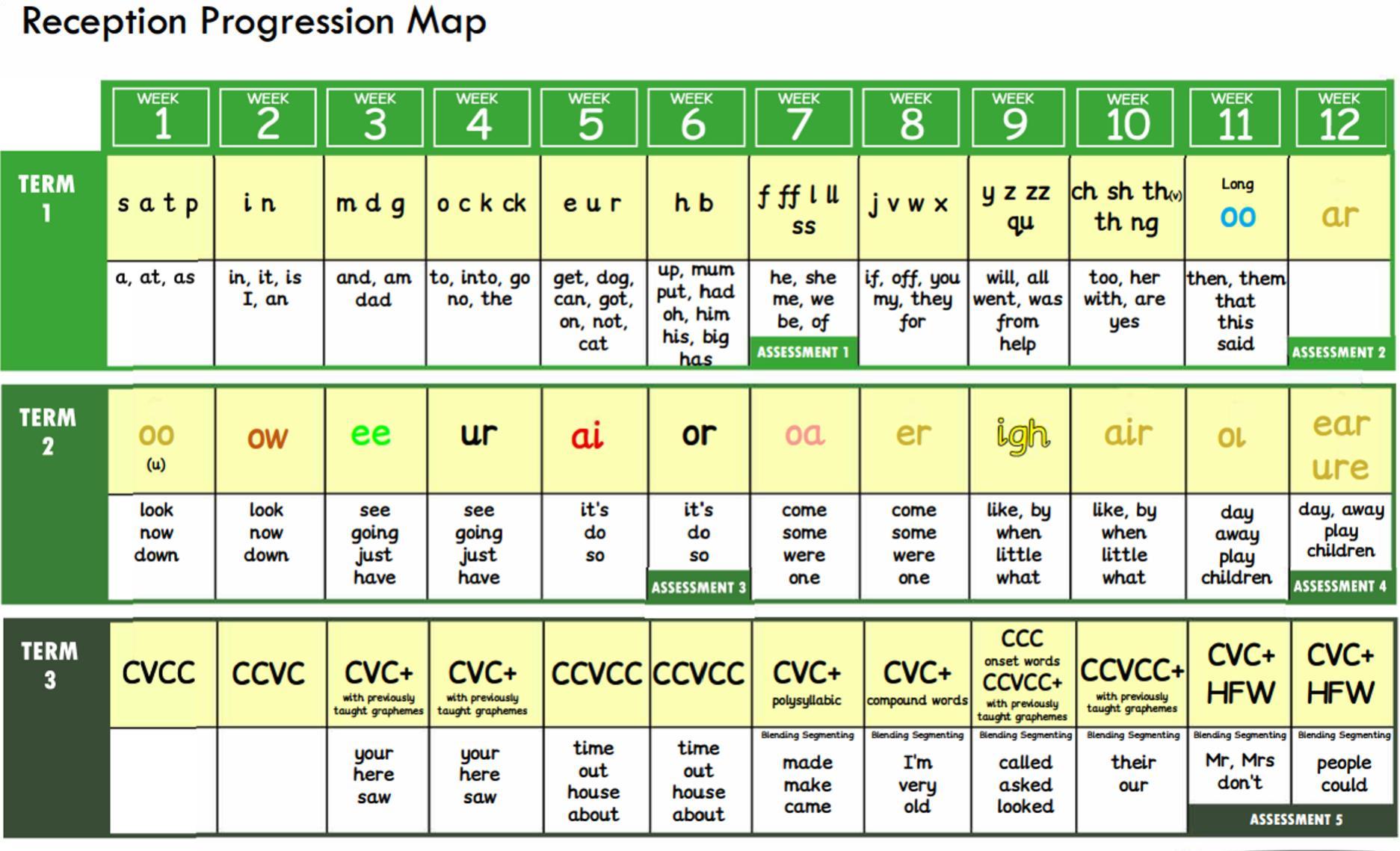
Development of Word
Reading
Monster Phonics
Intent
Vocabulary
Implementation
Development of Reading Comprehension
Intent
Children are taught the first set of sounds
s,a,t,p,i,n,m,d,g,o,c,k,ck,e,u, r,h,b,f,ff l,ll,ss
Hearing, listening, sound, phoneme, three sounds, two sounds, put it together, what can you hear?
Support and modelling of hearing initial sounds and using phonics fingers to break down a word into the phonemes e.g. cat – c/a/t.
Children are taught the second set of sounds j,v,w,x,y,z,qu,sh,ch,th,zz,ng
ai, ee,igh, oa, oo ow, or, ur, ar, oi, er, ear, air, ure
Letters, phonemes, read, sounds, tricky words.
During Phonics lessons children shown the graphemes and children saying the corresponding phonemes, during reading time children saying the phonemes in their books to match the graphemes seen. Children encouraged to segment and then blend the sounds together in both phonics lessons, literacy lessons and reading time. Children introduced to tricky words to sight read.
Digraph, read, sounding out, tricky word, CVC, sound buttons.
During Phonics lessons children shown digraphs, children to read the two graphemes as one phoneme. Reading fluency developed and children encouraged to read simple phrases and sentences during phonics lessons and reading time. Children introduced to more ‘tricky words’ to sight read.
Digraph, read, sounding out, tricky word, CVC, sound buttons.
During Phonics lessons children shown digraphs, children to read the two graphemes as one phoneme. Reading fluency developed and children encouraged to read simple phrases and sentences during phonics lessons and reading time. Children introduced to more ‘tricky words’ to sight read.
Tricky words, re-read, check, sense, edit, change, adapt, improve.
Children shown Phase 4 tricky words to sight read. Children reminded to reread their work to check for fluently.
Children joining in with rhyme, songs and poems. Children are encouraged to hold a book correctly and carefully turn pages.
Children understand books have a beginning and an end
Children listen and enjoy sharing a range of books both fiction and non-fiction.
Children know that text in English is read top to bottom and left to right. Children can recognise pictures and illustrations in a text Vs the writing. Children spotting familiar words in books.
Book, rhyme, join in, picture, illustration, words, text, follow, repeat, look, beginning, middle, end.
Reading together, pointing to the words, talking about the pictures in books, retell
Children being able to sequence two events from a familiar story – possibly with the use of prompts for support. Children discussing and hearing a range of books – nonfiction and fiction. Children being asked questions linked to the books read to them. Children using texts and images to answer simple questions.
Texts, books, story, nonfiction, fiction, questions, who, what, where, why, when, pictures, illustrations.
Reading together, exploring a wide range of books and discussing their features, Asking questions about books we have read, asking ‘yes’ and ‘no’
Children having favourite books and rhymes – they may know these books from memory. Say what they liked or disliked about a story. When listening to a story children use the images to help them read. Children are becoming increasingly more confident with their understanding of new words in stories. Children can use a books front cover or blurb to make a prediction.
Text, pictures, what, why, how, when, where, like, dislike, rhyme, play.
Model using pictures to infer clues about the text, Ask children to predict what is happening by using the pictures in different texts, discuss different
When children are playing they are adapting, roleplaying or using vocabulary from stories they’ve read or heard. When reading a wellknown or repeated story children will join in.
Showing an increasing confidence in sequencing a story. Gives a suggestion to the ending of a story using the front cover, blurb and beginning to support their suggestions.
Story, order, sequence, retell, end, repeat.
Give picture cards of stories, create story maps or provide small world areas with the characters from read stories, discuss and display new vocabulary, ask children for their predictions of how
Use events in a story to suggest what might happen next (with reasonable suggestions being made). Know what non-fiction and fiction means and can talk about the two text types. Correctly sequence a story. Use ‘because’ to give reason when answering ‘why’ questions about a text. Rehearse and recall rhymes and stories and remembering actions to well-known rhymes e.g. Incy Wincy spider, grand old duke of York.
Sequence, story, what, why, difference, nonfiction, fiction, poetry, act out, show me.
Children to sequence a story in their writing. Ask children questions about
Converses about books talking about the events, the parts they liked and dislikes and gives reason as to why they feel this way. Knows key vocabulary used in a range of books. Continue to develop their roleplay to involve the storylines of the books read to them. Recalls many parts of a text with accuracy.
Vocabulary, words, recall, retell, next, after that, why, when, like.
Provide resources for children to access linked to read texts, literacy tasks based on innovating known stories e.g. Going on a fish hunt. Asking children to reason how they feel about a text. Discussing and explaining
Early Development in Writing
Intent
Vocabulary
Implementation
Development of Composition Skills
stories, point out words. Sing nursery rhymes, songs and read poems. (link to themes and books suggested above)
Writes their name - copying it from a name card or trying to write it from memory. Develop an awareness that writing communicates meaning. Gives meaning to marks they make.
Listen, speak, speaking, writing, mean, explain, what.
Carpet time, use of the role play area, small group work modelling speaking skills, reminders to listen to and join in, reading books as a class, using the class book area, model writing during class inputs, name boards, write their name on sheets and in their writing book.
questions about texts, model using puppets to act out stories.
Forms the basic understanding of compositional skills through talk - to organise my play and describe
vocabulary and phrase meanings, ask questions about phrases used, ask children to vote for stories or say if they liked or disliked a story.
a story is going to end, ask children if they liked or disliked a story and to give a reason.
Continuing to develop a phoneme / grapheme relationship. Now has increasing control when making marks and drawing. Copies adult ‘writing behaviour’ e.g. writing on a whiteboard, writing messages. Uses some recognisable letters and own symbols such as their name or some initial sounds.
Copy, trace, same, drawing, picture, neat, phoneme, grapheme, symbols, marks, letters, name, writing.
Roleplaying resources, a mark making area or access to paper and writing tools, modelling writing during shared inputs and writing sounds ‘out loud’. Children have access to sound boards in the class.
Children recording letters for initial sounds and end sounds. Children building and recording simple CVC words.
Writing, initial sounds, hear, phoneme, listen, tune in, end sound, sound at the end.
Children given opportunities during writing lessons and during choosing time to write the initial sounds they can hear, modelling writing initial sounds during shared inputs. Children moving onto hearing end sounds once ready. Children moving onto CVC words once ready.
Understands that thoughts and stories can be written down from what has been modelled to them. Use talk to link ideas during conversation and play as
what will happen next and to give a reason, children to explain the kind of text the class is reading and how they know e.g. fiction books have information, ask ‘why’ questions about texts.
new vocabulary used in texts shared with them.
Orally sounds out CVC words. Breaking down words to ensure they’ve remembered all of the sounds.
Children build CVC, CVCC words using known graphemes. Children recording these. Use writing in their play. Some children moving onto caption writing if ready.
Words, writing, sounds, phoneme, graphemes, sounding out, independently, sound talk, sound buttons, roleplay.
CVC writing activities during guided group work and as independent challenges in the classroom, modelled during shared inputs, roleplay areas to have writing materials
All children being exposed to caption writing and simple sentence writing and extended to copy or create a simple caption e.g. it is a bus. Continue to build on knowledge of letter sounds in writing.
Writing, sounds, letter sounds, graphemes, phonemes, mark making.
New phonemes and graphemes introduced during phonics lessons, sound mats used in literacy lessons and within class provision, a range of literacy tasks and writing activities during guided group work drawing on previously read texts.
Children writing for a range of purposes e.g. nonfiction and fiction writing. Write short sentences sometimes using finger spaces, capital letters and full stops.
Instructions, recipe, story, non-fiction, fiction, information book, sentences, letter sounds, capital letters, finger spaces and full stops.
Children writing for a range of different purposes such as fact files, stories, recipes, instructions. Modelling writing sentences in sequence with the correct punctuation – children reminded to include this verbally or pictorially.
Orally compose a caption and hold it in memory before attempting to write it.
Write a simple sentence. Firstly focusing on including finger spaces.
Oral, out loud, sentence, rehearse, repeat, check, reread, writing, full stop,
Write sequenced simple sentences with some finger spaces – working towards including a capital letter and full stop
events and special occasions.
Experiences, events, Compose, talk, describe, tell, birthday, party, Christmas, roleplay, mums and dads, babies.
Intent
Vocabulary
Implementation
Listens to stories, joins in with class discussions, talks to friends or in guided groups including the teacher.
well as clarify their thinking and feelings.
Roleplay, feelings, happy, sad, story, message, stories, text.
Listens to stories, joins in with class discussions, talks to friends or in guided groups including the teacher, Roleplays with others and acts out stories, modelling writing down ideas as a shared input.
Oral, out loud, sentence, rehearse, repeat, check, re-read.
Models composing words and breaking them down into CVC words. Writing activities based on CVC words. Higher ability children challenged to put their CVC word into a sentence.
Oral, out loud, sentence, rehearse, repeat, check, re-read.
Models composing captions with the guidance of the class, children repeating your sentence back to you as a whole class, supporting children to orally compose a sentence during guided literacy tasks.
punctuate, end, finger space.
Models composing simple sentences with the guidance of the class, children repeating your sentence back to you as a whole class, supporting children to orally compose a sentence during guided literacy tasks.
Oral, out loud, sentence, rehearse, repeat, check, re-read, writing, full stop, punctuate, end, story, capital letters, finger spaces.
Writing activities based around a class story –retelling and innovating, modelling the use of capital letters, finger spaces and full stops and verbally or pictorially reminding children to use these.
Development of Spelling Intent
Vocabulary
Implementation
Orally segment simple words e.g. cat, dog. Write their name copying it from a name card or trying to write it from memory.
Segmenting, phonemes, graphemes, sounds, name writing, copy, trace, formations.
‘Robot talk’ to segment sounds in words, writing their names on sheets or in books.
Orally spell VC and CVC words by identifying the sounds. Write their own name.
Segmenting, phonemes, graphemes, sounds, name writing, copy, trace, formations, three sounds, sound buttons.
Phonics lessons based on orally segmenting words, writing names on sheets and in books during all activities.
Sounding out to write VC and CVC words independently using Phase 2 graphemes. Segmenting, phonemes, graphemes, sounds, name writing, copy, trace, formations, three sounds, sound buttons, spelling.
Literacy activities based on writing VC and CVC words. Phonics writing activities writing words with known graphemes.
Sounding out to write VC, CVC and CVCC words independently using Phase 2 and Phase 3 graphemes. Children can spell some tricky words e.g. the, to, no, go* independently. Segmenting, phonemes, graphemes, sounds, copy, trace, formations, three sounds, sound buttons, tricky words.
Literacy and Phonics writing activities writing words with known graphemes, sentence writing including tricky words.
Children using the knowledge and understanding of phoneme – grapheme correspondence to spell words. Make phonetically plausible attempts when writing unknown words that cannot be sounded out with only Phase 2 and 3 knowledge.
Segmenting, phonemes, graphemes, sounds, copy, trace, formations, three sounds, sound buttons, tricky words.
Literacy and Phonics writing activities writing words with known graphemes, sentence writing including tricky words.
Make phonetically plausible attempts when writing unknown words that cannot be sounded out with only Phase 2 and 3 knowledge. Spelling Phase 4 words if ready.
Spell tricky words e.g., he, she, we, be, me* independently.
Segmenting, phonemes, graphemes, sounds, sound buttons, tricky words, independent.
Literacy and Phonics writing activities writing words with known graphemes, Sentence writing including tricky words.
Development of Handwriting Intent
Vocabulary
Implementation
Know that words around me mean something and can be written by my classroom adults and me. Notices the direction English is written - left to right and top to bottom. Children draws lines and circles, basic shapes and pictures. Children writing their name with the beginning of some correct formations. Story, print, text, illustration, pictures, reading, left to right, drawing, making, marks, lines, circles.
Weekly handwriting lessons based on shapes and lines, daily reminders and recaps on how to hold a pencil.
Children form letters from their name mostly correctly. Children understand that we write from left to right and top to bottom. Children using ‘pinch and flick’ as a method to hold their pencil in a supportive grip for effective writing.
Pencil grip, pinch and flick, letters, formations, trace, copy, formation rhymes, spaces, finger spaces.
Weekly handwriting lessons based on letter formation progression, daily reminders and recaps on how to hold a pencil.
Children are beginning to show a dominant hand. Children begin to form more recognisable letters –although they may not ‘start’ in the correct place..
Pencil grip, pinch and flick, letters, formations, trace, copy, formation rhymes, spaces, finger spaces, hand, left to right, follow the page.
Weekly handwriting lessons based on letter formation progression, daily reminders and recaps on how to hold a pencil, children wiring in a literacy book.
Children hold their pencil effectively to form recognisable letters. Children building a repertoire of correct formations through weekly handwriting formation lessons.
Pencil grip, pinch and flick, letters, formations, trace, copy, formation rhymes, hand, left to right,, lazy letters, tall letters, on the line, under the line.
Weekly handwriting lessons based on letter formation progression, daily reminders and recaps on how to hold a pencil, children wiring in a literacy book on lines.
Children now form most lower-case letters correctly, starting and finishing in the right place. Children are beginning to include spaces between words.
Pencil grip, pinch and flick, letters, formations, trace, copy, spaces, correct formations.
Weekly handwriting lessons based on letter formation progression, daily reminders and recaps on how to hold a pencil, children wiring in a literacy book on lines and using finger spaces.
Children using a tripod grip to confidently write letters that can be clearly recognised. Children are forming some capital letters correctly.
Pencil grip, pinch and flick, letters, formations, trace, copy, capital letters, correct, writing.
Weekly handwriting lessons based on letter formation progression - to include capital letters, daily reminders and recap on how to hold a pencil, children wiring in a literacy book on lines and using finger spaces and capital letters.
Mathematics
Developing a strong grounding in number is essential so that all children develop the necessary building blocks to excel mathematically. Children should be able to count confidently, develop a deep understanding of the numbers to 10, the relationships between them and the patterns within those numbers. By providing frequent and varied opportunities to build and apply this understanding – such as using manipulatives, including small pebbles and tens frames for organising counting – children will develop a secure base of knowledge and vocabulary from which mastery of mathematics is built. In addition, it is important that the curriculum includes rich opportunities for children to develop their spatial reasoning skills across all mathematics including shape, space and measures. It is important that children develop positive attitudes and interests in mathematics, look for patterns and relationships, spot connections, ‘have a go’, talk to adults and peers about what they notice and not be afraid to make mistakes.
Ongoing mathematical skills developed throughout the year
• Linking the number system with its cardinal number value
• Counting beyond ten
• Comparing numbers
• Understanding the one more/one less relationship between consecutive numbers
• Compare length, weight and capacity
• Select, rotate and manipulate shapes to develop spatial reasoning skills
• Compose and decompose shapes so that children recognise a shape can have other shapes within it, just as numbers can
The Reception year provides the foundation for mathematical skills the children will build upon in Year one.
Number and place value (within 100)
Children will count to and across 100, forwards and backwards, beginning with 0 or 1, or from any given number, count, read and write numbers to 100 in numerals; count in multiples of twos, fives and tens; given a number, identify one more and one less; identify and represent numbers using objects and pictorial representations including the number line, and use the language of: equal to, more than, less than (fewer), most, least read and write numbers from 1 to 20 in numerals and word
Addition and subtraction
Children will read, write and interpret mathematical statements involving addition (+), subtraction (–) and equals (=) signs; represent and use number bonds and related subtraction facts within 20; add and subtract one-digit and two-digit numbers to 20, including zero; solve one-step problems that involve addition and subtraction, using concrete objects and pictorial representations, and missing number problems such as 7 = – 9.
Measurement
Children will compare, describe and solve practical problems for: lengths and heights; mass/weight; capacity and volume; time; measure and begin to record the following: lengths and heights; mass/weight; capacity and volume; time; recognise and know the value of different denominations of coins and notes; sequence events in chronological order using language; recognise and use language relating to dates, including days of the week, weeks, months and years; tell the time to the hour and half past the hour and draw the hands on a clock face to show these times
Number – multiplication and division
Children will solve one-step problems involving multiplication and division, by calculating the answer using concrete objects, pictorial representations and arrays with the support of the teacher.
Fractions
Children will recognise, find and name a half as one of two equal parts of an object, shape or quantity; recognise, find and name a quarter as one of four equal parts of an object, shape or quantity
Geometry
– Properties of shapes
Children will recognise and name common 2-D and 3-D shapes.
Geometry – position and direction
Children will describe position, direction and movement, including whole, half, quarter and three quarter turns.
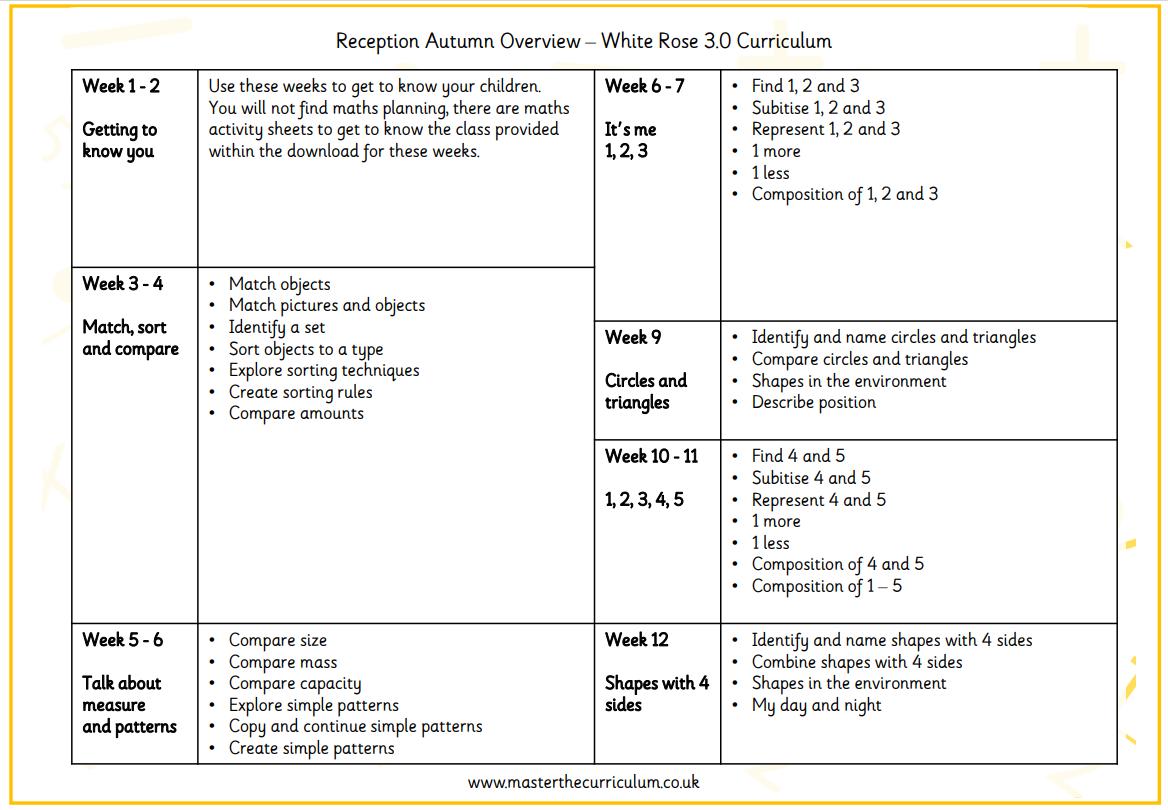
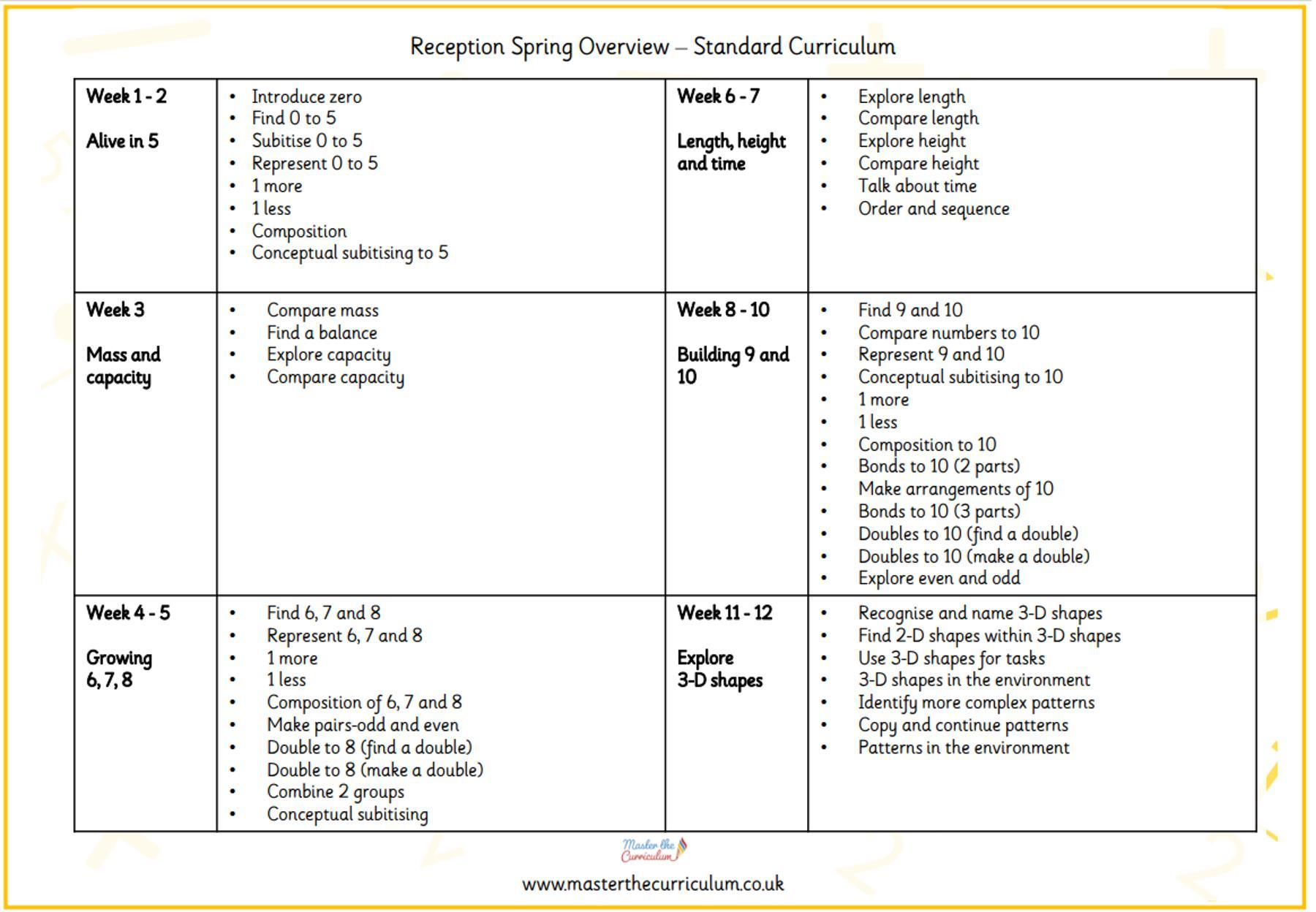
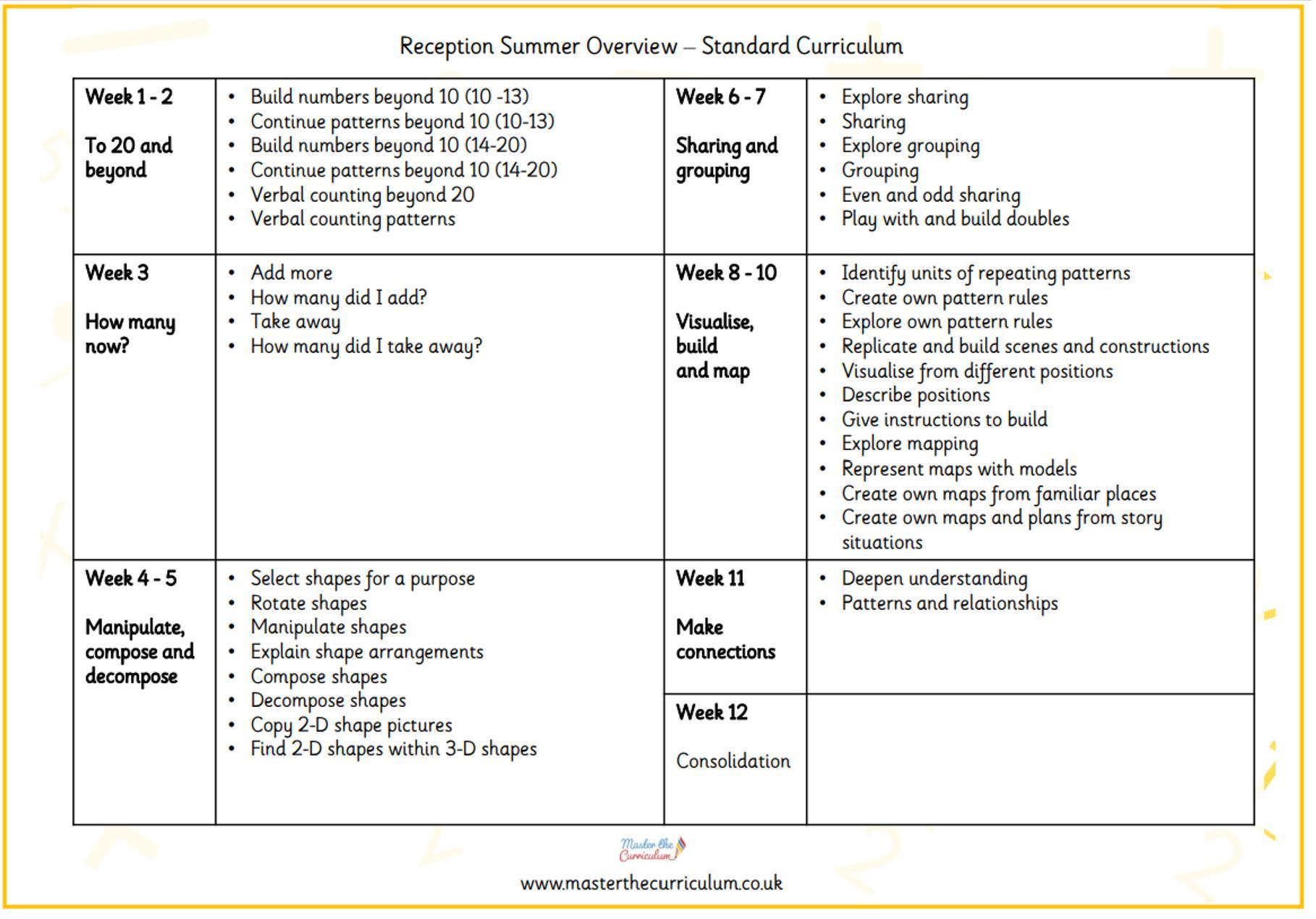
The Reception year provides the foundation skills that children will build upon in Year one.
Understanding the World
The Science National Curriculum (2014) … Working Scientifically: asking simple questions and recognising that they can be answered in different ways, observing closely, using simple equipment, performing simple tests, identifying and classifying, using their observations and ideas to suggest answers to questions, gathering and recording data to help in answering questions. Plants: identify and name a variety of common wild and garden plants, including deciduous and evergreen trees, identify and describe the basic structure of a variety of common flowering plants, including trees. Animals, including humans: identify and name a variety of common animals including fish, amphibians, reptiles, birds and mammals, identify and name a variety of common animals that are carnivores, herbivores and omnivores, describe and compare the structure of a variety of common animals (fish, amphibians, reptiles, birds and mammals, including pets), identify, name, draw and label the basic parts of the human body and say which part of the body is associated with each sense Everyday materials: distinguish between an object and the material from which it is made, identify and name a variety of everyday materials, including wood, plastic, glass, metal, water, and rock, describe the simple physical properties of a variety of everyday materials, compare and group together a variety of everyday materials on the basis of their simple physical properties. Seasonal changes: observe changes across the four seasons, observe and describe weather associated with the seasons and how day length varies
The Geography National Curriculum(2014) states Pupils should be taught to: Location knowledge name and locate the world’s seven continents and five oceans name, locate and identify characteristics of the four countries and capital cities of the United Kingdom and its surrounding seas Place knowledge understand geographical similarities and differences through studying the human and physical geography of a small area of the United Kingdom, and of a small area in a contrasting non-European country Human and physical geography identify seasonal and daily weather patterns in the United Kingdom and the location of hot and cold areas of the world in relation to the Equator and the North and South Poles use basic geographical vocabulary to refer to: key physical features, including: beach, cliff, coast, forest, hill, mountain, sea, ocean, river, soil, valley, vegetation, season and weather key human features, including: city, town, village, factory, farm, house, office, port, harbour and shop Geographical skills and fieldwork use world maps, atlases and globes to identify the United Kingdom and its countries, as well as the countries, continents and oceans studied at this key stage use simple compass directions (North, South, East and West) and locational and directional language [for example, near and far; left and right], to describe the location of features and routes on a map Geography – key stages 1 and 2 3 use aerial photographs and plan perspectives to recognise landmarks and basic human and physical features; devise a simple map; and use and construct basic symbols in a key use simple fieldwork and observational skills to study the geography of their school and its grounds and the key human and physical features of its surrounding environment
The History National Curriculum (2014) states that Pupils should be taught about: changes within living memory. Where appropriate, these should be used to reveal aspects of change in national life events beyond living memory that are significant nationally or globally [for example, the Great Fire of London, the first aeroplane flight or events commemorated through festivals or anniversaries] the lives of significant individuals in the past who have contributed to national and international achievements. Some should be used to compare aspects of life in different periods [for example, Elizabeth I and Queen Victoria, Christopher Columbus and Neil Armstrong, William Caxton and Tim Berners-Lee, Pieter Bruegel the Elder and LS Lowry, Rosa Parks and Emily Davison, Mary Seacole and/or Florence Nightingale and Edith Cavell] significant historical events, people and places in their own locality
Characteristics of Effective Teaching and Learning
The EYFS statutory framework (2021) outlines in planning and guiding what children learn, practitioners must reflect on the different rates at which children are developing and adjust their practice appropriately.
Three characteristics of effective teaching and learning are:
• playing and exploring - children investigate and experience things, and ‘have a go’
• active learning - children concentrate and keep on trying if they encounter difficulties, and enjoy achievements
• creating and thinking critically - children have and develop their own ideas, make links between ideas, and develop strategies for doing things.
Development of Chronology
Children talk about members of their family and the relationship to them e.g. Mum, Dad.
Family, relationships, Mum, Dad, sister, brother, grandma, grandad, friends.
Children use the language of time when talking about past and present events in their own lives and in the lives of others including people they have learnt about through books.
Last week, yesterday, a long time ago, last year, before I was born.
Discussions around past and present – events such as celebrations, remembrance day (war).
Children talk about and understand changes in their own lifetime and what happens when they get older.
Children recount an event that has happened.
Event, special, holiday, what happened, then, next.
Intent
Vocabulary
Implementation
Children join in with discussions and stories about family. Children focus on learning based on ‘all about me’ and their family and friends.
Children talk about people who are familiar to them and describe them.
Principal, teacher teaching assistant sports coach, cook, midday supervisor, site manager, cleaner, office manager/assistant, hairdresser, police, nurse
Children meet and talk to adults who are familiar to them. Children focus on learning based on occupations of familiar people.
Development of Enquiry
Children talk about roles people have in society
(both in the present and past). Children understand the need for these roles.
Key worker, job, help, helpful, community
Children visually represent their day on a simple timeline.
Timeline, day, week, first, last, them, next, days of the week – names.
Children learn about the days of the week in and out of Maths lessons. Children have a visual timetable. Children complete practical activities visually representation their week.
Changes, baby, toddler, child, teenager, adult, elderly, ages, life cycle, farm animal and baby names
Learning about life cycles of animals, learning about how we grow and change as people.
Discussions around events we have had at school such as school trips, visits and holidays with family etc.
Children can order experiences that have happened to them and in stories they have read. First, then, next, after that, finally, story.
Adults prompting children to order experiences and stories verbally or in a written method.
Children find out about key historical events and why and how we celebrate today? Remembrance Day, Christmas Day, Diwali.
History, past, celebrations, festivals.
Adults provide opportunities to explore a
Understand some changes in the natural world around them, including the seasonsWinter.
Technology, search, internet, China (Chinese New Year), seasons
Understand some changes in the natural world around them, including the seasonsSpring.
Technology, search, internet, seasons
Adults model using technology. Children have
Children compare and contrast the past and present and can describe and ask questions about old and new. They notice similarities and differences independently and talk about these.
Images, pictures, past, present, change, different,
Children confidently compare and contrast characters from stories, including figures from the past.
Stories, characters, pictures, past, people, places, time, compare, comparison, same
Intent
Vocabulary Implementation
RE
Development of the Understanding of Respect
range of festivals and celebrations.
Children know that you can find out information from different sources
Information, books, videos, search, internet,
Adults model how to find information using a range of sources. Adults give children access to books to find information
Adults model using technology. Children have access to the technology to find information.
Children describe images of familiar situations in the past when looking and contrasting images or stories. Children are taught about change in relation to transport and learn about figures from the past – The Wright Brothers.
Images, pictures, past, present, same, different, grow, change.
Children explore images from the past through stories. Adults provide activities and inputs based on transport and how vehicles have changed.
access to the technology to find information.
people, places, time, compare, comparison, same.
Children provided with images to compare with past and present – link to People Day. Discussions around past and present
Understand some changes in the natural world around them, including the seasonsSummer.
Technology, search, internet, seasons
Adults model using technology. Children have access to the technology to find information.
Adults share stories and characters are compared. Children provided with images of people to compare past with present.
Throughout the year, children will learn about different religions, views and values through special places, books, people and objects . RE will be taught through stories and practical activities and children will explore religion through discussion points where they will have the chance to express their own feelings and experiences of religion. RE –Religious Education, links to the EYFS curriculum through PSED and UTW.
Religion, special, people, books, places, church, synagogue, worship, feelings, similar, different
Children learn about a range of faiths and their similarities and differences. Children are immersed in festivals and religious celebrations.
Myself
Understanding there are different religions –Christian, Muslim, Jew, Hindu
Understanding what it means to be part of a religious group/community
Being able to relate a being part of a religious group to
Special People to Me
Special people in religion, e.g. Jesus, Prophet Muhammad, Moses, Guru Nanak, etc.
Understanding the idea that some people in religious communities have special jobs, e.g. vicar, imam, rabbi, etc.
Think about different jobs these people have, e.g. teacher, leader, someone to look after the community, etc.
Our Special books
Name sacred books from different religions e.g. Bible, Qur’an, Torah
Name and identify features of the Bible.
Name and identify features of the Qur’an.
Our Special Objects
Name sacred objects from different religions
Communicate the meaning behind religious artefacts and symbols.
Have an understanding that each religion has its own special objects (artefacts and symbols)
Our Special Places
Name sacred places from different religions
Communicate the meaning behind religious artefacts and symbols.
Have an understanding that each religion has its own special places (artefacts and symbols)
Intent
Vocabulary Implementation themselves and the groups they are in.
Muslim people such as Imran believe that the Qur’an contains the exact words of Allah (God) that were said to Muhammad, his messenger
Communicate the meaning behind religious stories.
Have an understanding that religious stories have meaning.
Development of Mapping
Skills

Children listen to stories with maps and follow and talk about simple maps. Children recognise some common signs in local area.
Maps, mapping, classroom map, local area map, signs, logos, up, down, Grimsby, Humberston
Intent
Vocabulary Implementation
Development of Scientific Knowledge and Vocabulary
Explore maps as a class, read stories with maps, create a classroom map with labels, and map of school grounds using journey strings.
Children learn about the seasons and know it is Autumn. Children talk about the seasons and have some understanding about the changes that happen e.g. food that grows on the farm in different seasons.
Intent
Vocabulary
Implementation
Autumn, day, dark, light, Winter, night, season, Moon, Sun, lighter, darker, shadow
Children use positional language.
Maps, mapping, environment, under, over, beside, on top, next to
Model how to use positional language.
Children can use positional language and extend this to using a BeeBot or instructing a friend to move.
Maps, mapping, environment, bee-bot, under, beside, on top, same, different, features.
Modelling how to use a bee-bot and positional language. Adults set up a small world track for children to use the Beebots with.
Children can confidently programme a BeeBot. Children can talk about technology and how it can help us direct ourselves –Google Maps.
Maps, mapping, environment, bee-bot, under, beside, on top, google maps, features.
Modelling how to use a bee-bot and positional language. Children having the Bee-bot grid maps to use. Children being shown what Google maps is and use it to find school.
Children learn about light and dark and have some understanding about the differences between night and day. They can identify where light comes from.
Nocturnal animals/hibernation
Light, dark, night, day, bright, light source, shadow, light source, reflective, nocturnal hibernate
Children learn about the seasons and know it is Winter. Children talk about the seasons and have some understanding about the changes that happen e.g. food that grows on the farm in different seasons.
Autumn, day, dark, light, Winter, night, season, Moon, Sun, lighter, darker, shadow
Exploring seasons through stories, videos, books.
that that are important to their faith, beliefs and way of life. that that are important to their faith, beliefs and way of life.
Discussions around human lifecycles and how we grow and change –children understand how they have grown and how they will continue to grow. Look at how they look and people older than them look – what is the same and what is different.
Name body parts and how to keep ourselves healthy. Know the importance of oral health.
Children can draw information from a simple map and identify familiar landmarks.
Children recognise some environments are different to the one in which they live.
Maps, mapping, environment, features, landmarks, left, right, local area.
Children identify landmarks on a simple map.
Children learn about the seasons and know it is Summer. Children talk about the seasons and have some understanding about the changes that happen e.g. food that grows on the farm in different seasons.
Autumn, day, dark, light, Winter, night, season, Moon, Sun, lighter, darker, shadow
Children can create own maps using grid paper and symbols to represent a story.
Maps, mapping, environment, features, landmarks.
Children using the available materials to create their own maps as modelled by the adults in school.
Children describe what they see, hear and feel whilst outside.
Children recognise some environments are different from the one in which they live - Uganda
Children can name parts of a plant and what it needs to grow as part of the current topic. Children can grow their own plants and look after them. Children observe the
Exploring seasons through stories, videos, books. Making a record of the seasons or weather such as a weather chart, seasons booklet etc.
Exploring the materials as a class – Exploring night and dark as a class –naming light sources. Exploring reflective materials and light sources such as torches through continuous provision and whole class inputs. Reading and investigating the differences between light and dark and day and night. Look at nocturnal animals
Making a record of the seasons or weather such as a weather chart, seasons booklet etc.
Hygiene, healthy, nonhealthy, grow, change, germs, 5 senses, teeth brushing, dentist, face, hair, leg, human, knee, arm, elbow, back, head, toes, ear, hands, eye, fingers, mouth, nose, parent, baby, child, adult, grandparent
Continue with the work on seasons and weather from the Autumn term. Discussions and inputs around growth and changes in humans and animals. Learn about healthy eating and how the body works. Know the importance of cleaning your teeth and visiting the dentist.
Exploring seasons through stories, videos, books. Making a record of the seasons or weather such as a weather chart, seasons booklet etc.
Children can describe an animal using some scientific vocabulary. Children have an understanding of some animal habitats and can describe them and who lives in them.
seashore, rock pool, crab, star fish
Explore animals and label them. Explore what animals need to survive and how that changes depending on the environment they are in.
Children the natural world around them.
plants and trees around them and how they change. Children are developing a good understanding of a lifecycle as part of the topic
Tulip, daffodil, bluebells, crocuses, snowdrops, dandelions, buttercups, daisy Plant, stem, leaf, roots, bulb, shoot, seed, growth flower, trunk, branches. life cycle, egg, caterpillar, chrysalis, cocoon, butterfly, water, food, air
Explore plants and the parts of the plants, look at lifecycles of plants, identify plants
Children are confident at naming a range of animals and where they live (habitat) and can sort some animals into the country they live in. Children care for and look after animals and encourage others to do son. Children can compare animals and observe their changes (Lifecycles)
Pond, garden, woodland, seaside, mountain, habitat, wild, wildlife, native, woodland, birds, (owl, duck), insects/bugs/ minibeasts (lacewing, ladybird, woodlouse, bee, wasp, spider, tarantula, earthworm, snail, millipede, butterfly, caterpillar, microhabitats,
Identifying, observing and exploring British animals –in person, through books, videos etc.
Expressive Arts and Design
Art
Expressive Arts and Design The development of children’s artistic and cultural awareness supports their imagination and creativity. It is important that children have regular opportunities to engage with the arts, enabling them to explore and play with a wide range of media and materials. The quality and variety of what children see, hear and participate in is crucial for developing their understanding, self-expression, vocabulary and ability to communicate through the arts. The frequency, repetition and depth of their experiences are fundamental to their progress in interpreting and appreciating what they hear, respond to and observe.
DT
Children explore malleable media such as clay, salt dough, playdough and sand. Children can cut shapes using scissors and other modelling tools. Children use tools such as scissors, staplers, clay tools, split pins competently and appropriately. They build construction/sculpture using a variety of objects from observation and imagination for example recycled, natural and manmade materials. Children can choose their own resources and tools.
Computing

Intent
Digital Literacy – Lesson 1, 2, 3
Computer Science –Lesson 1,2,3
Tell you the things that they are allowed/not allowed to do when using technology/the internet.
Name some things that might make them happy/unhappy/angry/sad when they use technology and the internet Name at least one trusted adult who can help them stay safe when using technology/internet.
Give some examples of the rules they have about using
Collaborate with others to solve a problem by planning a way to help the delivery driver get all the parcels to the correct places Spot patterns in the design of emergency vehicles and uniforms and then create their own design. Continue the provided partially completed patterns and can create their own emergency vehicle designs, incorporating pattern into them.
Digital Literacy – Lesson 4, 5, 6, 7 (link to Safer Internet day)
I can talk about how to use the internet as a way of finding information online.
I can talk about how I can use the internet to find things out.
I can identify devices I could use to access information on the internet.
Identify and name examples of their own personal information.
Name people they trust.
Information Technology –Camera and Clips
Computer Science –Lesson 1,2,3,4
I can take photos on the ipad. I can zoom in and out; I can review my photos in the Photos app.
I can take photos on Clips; I can record sound and add it to the clip.
Information Technology –Book Creator
Computer Science –Lesson 1,2, 3
I can take a picture and add it to a page on Book Creator; I can add sound.
Find out about the human body from a range of sources, such as observation of their own bodies, looking at books, watching film clips, listening to stories, singing songs about bodies and role play.
Children create representations of a body by making pictures and models.
Make aliens using play, getting inspiration from books. Make choices about features of their aliens and explain them. Talk about similarities and differences in their creations and group them based on a criteria.
Make rockets from a range of recycled materials. Experiment with the materials and resources provided to create and improve their rocket.
Children give instructions to direct a rocket around a
technology. Attempt to say why they are allowed or not allowed to do these things. State what to do if they are worried or unsure about something online.
I know that I can say ‘no’ / ‘please stop’ / ‘I’ll tell’ / ‘I’ll ask’ to somebody who asks me to do something that makes me feel sad, embarrassed or upset I can give different examples of how to say ‘no’ / ‘please stop’ / ‘I’ll tell’ / ‘I’ll ask’ I can explain how this could be better to do in real life or online
Children work in small groups to design uniforms for a firefighter. Look at images to find out which main features all the uniforms have in common. This helps them plan what they need to include in their own designs. Create their designs on the outline provided incorporating the main features and adding labels if appropriate
Recognise the wide range of internet connected devices at home.
Name some of the features of a connected device.
I can name some ways that members of my family talk to each other and other people using the internet I can name an app, a piece of software or a technology that I use or could use to talk to people I know
Vocabulary
Computer Science
Positional vocab: on/off/in/out over/under/on top next to/in front/behind above/below inside/outside through/around beside/between
Directional vocab: forwards/backwards up/down left/right diagonal turn/turn around full turn/half turn open/close Instructions command programme communicate coding
Digital Literacy safe safety rules trusted adult allowed/not allowed personal information online/Offline real life connect/connected
Learn about growth through books and pictures they notice the different stages of growth and put these stages in order. Follow instructions (an algorithm) for a simple set of movements or dance routine. They then adapt and change this to make their own routine and test to see if it works
grid to reach planets. These instructions can be written down using symbols, words or numbers, creating an algorithm, or a set of instructions.
The Year one expectations in EAD
Microphone
Headphones
Key/keys
Expressive Arts and Design
Art
A summary of the techniques developed in Y1. The children will: mark make using different tools, colour neatly, show different tones with pencils. They will combine materials, begin techniques such as rolling, cutting, moulding, carving and marking using simple tools and make joins.
A summary of the influence work developed in Y1. The children will: observe and describe patterns and begin to replicate them and talk to a peer or adult about the artwork made. They will take inspiration from artwork to influence their own pieces. They will express and share opinions about artwork.
A summary of the convey skills developed in Y1. The children will: build knowledge of the primary and secondary colours, identify colours in pictures and on objects, decide which tools would be appropriate when creating thick and thin lines and explore the use of observational drawing to record what is seen.
Design and Technology
A summary of the inspiration work developed in Y1. The children will: develop knowledge that food comes from plants or animals, that food has to be farmed, grown or caught, describe the differences between some food groups (e.g sweet, vegetable) They will begin to design products that have a clear purpose and an intended user and will learn about an inventor
A summary of the invention work developed in Y1. The children will: demonstrate a range of cutting and shaping techniques (such as tearing, cutting, folding and curling). They will cut, peel or grate ingredients safely and hygienically.
A summary of the improvement work developed in Y1. The children will: build knowledge of the primary and secondary colours, identify colours in pictures and on objects, decide which tools would be appropriate when creating thick and thin lines and explore the use of observational drawing to record what is seen.
Music
A summary of the composition work developed in Y1. The children will: experiment with creating, selecting and combing sounds, improvising and composing music for a range of purposes and use and understand staff and other musical notations.
A summary of the performance work developed in Y1. The children will: use their voices expressively and creatively by singing songs and speaking chants and rhymes. They will listen with attention to detail and recall sounds with increasing aural memory and play and perform in solo and ensemble contexts.
A summary of the appraisal work developed in Y1. The children will: listen with concentration and understanding to a range of high-quality live and recorded music.
Statutory Guidance from the EYFS Framework
The development of children’s artistic and cultural awareness supports their imagination and creativity. It is important that children have regular opportunities to engage with the arts, enabling them to explore and play with a wide range of media and materials. The quality and variety of what children see, hear and participate in is crucial for developing their understanding, self expression, vocabulary and ability to communicate through the arts. The frequency, repetition and depth of their experiences are fundamental to their progress in interpreting and appreciating what they hear, respond to and observe.
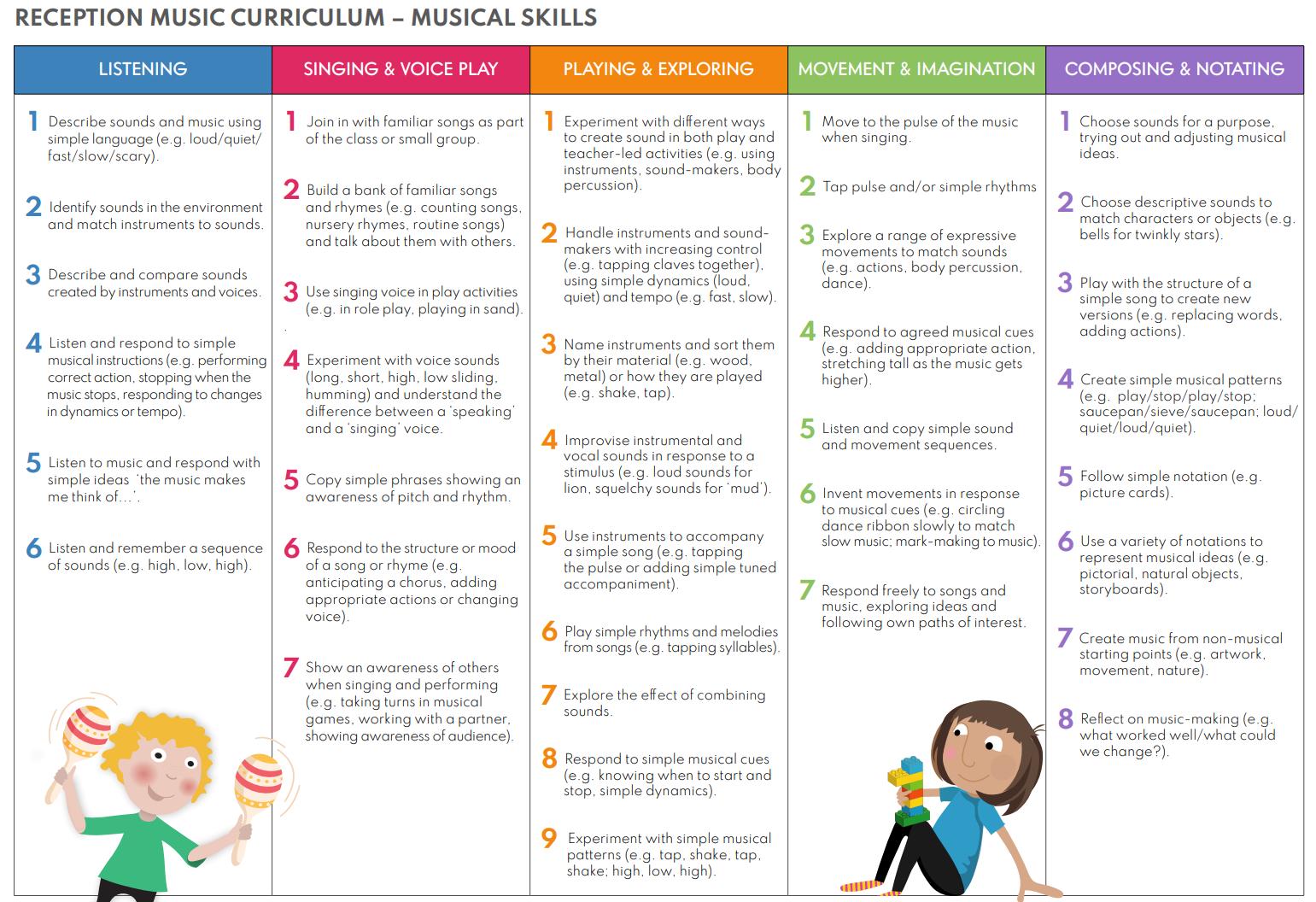
Music Development
Intent
Vocabulary
Implementation
Singing simple well know songs and rhymes, introducing new daily rhymes.
Describing the sounds I can hear.
Pitch, music, singing, songs, nursery rhymes, actions, listen, loud /quiet / fast / slow, dance, shouting, song words, clap, stamp, move
Introduction to new songs, rhymes. Phase 1 phonics lessons focusing on tuning in.
Nativity Performance – joining in with the words to songs and using actions.
Listening to music.
Instruments, play, music, sounds, singing, songs, actions, listen, loud /quiet / fast / slow, dance, shouting
Daily singing of learnt songs, rhymes or poems, listening to music together as a class, rehearsing to then perform the school Nativity production.
Exploring musical instruments including body percussions.
Playing instruments in time and in a simple composition.
Pitch, tempo, sequence, composition, instruments, play, music, sounds, singing, songs, actions, listen, loud /quiet / fast / slow, dance, shouting, percussion, pattern, African instruments, drum, tambourine, bells, maracas, glockenspiel and xylophone, shake, tap, bang, pulse, beat, orchestra, horn, bells.
Being shown a range of instruments and having these in provision, music lessons on body percussion and creating repeating patterns and compositions using instruments with
Experimenting with changing my voice with different tempo, pitch and dynamics.
Describing instrument sounds.
Loud, quiet, fast, slow, instruments, play, music, sounds, singing, songs, listen, loud /quiet / fast / slow, dance, shouting, voices, whispering, voices, talking voices, change, high, low.
Music lessons based on adapting and changing voices using a range of methods, picture cues in provision, instruments in provision, exploring instruments to describe their sound in comparison to others
Singing a range of familiar nursery rhymes and songs –singing sometimes in tune.
Talk about how music makes me feel.
Pitch, instruments, play, music, sounds, singing, songs, nursery rhymes, listen, loud /quiet / fast / slow, dance, shouting, listen, like, dislike, sad, happy, exciting, angry, scary, Rimsky Korsakov, Flight of the Bumblebee
Daily singing of a range of songs and learnt rhymes, discussions around music and emotions – exploring a wide range of appropriate songs.
Performing songs, rhymes, poems and stories and moving in time with the music.
Composing and adapting my own music using my voice and with instruments.
Pitch, instruments, play, music, sounds, singing, songs, nursery rhymes, actions, listen, loud /quiet / fast / slow, dance, shouting, listen, bang, tap, scratch.
Both singing and performing learnt songs, rhymes or poems, listening to music together as a class, Instruments in class to allow children to make their own music (including singing).
Being Imaginative and Expressive (ELG)
Creating with Materials (ELG)
Across the year, children will experience and develop arrange of creative, artistic skills. The children will have daily, continuous access to a wide range of open ended, ambiguous resources allowing the opportunity to explore, experiment and develop creativity. They will have the opportunity to create collaboratively sharing ideas and resources as well on solo work. Throughout the year, the children will have the opportunity to return to and build on their previous learning, refining ideas and developing their ability to represent them. Specific skills, knowledge and experiences will also be planned in across the year as noted below.
Artist Studies Jason Pollack Henry Matisse Vincent Van Gogh
Mark Making
Understand how to grip a pencil comfortably and explore making marks, creating lines and circles. Give meaning to marks made.
(Skill) Observational drawing - Pumpkins Understand how to create closed shapes with continuous lines, and begin (Skill) Show different emotions in their drawing e.g. happiness, sadness. Draw with increasing complexity and detail, such as representing a face with
(Skill) Observational drawing – Daffodils
Observe, copy, look, notice, shape, colour, lines, represent, flower, daffodil.
(Skill) Observational drawing - Sunflowers Show accuracy and care in their drawing.
Observe, copy, look, notice, shape, colour, lines,
(Skill) Produce more detailed work and say what they have included.
Intent
Vocabulary
Implementation
Colour
Intent
Vocabulary
Implementation
Grip, pinch and flick, tight, loose, hand, lines, circles, shapes, copy, explain
Mark making area, Workshop and creative areas, modelling how to use equipment safely.
to use these shapes to represent objects.
Observe, copy, look, notice, shape, colour, lines, represent.
Mark making area, Workshop and creative areas, modelling how to use equipment safely, Pumpkins on Creative table, modelling observational skills.
(Knowledge) Recognise and name colours.
Colours, colour names, change, lighter, darker, mix, primary colour, secondary colours, light, dark.
Discussing colour names during play and discussions.
Explore colours and how colours can be changed. Identify light and dark colours.
Colours, colour names, change, lighter, darker, mix, primary colour, secondary colours, light, dark.
Paints available to children, modelling mixing colours, prompting children to identify dark and light colours in play and discussions
(Skill/Knowledge)
Splatter painting link to fireworks
Paint, painting, colour, choice, splatter, flick, J
Creative area, workshop area, toothbrushes in provision, paintbrushes in provision,
(Skill/Knowledge)
Splatter painting link to fireworks.
Paint, painting, colour, choice, splatter, flick, J
Creative area, workshop area, toothbrushes in provision, paintbrushes in provision.
a circle and including details.
Emotion, feeling, detail, features, circles, shapes, lines, colour
Mark making area, Workshop and creative areas, modelling how to use equipment safely, Modelling adding finer details, using the work of Miro.
(Skill) Exploring shades of colour and how to make different shades.
Colours, colour names, change, lighter, darker, mix, primary colour, secondary colours, light, dark, shades.
Exploring black and white and how it can change a colour, a range of colours available on the painting table for children to explore.
Mark making area, Workshop and creative areas, modelling how to use equipment safely, Modelling observational skills and the use of colour.
represent, flower, sunflower, Van Gogh.
Mark making area, Workshop and creative areas, modelling how to use equipment safely, Modelling observational skills, the use of colour and taking care and time.
Detail, explain, thick, thin, colour, observe, notice, like, dislike, reason.
Mark making area, Workshop and creative areas, modelling how to use equipment safely, Modelling observational skills, the use of colour, adding finer detail and explaining your art work, questioning children about their work.
(Skill) Exploring shades of colour and how to make different shades.
Colours, colour names, change, lighter, darker, mix, primary colour, secondary colours, light, dark, shades.
Exploring black and white and how it can change a colour, a range of colours available on the painting table for children to explore.
(Skill) Choosing a particular colour for a purpose
Colours, colour names, change, lighter, darker, mix, primary colour, secondary colours, light, dark, purpose.
Creative area with paints set up for children to access and colouring pencils and crayons, a range of art work examples.
(Skill) Choosing a particular colour for a purpose
Colours, colour names, change, lighter, darker, mix, primary colour, secondary colours, light, dark, purpose.
(Experience) Explore different paint typeswatercolour, powder paint, acrylic, ready mix paint.
(Skill) Mix paints to make new colours following instructions.
Paint, painting, colour, choice, mix, new, primary and secondary
Creative area with paints set up for children to access and colouring pencils and crayons, a range of art work examples. Painting Intent Vocabulary
Implementation
Paint, painting, colour, choice, type, poster, ready mix, acrylic, powder, water colour. Creative area, workshop area, toothbrushes in provision, paintbrushes in provision, exploration of a range of media through modelling and then in provision.
Creative area, workshop area, toothbrushes in provision, paintbrushes in provision, exploration of mixing paints to make new colours
(Experience) Explore working with paint on different surfaces and in different ways i.e. coloured, sized and shaped paper. Explore using different brush types.
Paint, painting, colour, choice, surface, paper, card, brushes, thick, thin, difference. Creative area, workshop area, toothbrushes in provision, paintbrushes in provision, exploration of a range of media.
(Skill) Paint through inspiration, feeling, observation or imagination. Evaluate their own work and others, suggest how work can be improved.
Paint, painting, colour, choice, inspiration, feeling, emotion, imagination, observation, evaluate, like, dislike, change, similar, different, improve, better.
Creative area, workshop area, toothbrushes in provision, paintbrushes in
provision, exploration of a range of media.
Printing
Intent
Vocabulary
Implementation
(Skill) Printing with hands, feet and fingers. Printing materials explored together as a class and on offer in provision.
(Skill) Printing with sponges and rollers, shapes.
Inspiration Mondrian (primary colours) & Kandinsky (shapes)
Print, paint, choice, smudge, clear print, sponge, rollers, shapes, Mondrian, primary colours, Kandinsky.
(Skill) Printing with hands, feet and fingers. Printing materials explored together as a class and on offer in provision.
(Skill) Printing with sponges and rollers, shapes.
Inspiration Mondrian (primary colours) & Kandinsky (shapes)
Print, paint, choice, smudge, clear print, sponge, rollers, shapes, Mondrian, primary colours, Kandinsky.
(Skill) Printing with natural objects/food e.g. leaves, pine cones.
Print, paint, choice, smudge, clear print, objects, leaves, pine cones, flowers.
Printing materials explored together as a class and on offer in provision.
Exploration of natural materials – bring in from outside to print.
(Skill) Printing simple repeating patterns. Recognise patterns in the environment.
Print, paint, choice, smudge, clear print, objects, patterns, environment, world, nature.
(Skill) Printing with natural objects/food e.g. leaves, pine cones.
Print, paint, choice, smudge, clear print, objects, leaves, pine cones, flowers.
Printing materials explored together as a class and on offer in provision. Exploration of natural materials – bring in from outside to print.
(Skill) Printing simple repeating patterns. Recognise patterns in the environment.
Print, paint, choice, smudge, clear print, objects, patterns, environment, world, nature.
(Experience) Explore working with paint on different surfaces and in different ways i.e. coloured, sized and shaped paper. Explore using different brush types.
Paint, painting, colour, choice, surface, paper, card, brushes, thick, thin, difference. Creative area, workshop area, toothbrushes in provision, paintbrushes in provision, exploration of a range of media.
(Skill) Paint through inspiration, feeling, observation or imagination. Evaluate their own work and others, suggest how work can be improved.
Paint, painting, colour, choice, inspiration, feeling, emotion, imagination, observation, evaluate, like, dislike, change, similar, different, improve, better.
Creative area, workshop area, toothbrushes in provision, paintbrushes in provision, exploration of a range of media.
Cutting Skills
Intent
Vocabulary
Implementation
(Skill) Using one-handed tools and equipment, for example, making snips in paper with scissors.
Tools, cutting, scissors, care, safety, equipment, snips, small snips, large snips, paper.
Demonstration and discussions around scissor safety, modelling the use of scissors – open and close to make small snips in a repeated process, scissors in provision.
(Skill) Use scissors to cut in a straight line.
Tools, cutting, scissors, care, safety, equipment, snips, small snips, large snips, paper, straight line, copy, follow.
Demonstration and discussions around scissor safety, modelling the use of scissors – open and close to make small snips in a repeated process to follow a line, scissors in provision.
(Skill) Use scissors to cut curved lines.
Tools, cutting, scissors, care, safety, equipment, snips, small snips, large snips, paper, curved lines, copy, follow, trace.
Demonstration and discussions around scissor safety, modelling the use of scissors – open and close to make small snips in a repeated process while moving the paper around to follow a curved line, scissors in provision.
(Skill) Use scissors to cut shapes.
Tools, cutting, scissors, care, safety, equipment, snips, small snips, large snips, paper, shapes, lines, copy.
Scissors in provision, a variety of shapes for children to cut, materials and pictures available for children to cut freely.
(Skill) Use scissors independently.
Tools, cutting, scissors, care, safety, equipment, snips, small snips, large snips, paper, independence, lines, follow.
Scissors in provision, a variety of shapes for children to cut, materials and pictures available for children to cut freely.
(Skill) Use scissors for a particular purpose when combining different media and materials.
Tools, cutting, scissors, care, safety, equipment, snips, small snips, large snips, paper, purpose, independence.
Scissors in provision, a variety of shapes for children to cut, materials and pictures available for children to cut freely.
Being Imaginative
Take part in simple, pretend play often based on familiar experiences, e.g. making dinner. Uses available resources to create props or creates imaginary ones to support play. Develop storylines through smallworld or role-play.
Join in, pretend, roleplay, home corner, mums, dads, baby, small world, people, vehicles, cars, recreate, represent, shops, schools.
Updated roleplay area, creative area with resource for children to create and build from, modelling of how to use the role play area and creative area, stories read as a class, small world area available to children.
Take part in simple, pretend play often based on familiar experiences, e.g. making dinner. Uses available resources to create props or creates imaginary ones to support play. Develop storylines through smallworld or role-play.
Join in, pretend, roleplay, home corner, mums, dads, baby, small world, people, vehicles, cars, recreate, represent, shops, schools.
Updated roleplay area, creative area with resource for children to create and build from, modelling of how to use the role play area and creative area, stories read as a class, small world area available to children.
Retell parts of familiar stories through use of puppets, toys, masks or small-world. Create more complex narratives in their pretend play, building on the contributions of their peers.
Join in, pretend, roleplay, retell, stories, acting out, puppets, toys, small world, masks, home corner, conversations, taking on a role, pretending.
Updated roleplay area, creative area with resource for children to create and build from, modelling of how to use the role play area and creative area, stories read as a class, small world area available to children.
Retell parts of familiar stories through use of puppets, toys, masks or small-world. Create more complex narratives in their pretend play, building on the contributions of their peers.
Join in, pretend, roleplay, retell, stories, acting out, puppets, toys, small world, masks, home corner, conversations, taking on a role, pretending.
Updated roleplay area, creative area with resource for children to create and build from, modelling of how to use the role play area and creative area, stories read as a class, small world area available to children.
Invent, adapt and recount narratives and stories with peers and their teacher. Creates representations of both imaginary and real-life ideas, events, people and objects. Uses combinations of art forms, e.g. moving and singing, making and dramatic play, drawing and talking, constructing and mapping
Join in, pretend, roleplay, retell, stories, converse, conversation, represent, real life, imagination, celebrations, daily life, shopping, school.
Updated roleplay area, creative area with resource for children to create and build from, modelling of how to use the role play area and creative area, stories read as a class, small world area available to children, singing songs, rhymes and doing guided roleplaying activities together as guided groups or a whole class.
Invent, adapt and recount narratives and stories with peers and their teacher. Creates representations of both imaginary and real-life ideas, events, people and objects. Uses combinations of art forms, e.g. moving and singing, making and dramatic play, drawing and talking, constructing and mapping
Join in, pretend, roleplay, retell, stories, converse, conversation, represent, real life, imagination, celebrations, daily life, shopping, school.
Updated roleplay area, creative area with resource for children to create and build from, modelling of how to use the role play area and creative area, stories read as a class, small world area available to children, singing songs, rhymes and doing guided roleplaying activities together as guided groups or a whole class.