EASTERSIDE ACADEMY Year 3 and 4 - Predator or Prey? (6) (6) 5(Viking- traders/raiders)
Memorable Experience Visit from Zoo Lab National Curriculum PoS – Art
To create sketch books to record their observations and use them to review and revisit ideas. To improve their mastery of art and design techniques, including drawing, painting and sculpture with a range of materials [for example, pencil, charcoal, paint, clay.
National Curriculum PoS – Geography
Locate the world’s countries, using maps to focus on Europe (including the location of Russia) and North and South America, concentrating on their environmental regions, key physical and human characteristics, countries, and major cities. Identify the position and significance of latitude, longitude, Equator, Northern Hemisphere, Southern Hemisphere, the Tropics of Cancer and Capricorn, Arctic and Antarctic Circle, the Prime/Greenwich Meridian and time zones (including day and night). Understand geographical similarities and differences through the study of human and physical geography of a region of the United Kingdom, a region in a European country, and a region within North or South America. Use maps, atlases, globes and digital/computer mapping to locate countries and describe features studied.
Connect Explicitly connect to key concept revisited. KS1 - What makes a habitat a home? Key Concepts Art – Master Techniques / Geography – Communicate Geographically Declarative Knowledge – Art
Declarative Knowledge – Geography
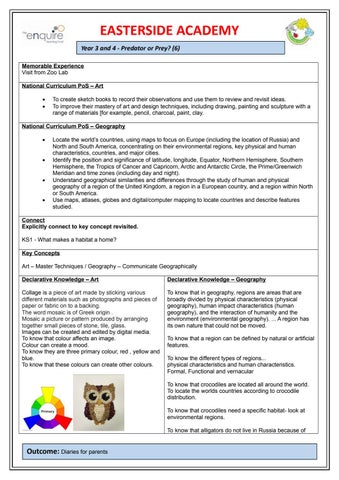
Collage is a piece of art made by sticking various different materials such as photographs and pieces of paper or fabric on to a backing. The word mosaic is of Greek origin . Mosaic a picture or pattern produced by arranging together small pieces of stone, tile, glass. Images can be created and edited by digital media. To know that colour affects an image. Colour can create a mood. To know they are three primary colour, red , yellow and blue. To know that these colours can create other colours.
To know that in geography, regions are areas that are broadly divided by physical characteristics (physical geography), human impact characteristics (human geography), and the interaction of humanity and the environment (environmental geography). ... A region has its own nature that could not be moved. To know that a region can be defined by natural or artificial features. To know the different types of regions... physical characteristics and human characteristics. Formal, Functional and vernacular To know that crocodiles are located all around the world. To locate the worlds countries according to crocodile distribution. To know that crocodiles need a specific habitat- look at environmental regions. To know that alligators do not live in Russia because of
Outcome: Diaries for parents